
Most terms of service are written once, approved, and then left alone while the product changes underneath them. The published text describes a service that no longer exists, and the gap stays invisible until a customer quotes a clause the company has quietly stopped honoring. AI用户协议 makes this worse when it is used to generate more clauses instead of checking the ones already live.
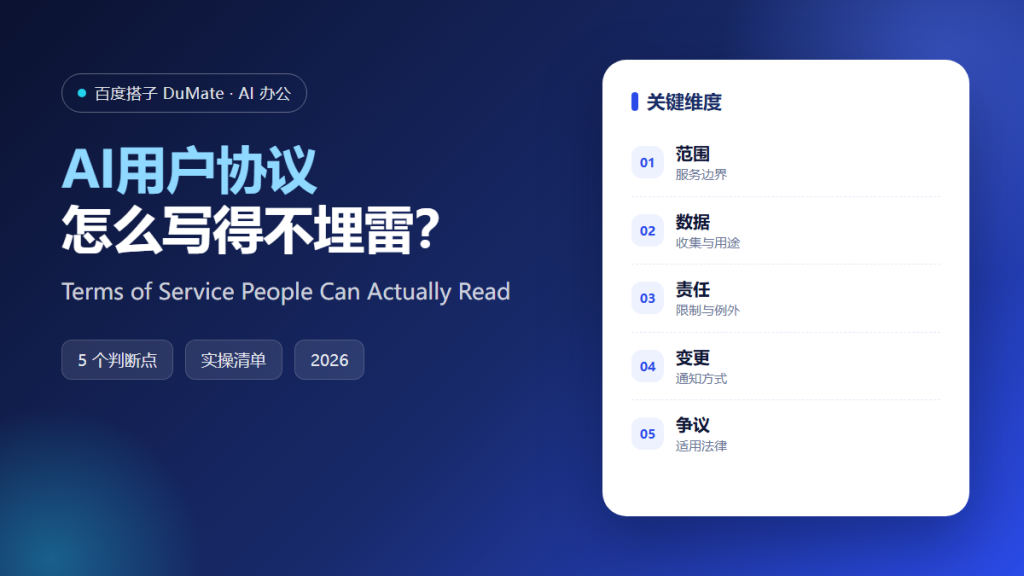
This guide sets out a five-step method for AI用户协议 that starts from observed behavior, then writes the text to match it, and keeps a version trail that survives an audit.
Key Takeaways
- Describe the service as it actually operates today.
- AI用户协议 needs a plain-language summary above the legal text.
- Every data use in the document should map to a real system.
- Changes need a version number, a notice period, and an archive.
- Test whether a reader can find one answer in two minutes.
Why AI用户协议 Needs an Operational Test
A clause is a statement about behavior. If the product sends promotional email but the agreement mentions only service messages, the clause is false no matter how carefully it is drafted. Legal review catches ambiguity; it does not catch a feature that shipped last month. AI用户协议 therefore needs a check against systems, not only against style.
Readers approach the document with one question, usually about cancellation, data, or liability. A wall of defined terms answers none of them. A short summary with five headings and a link to the relevant clause respects the reader and reduces support contacts, because most people who write in are asking something the text already covers in a paragraph they could not find.
Change is the third pressure. Products gain vendors, regions, and features, and each addition alters what the agreement should say. Without a versioned record, nobody can prove what a customer accepted six months ago. AI用户协议 is only useful as evidence when the version, the date, and the notice are all retrievable.
How AI用户协议 Works in Five Steps
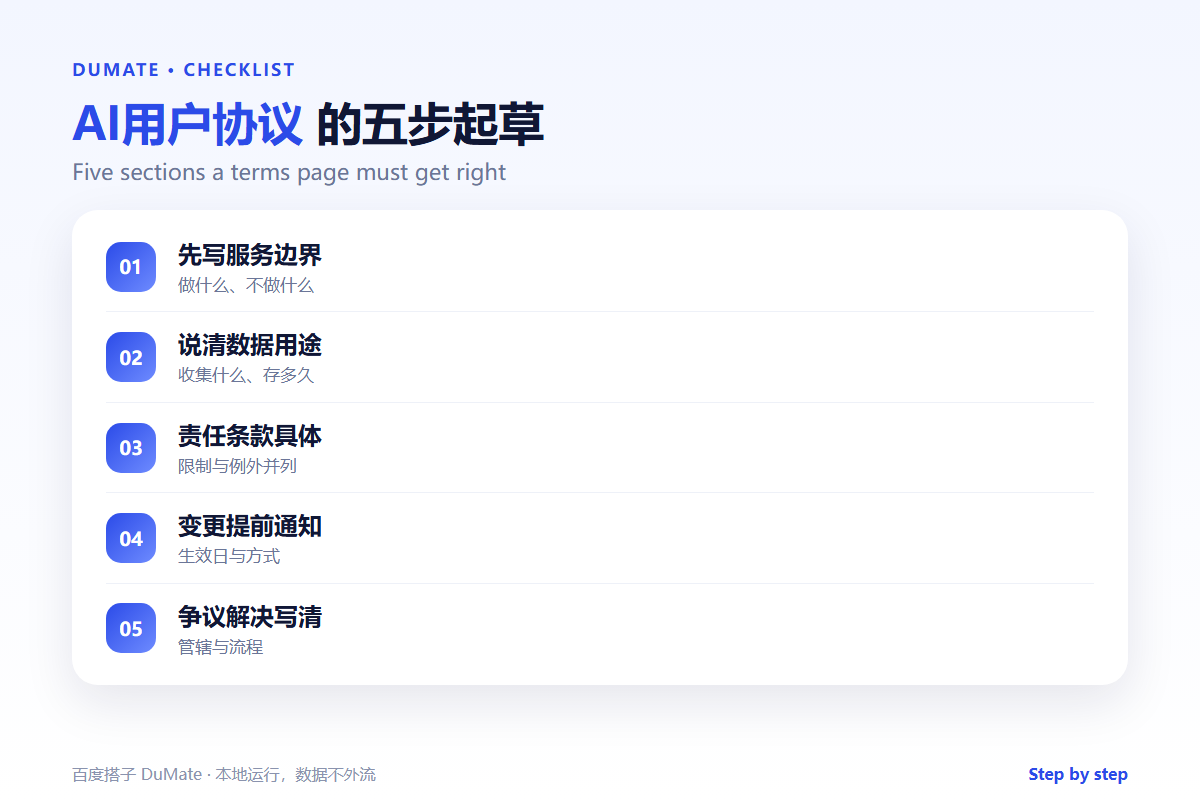
Step 1: Inventory the real data flows
List every system that receives customer data, what it stores, how long, and which vendor operates it. Include analytics, support tools, and backup storage. This inventory is the factual basis for the agreement, and building it usually reveals two or three uses that nobody documented anywhere.
Step 2: Write the summary first
Draft five short sections: what is collected, why, how long it is kept, who receives it, and how a user deletes it. Write these in plain sentences before touching the legal text. If a section cannot be written clearly, the underlying practice is probably unclear as well.
Step 3: Match clauses to behavior
Walk through each clause and name the system that implements it. Clauses with no owner should be removed or the product changed. AI用户协议 should not promise a review process that no team performs, because an unfulfilled promise is worse than a narrow one.
Step 4: Design the change process
Give every revision a number, a date, and a one-line reason. Notify users before material changes take effect, and keep an archive of prior versions on a public page. Decide in advance which changes need fresh consent rather than continued use.
Step 5: Test with a reader task
Ask five customers to find how to close an account and how to request a copy of their data. Time the search. If it takes more than two minutes, the structure is failing regardless of the wording. AI用户协议 improves when the test is repeated after each revision, not only at launch.
A Drafting Checklist for AI用户协议
- Each data use names a system and a retention period.
- The summary appears before the legal sections.
- Termination and refund rules are stated in one place.
- Prior versions remain accessible with dates.
- AI用户协议 is reviewed whenever a vendor or region changes.
Where AI用户协议 Fails
It fails when it is treated as a one-time legal deliverable rather than a description of a running service. AI用户协议 also fails when the summary and the clauses disagree, because readers trust the summary and lawyers rely on the clause, leaving the company exposed on both sides.
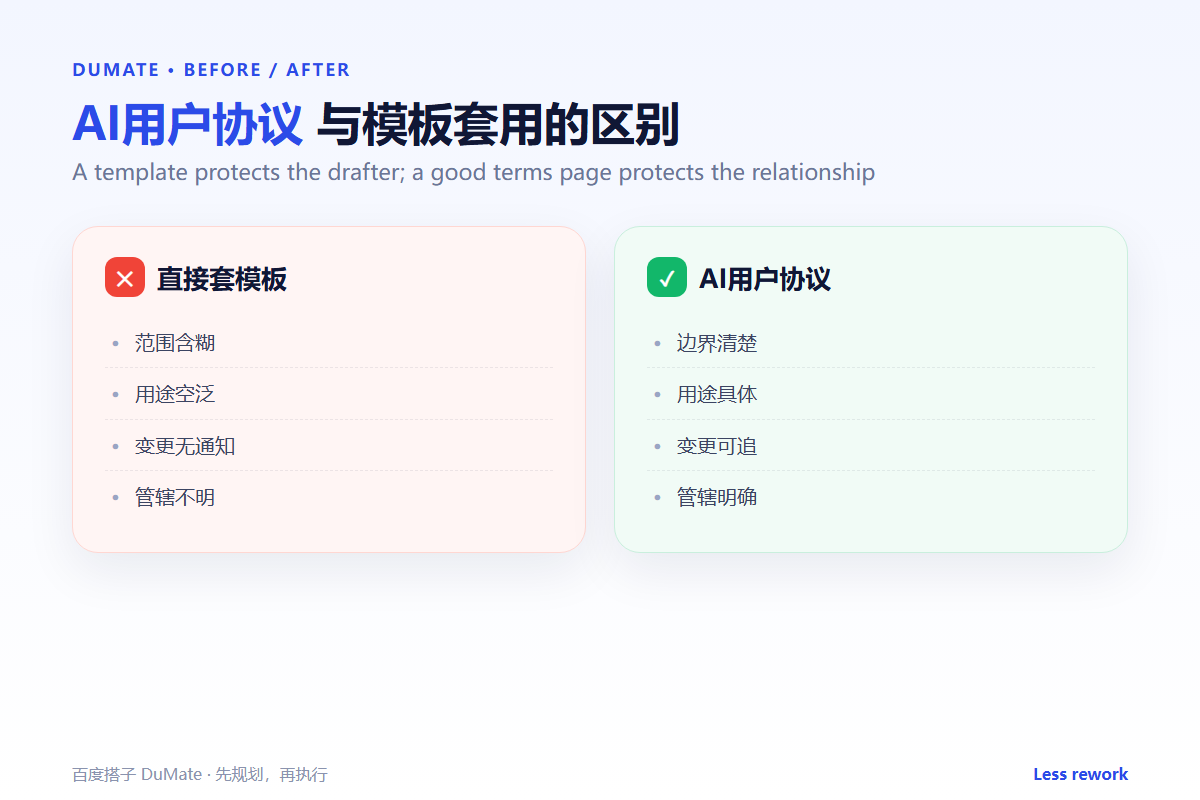
- Clauses copied from a different product and never reconciled.
- Retention periods described only as long as reasonably necessary.
- Notice sent after a change has already taken effect.
- No owner, so updates wait for the next redesign.
Before and After
Before, a subscription platform published a single agreement of eleven thousand words, last edited two years earlier. Support answered roughly sixty questions a month about cancellation, and the answers sometimes contradicted the document.
After, AI用户协议 opened with a five-part summary, each linked to its clause, and the cancellation rule appeared in one paragraph. Questions about cancellation fell by about half, and the first revision under the new process shipped with a dated changelog and a thirty-day notice.
FAQ
Can AI用户协议 be generated automatically?
Drafts, yes; publication, no. A generated clause still needs a person to confirm that the described behavior exists and that the jurisdiction is correct.
How often should the document be reviewed?
At least twice a year, and immediately after any new vendor, region, or pricing model. A review that starts from the data inventory takes hours rather than weeks.
Does a summary weaken the legal text?
No, if it points to the clauses and avoids new promises. A summary that introduces commitments the clauses do not contain creates the very risk it was meant to reduce.
延伸阅读
Start with AI privacy policy for the data sections, then use legal consultation on jurisdiction and compliance check before publication. Contract review catches conflicts with enterprise agreements, and document proofreading removes the small errors that invite disputes. External references: NIST AI Risk Management Framework and ISO/IEC 42001.
评论
还没有评论,来说两句吧。