
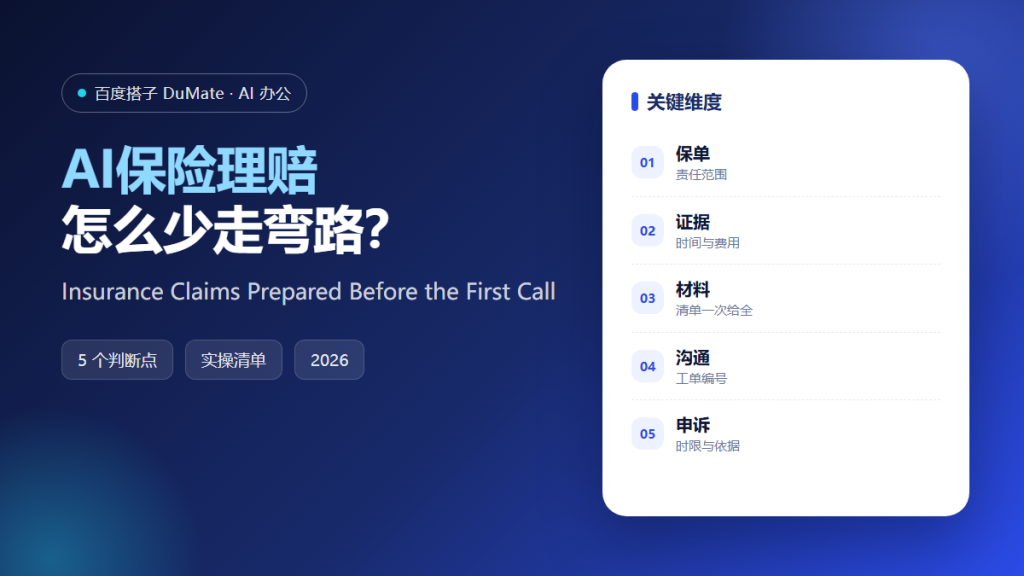
A claim is not won by explaining how difficult the loss has been, although the difficulty is real. It is decided by a schedule, a set of documents, and a list of exclusions that the insurer applies in order. Claimants who write long appeals before reading the policy usually spend their energy in the wrong place. AI保险理赔 should begin with that schedule, not with a letter.
This guide sets out a five-step method for AI保险理赔 that builds an evidence file the adjuster can process without asking a follow-up question.
Key Takeaways
- Read the policy schedule and the exclusions before writing anything.
- AI保险理赔 should start from an evidence matrix, not a narrative.
- Every amount needs an invoice, a receipt, or a bank record.
- Dates must line up across the claim form, the reports, and the receipts.
- Submit one complete file, then track it by reference number.
Why AI保险理赔 Needs an Evidence Matrix
Adjusters work from a checklist, because the policy defines what is payable and the file must show each condition is met. A narrative that describes the event but omits the purchase receipt gives the reviewer nothing to approve. AI保险理赔 is most useful when it converts that checklist into a matrix and marks each line as present, missing, or not applicable.
The second reason is time. Most policies set a notification window and a deadline for supporting documents, often thirty days and ninety days respectively. A file assembled in the right order meets those dates without a scramble. A file assembled by searching old email usually misses one document, and the request for it restarts a clock nobody was watching.
The third reason is consistency. A claim contains the same facts in several places: the form, the repair estimate, the police report, the medical note. Small differences in date or amount read as doubt. A single chronology, checked against every attachment, removes those differences before the reviewer finds them. AI保险理赔 that reconciles figures first saves a round of questions later.
How AI保险理赔 Works in Five Steps
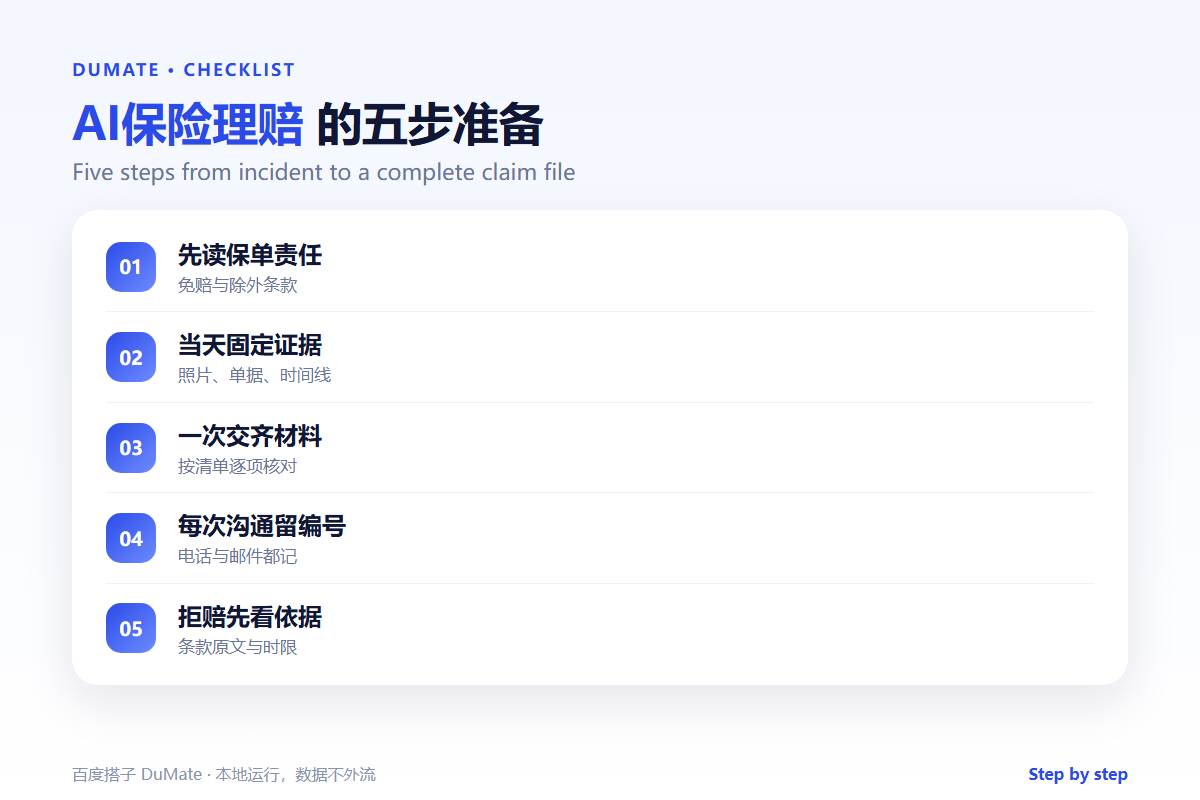
Step 1: Extract the policy conditions
Copy the coverage limit, the deductible, the exclusions, and the notice deadlines into one page. Note the definition of the insured event and any condition about reporting to authorities. These four facts decide most outcomes, and they are easier to read on one page than across a forty-page booklet.
Step 2: Build the evidence matrix
List each document the policy requires beside the claim item it supports. Add proof of ownership, proof of value, and proof of the event. Mark each row with a status and a date, then work down the list until nothing is missing.
Step 3: Write one dated chronology
Record what happened in order, with times where they matter, and cite the document that proves each entry. Keep it to one page. AI保险理赔 should remove adjectives from this page entirely, because a chronology is read for sequence and consistency rather than for sympathy.
Step 4: Reconcile every amount
Total the invoices, subtract the deductible, and check the result against the bank records. Note currency, tax, and any amount already reimbursed. If two documents disagree by a small amount, explain it in one sentence rather than leaving the reviewer to guess.
Step 5: Submit once and track
Send the complete file through the channel the insurer specifies, and keep the confirmation. Log the date, the reference number, and the name of anyone you speak to. AI保险理赔 produces a clean handover, but the follow-up still needs a person with a calendar.
A Filing Checklist for AI保险理赔
- The policy number and claim type match the form.
- Every claimed item has proof of ownership and value.
- Dates agree across the form, reports, and receipts.
- The deductible is applied once, and shown.
- AI保险理赔 files include a contactable person and a phone number.
Where AI保险理赔 Fails
It fails when the tool is asked to argue rather than to organize. AI保险理赔 cannot invent a receipt, and a persuasive paragraph about hardship does not satisfy a condition in the policy. Files also fail when they are split across three emails, because the reviewer sees a fragment and requests the rest.
- Photographs without dates or a scale reference.
- Estimates from an unapproved repairer.
- Amounts rounded, so totals do not match the invoices.
- Repeated resubmission of the same incomplete file.
Before and After
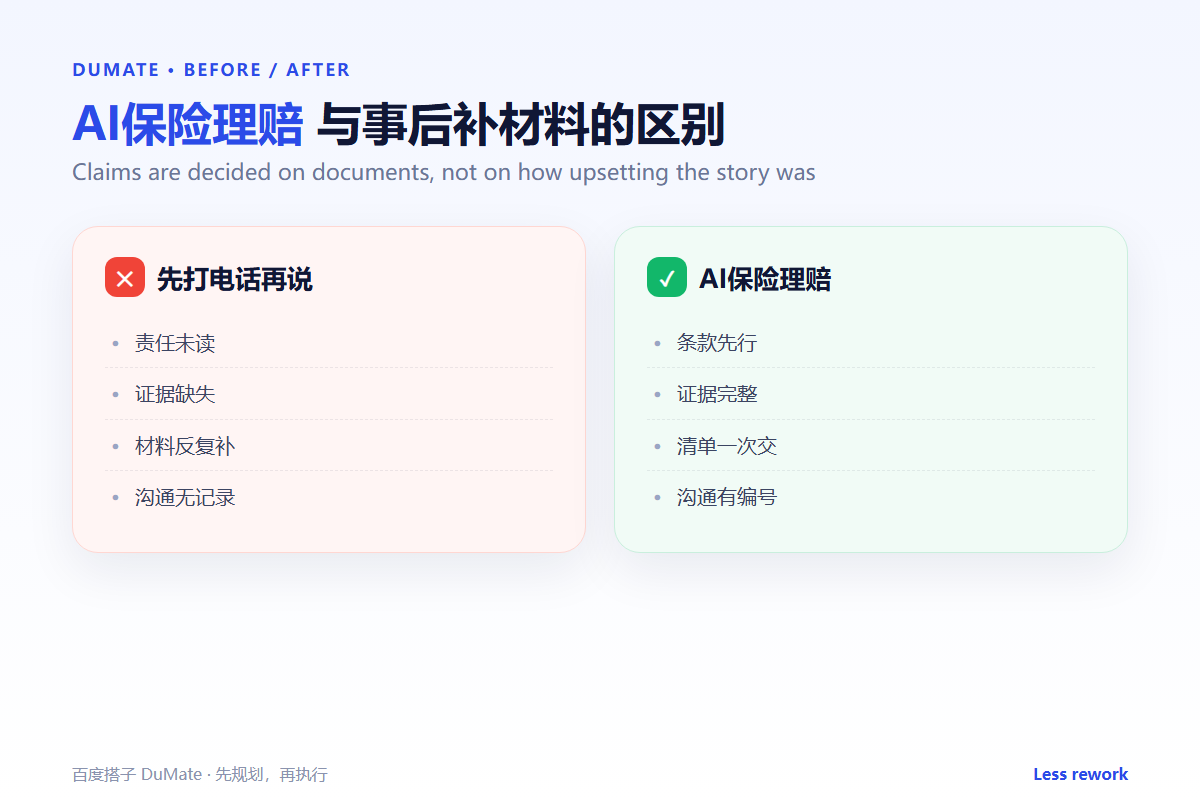
Before, a small business filed a water damage claim with a four-page letter and nineteen photographs. Two receipts were missing, the repair estimate used a different date format, and the file was returned twice. The decision arrived after eleven weeks.
After, AI保险理赔 produced a one-page chronology, a matrix of fourteen documents, and a total that matched the invoices to the cent. The insurer asked one question about a storage unit, answered the same day. The claim settled in nineteen days, slightly below the estimate.
FAQ
Should a claim letter mention hardship?
Briefly, and only after the facts. The policy pays on conditions, not on distress, so put the evidence first and keep the personal context to two sentences.
What if a document cannot be found?
Say so early and offer a substitute, such as a bank statement or a supplier duplicate. A declared gap is easier to assess than a gap the reviewer discovers.
Can AI保险理赔 negotiate?
No. It can organize a file and draft a factual response to a query. Negotiation over coverage or valuation belongs to a person who can accept the risk.
延伸阅读
Claims files benefit from invoice data extraction for receipts and expense audit for checking totals. Use document proofreading before submission, legal consultation when an exclusion is disputed, and PDF editing to keep page order and numbering intact. External references: NIST AI Risk Management Framework and ISO/IEC 42001.
评论
还没有评论,来说两句吧。