

Most fitness plans fail in the second week, not because the exercises are wrong but because the plan was written for an ideal week that never happened. Five sessions become two, the missed days feel like failure, and the program is abandoned. AI健身计划 starts with the week you actually have.
The method below covers a baseline week, a schedule that fits, progression, recovery, and the two measures that tell you whether the plan is working.
Key Takeaways
- Measure a normal week before writing a program.
- AI健身计划 should fit three sessions before it adds a fourth.
- Progress comes from small increases, not constant variety.
- Recovery is part of the plan, not a failure to train.
- Track two measures, not ten.
Why AI健身计划 Needs Adherence Before Optimization
The best program is the one that gets done. A plan with five sessions and a long commute looks rigorous on paper and collapses in a busy month. AI健身计划 should start with the number of sessions a person attended in the last month, then build a program that fits that number plus one.
Adherence also protects the body. A sudden jump from one session to five produces soreness, then a missed week, then a stop. Gradual progression gives tendons and sleep time to adjust. AI健身计划 that respects recovery produces slower weeks and faster years, which is the opposite of what most programs promise.
The third reason is measurement. People quit when progress is invisible. Two measures, such as strength on one lift and resting heart rate, are enough to show a trend. A dashboard with ten metrics hides the one that matters, and AI健身计划 should keep the dashboard small enough to read on a tired evening.
How AI健身计划 Works in Five Steps
Step 1: Record a baseline week
Note sleep, work hours, travel, and any activity already in the calendar. Include the days that are usually impossible. A plan that ignores a standing Tuesday commitment will lose Tuesday every week. AI健身计划 builds around the calendar rather than against it. Two weeks of notes is enough to see the pattern.
Step 2: Choose three sessions
Pick three days with a fixed time, and make each session thirty to forty-five minutes. Cover a push, a pull, a hinge, a squat, and a carry across the week. Keep the first two weeks deliberately easy, because the goal is attendance, not exhaustion. A session that leaves you unable to work the next day is a session you will skip. AI健身计划 should be boring in the first month.
Step 3: Progress one variable
Increase weight, repetitions, or time on one exercise at a time, and only when the previous week felt manageable. A small increase every week beats a heroic session followed by five days off. AI健身计划 should record the number so the next session has a target and the month has a trend.
Step 4: Schedule recovery
Put two rest days in the plan and protect them as if they were sessions. Sleep is the part of training that most plans omit. If a week goes badly, drop the accessory work rather than the main lift, and keep the habit intact. Recovery is not a reward for good behavior; it is where the adaptation happens. A rest day that is not in the calendar becomes a rest week.
Step 5: Review every four weeks
Compare the two measures, the number of sessions completed, and how the joints feel. If adherence is below seventy percent, reduce the plan rather than adding discipline. AI健身计划 is working when the schedule survives a busy week, not when it looks impressive on paper.

A Training Checklist for AI健身计划
- The baseline week is written down.
- Three fixed sessions fit the calendar.
- One variable increases at a time.
- Rest days are planned and protected.
- The plan is reviewed every four weeks.
Where AI健身计划 Fails
It fails when the plan is designed for a photo rather than a person, and it fails when a missed session is treated as a reason to restart. AI健身计划 should make the next session easy to begin.
- A program built for six days a week.
- New exercises every session.
- No record of weight or repetitions.
- All-or-nothing rules about missed days.
Before and After
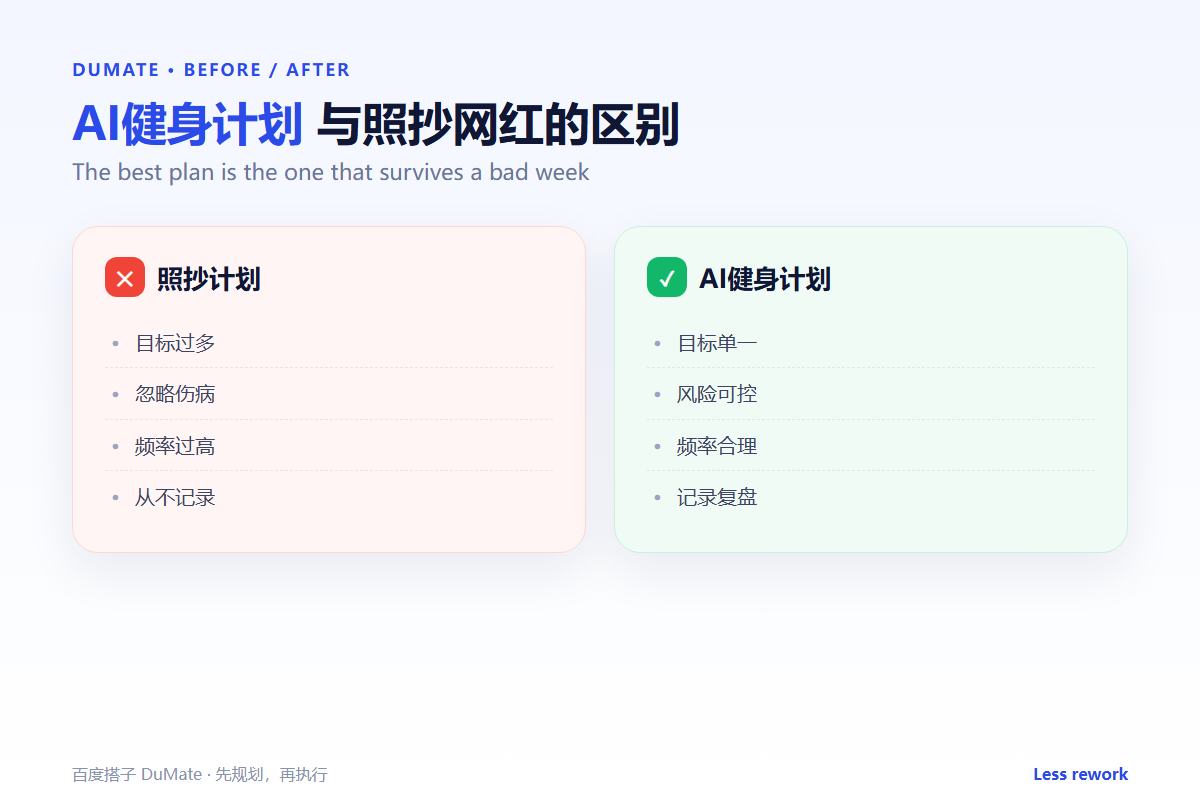
Before, an office worker started a five-day split, trained for nine days, missed a work trip, and stopped for four months. The plan had no rest days and no numbers to beat, so every return began from zero.
After, AI健身计划 set three sessions of thirty-five minutes and one variable to increase each week. He trained for twelve weeks, added 12 kilograms to one lift, and missed only four sessions. The review moved one exercise rather than rebuilding the program, and the habit survived two more work trips.
FAQ
How long should a session last?
Thirty to sixty minutes is enough for most goals. Consistency matters more than duration, especially in the first two months. AI健身计划 should fit the shorter version first.
Do I need equipment?
Not at the start. Body weight, a band, and one pair of dumbbells cover a beginner program. Add equipment when the current one stops providing progress.
What if I miss a week?
Resume at about eighty percent of the previous load and continue. Do not restart the program or double the sessions to catch up, because that is how a missed week becomes a missed month.
延伸阅读
A training habit borrows discipline from a study plan, where fixed slots beat good intentions, and from travel planning that protects the calendar. Use career planning to connect the routine to a reason, mock interview practice to see how feedback loops work, and employee training to compare adherence at work. External references: NIST AI Risk Management Framework and ISO/IEC 42001.
评论
还没有评论,来说两句吧。