
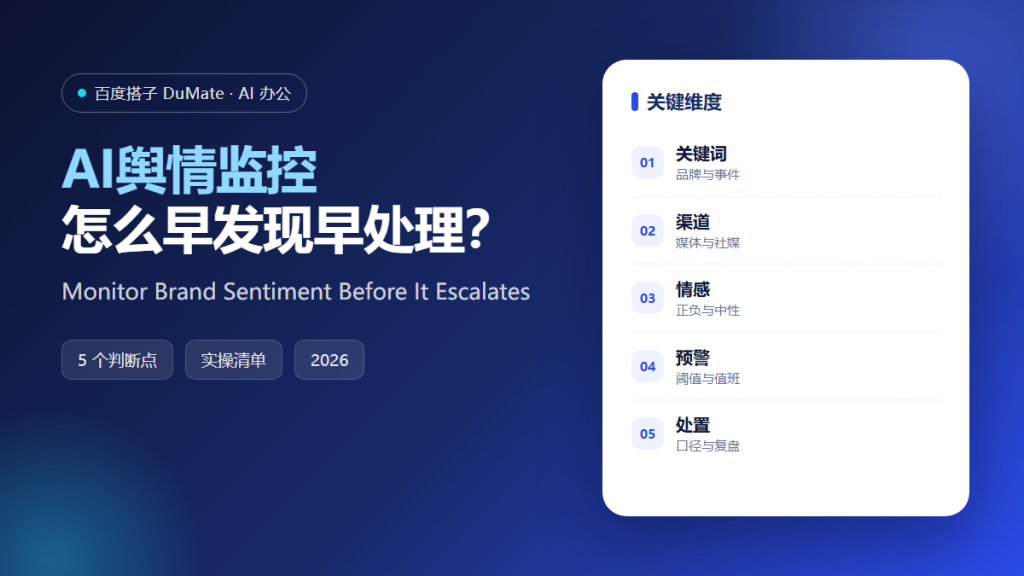
AI舆情监控 is not a dashboard that shows a sentiment score. It is a routine that decides who looks, who responds, and what counts as serious. Without those decisions, a negative spike becomes a screenshot in a group chat and nothing else happens.
This guide covers a five-step monitoring routine, the thresholds that trigger action, and the weekly brief that turns noise into a pattern.
Key Takeaways
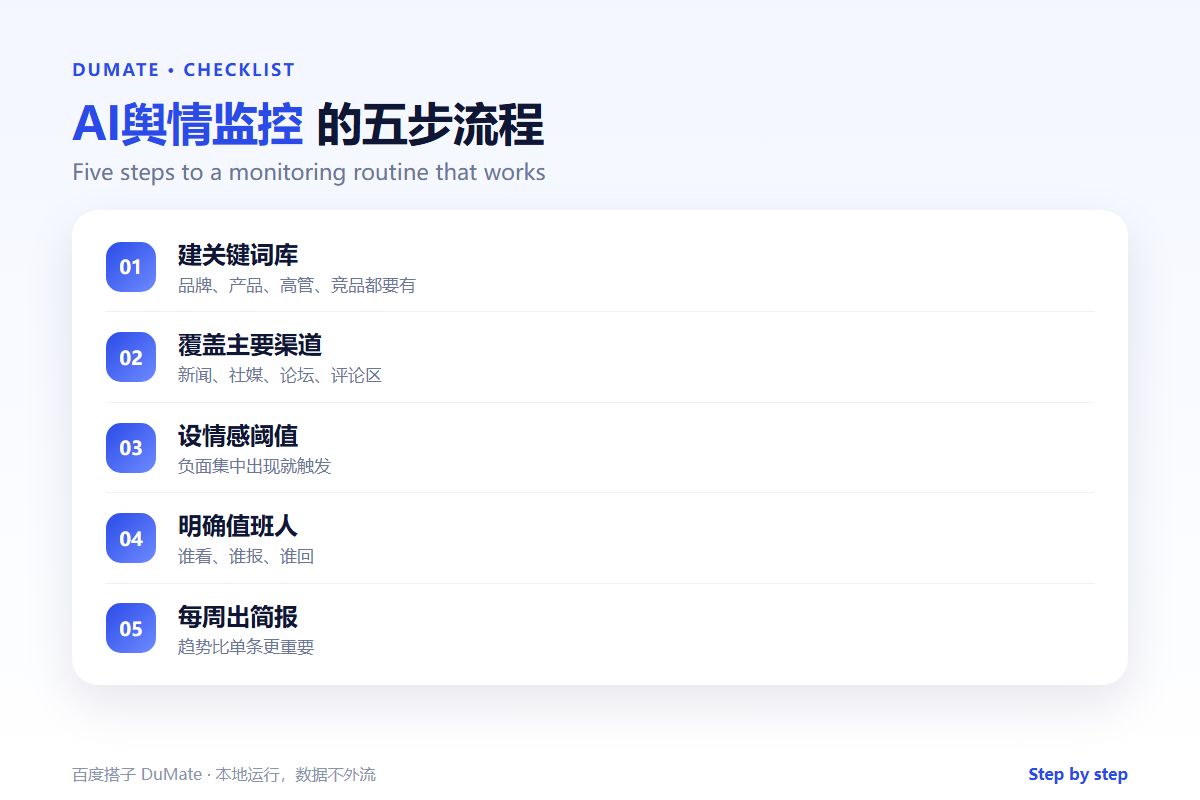
- Build a keyword list for brand, product, and executives.
- Cover the channels your customers actually use.
- Set sentiment and volume thresholds.
- Name an owner for each severity level.
- Publish a weekly brief with trends.
Why AI舆情监控 Needs an Escalation Owner
Monitoring without ownership produces awareness without action. When a negative thread appears, someone must decide whether to reply, wait, or escalate. AI舆情监控 can surface the item, but a person must own the response.
The second reason is context. Sentiment models misread sarcasm and industry jargon. A human review before any public response prevents a defensive reply to a joke or a misunderstanding.
How AI舆情监控 Works in Five Steps
Step 1: Build the keyword list
Include the brand, product names, executive names, common misspellings, and key competitors. AI舆情监控 should use exact phrases and variants, not only one spelling.
Step 2: Cover the right channels
Start with the three channels where customers actually talk. Add news and review sites if relevant. AI舆情监控 should not spread across ten platforms before the first three are handled well.
Step 3: Set thresholds
Trigger an alert when negative mentions exceed a normal weekly range or when a single post gains unusual engagement. AI舆情监控 should distinguish volume spikes from sentiment shifts.
Step 4: Assign owners
Define who handles product issues, service complaints, and executive mentions. Give each a response window. AI舆情监控 should route the item to the right queue automatically.
Step 5: Publish a weekly brief
Summarize volume, sentiment, top issues, and actions taken. Keep it to one page. AI舆情监控 can draft the brief from the week’s items.
A Monitoring Checklist
- Keywords include misspellings and products.
- Three core channels are covered daily.
- Thresholds are based on a normal range.
- Each severity has an owner.
- The weekly brief records actions.
Where AI舆情监控 Fails
It fails when the team reacts to every negative post, which amplifies small complaints. It also fails when the sentiment model is trusted without reading the original text.
- Alerts with no context.
- Replies written in anger.
- No record of what was done.
- Ignoring positive signals.
Before and After
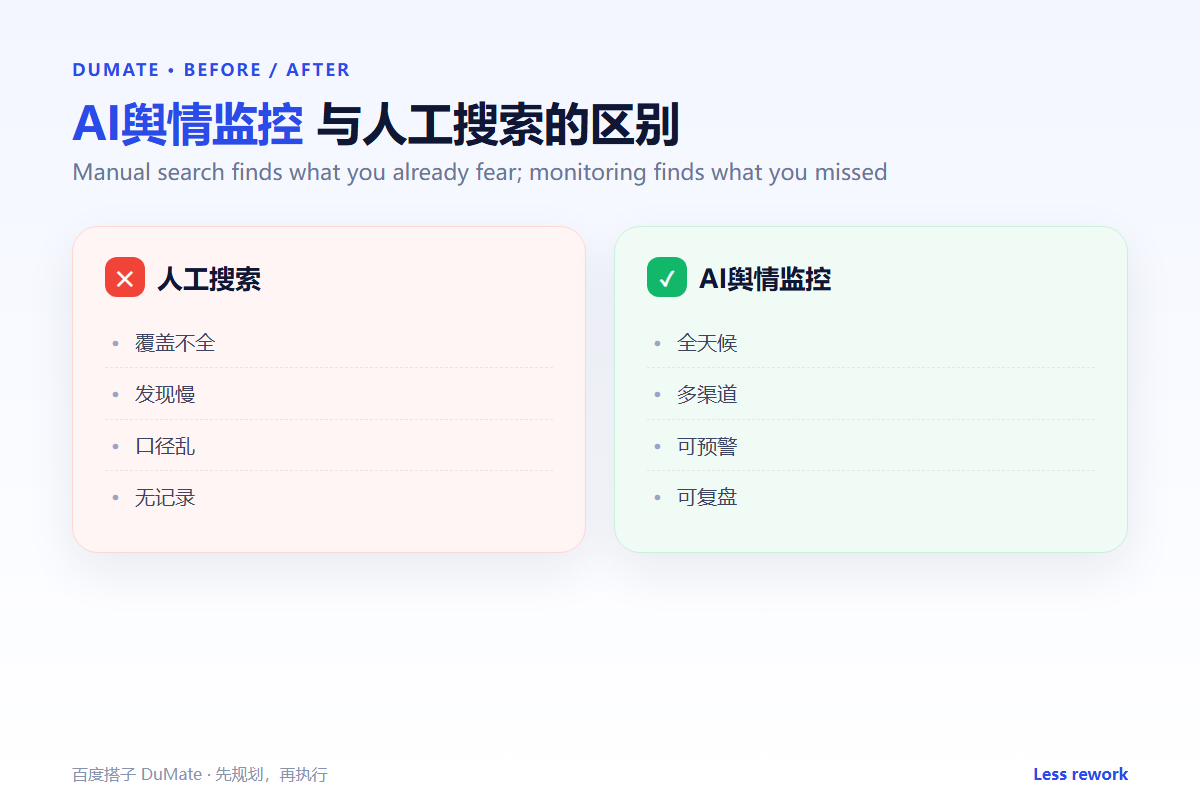
Before, a negative thread ran for two days before anyone noticed. After, AI舆情监控 flagged it within an hour, the owner replied with a fix, and the weekly brief recorded the cause so the product team could address it.
Monitoring is not about watching. It is about shortening the distance between a signal and a decision.
Used consistently, AI舆情监控 becomes part of the normal review routine rather than a separate project.
A final check with AI舆情监控 takes a minute and catches the errors that are easiest to miss.
The same AI舆情监控 routine works for small tasks and large ones, which is why teams keep using it.
A Four-Week Rollout
The first week with AI舆情监控 should be a small pilot, not a team-wide launch. Choose one recurring task with a clear output and run it end to end. Keep the sample small enough to check by hand. The point is to see where AI舆情监控 saves time and where it creates review work.
During the pilot, keep a short log of inputs, outputs, and corrections. Record the time spent before and after. AI舆情监控 feels faster even when it is not, so the log matters. At the end of the week, review the log with one colleague and decide whether to continue, change the input, or stop.
In week two, write a one-page standard for input and output. Include what must be checked and who approves the result. AI舆情监控 works better when the standard is visible to everyone. In week three, add permissions and a review step. In week four, compare the results and write a short guide. That guide is what makes AI舆情监控 survive after the first month.
Keep the pilot narrow. A broad rollout hides which step failed, and a narrow one shows exactly where the workflow needs help. Expand only after the narrow case is stable.
Keep the first month simple. One task, one owner, and one weekly review are enough to prove the workflow before it spreads across the team.
Write down what changed after each run. A short note is easier to trust than a memory, and it makes the next improvement obvious.
Review the output before it leaves your desk. A two-minute check catches most of the errors that would otherwise come back as questions.
Keep one example of a good result. New team members learn faster from a concrete reference than from a long explanation.
FAQ
How often should we check?
Daily for core channels, with real-time alerts for high-severity keywords.
Should we reply to every mention?
No. Reply when there is a factual error, a service failure, or a safety issue. Ignore pure opinion unless it spreads.
What should the weekly brief contain?
Volume, sentiment, top three issues, actions taken, and one recommendation.
延伸阅读
For analysis, see AI数据分析工具 and AI报告生成. For response drafting, read AI写作助手. Customer follow-up is covered in AI邮件助手. Industry templates are in AI专家套件. Tool selection is in AI效率工具. External references: NIST AI Risk Management Framework and ISO/IEC 42001.
评论
还没有评论,来说两句吧。以下为本文的引用通告: