
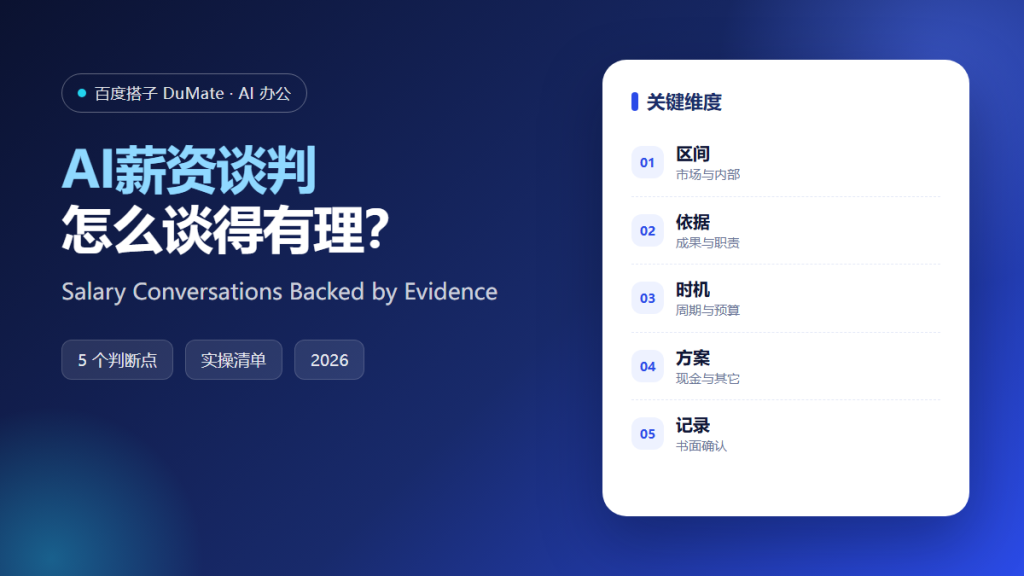
Salary conversations often begin with a number and then search for a reason. The candidate names a figure from a friend’s offer, the manager anchors to the budget, and both leave with a compromise neither can explain. AI薪资谈判 reverses the order: evidence first, a range second, and a specific number last.
This guide covers the market band, the total package, the evidence file, the conversation itself, and the written confirmation that closes the negotiation.
Key Takeaways
- Research the band before naming any number.
- AI薪资谈判 should compare total compensation, not base alone.
- Evidence of impact is stronger than a list of duties.
- Ask for the employer’s range before giving yours.
- Confirm every agreed term in writing within a day.
Why AI薪资谈判 Needs a Band, Not a Number
A number is easy to reject. A band with a source invites a conversation about where inside it you belong. AI薪资谈判 should produce three figures before any call: the market median for the role and city, the internal range for the level, and the minimum you will accept. Those three frame every sentence that follows.
Total compensation changes the comparison. Base salary, bonus, equity, pension, insurance, and paid leave can move the effective value by a fifth or more. A candidate who compares base only may accept a package worth less than the one they declined last month. AI薪资谈判 should put the whole package in one table, with assumptions written beside each line, before the conversation starts.
The third reason is timing. The first number spoken tends to set the range, and a rushed figure is hard to withdraw. If the employer asks first, asking for their band is a reasonable reply. If you must name one, name the top of your researched band and explain the evidence behind it, because AI薪资谈判 rewards the person who can show the work rather than the person who sounds confident.
How AI薪资谈判 Works in Five Steps
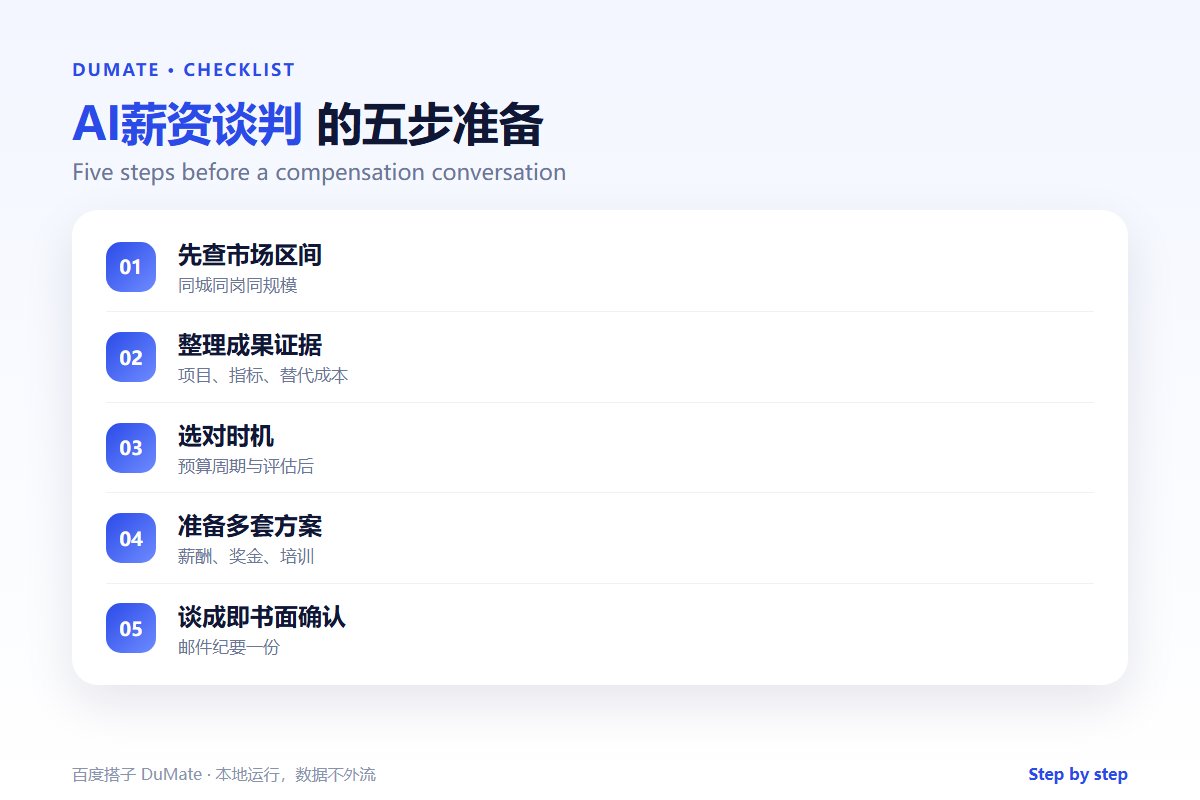
Step 1: Collect the band
Use two independent sources: a salary survey for the role and city, and three recent postings with published ranges. Record the date and the level for each, and adjust for company size and stage. A survey from two years ago is a historical document, not a market. AI薪资谈判 starts with a band you can defend, not with a hope.
Step 2: Build the evidence file
List four achievements with a number attached: revenue, cost, time, or quality. Write each as a situation, an action, and a result in two sentences. Avoid adjectives, because a manager can take a number to a compensation committee and cannot take hard-working anywhere. Rehearse each item aloud until it takes thirty seconds, which is the length AI薪资谈判 usually allows before the other side responds.
Step 3: Price the whole package
Put base, bonus target, equity, pension, insurance, leave, and remote flexibility in one table. Estimate the annual value of each with conservative assumptions, including the probability that equity vests. Then compare offers on that total. AI薪资谈判 should mark which parts are negotiable and which are fixed by policy, so the conversation does not waste time on the wrong line.
Step 4: Run the conversation
Ask for the range for the level, then respond with your band and the evidence. Use one sentence per point and pause after each. If the offer sits below the band, ask what would need to be true for it to move. Avoid ultimatums you will not keep, and avoid apologizing for a number you can support.
Step 5: Confirm in writing
Send a short summary the same day: title, base, bonus, equity, start date, review date, and any promised flexibility. Ask for confirmation in reply. AI薪资谈判 ends when the terms are written down, because a verbal promise has a way of changing before the contract arrives. Keep the summary factual and short enough to read on a phone.
A Negotiation Checklist for AI薪资谈判
- The band comes from two independent sources.
- Achievements are stated with numbers.
- Total compensation is compared, not base alone.
- The employer’s range is requested first.
- Agreed terms are confirmed in writing.
Where AI薪资谈判 Fails
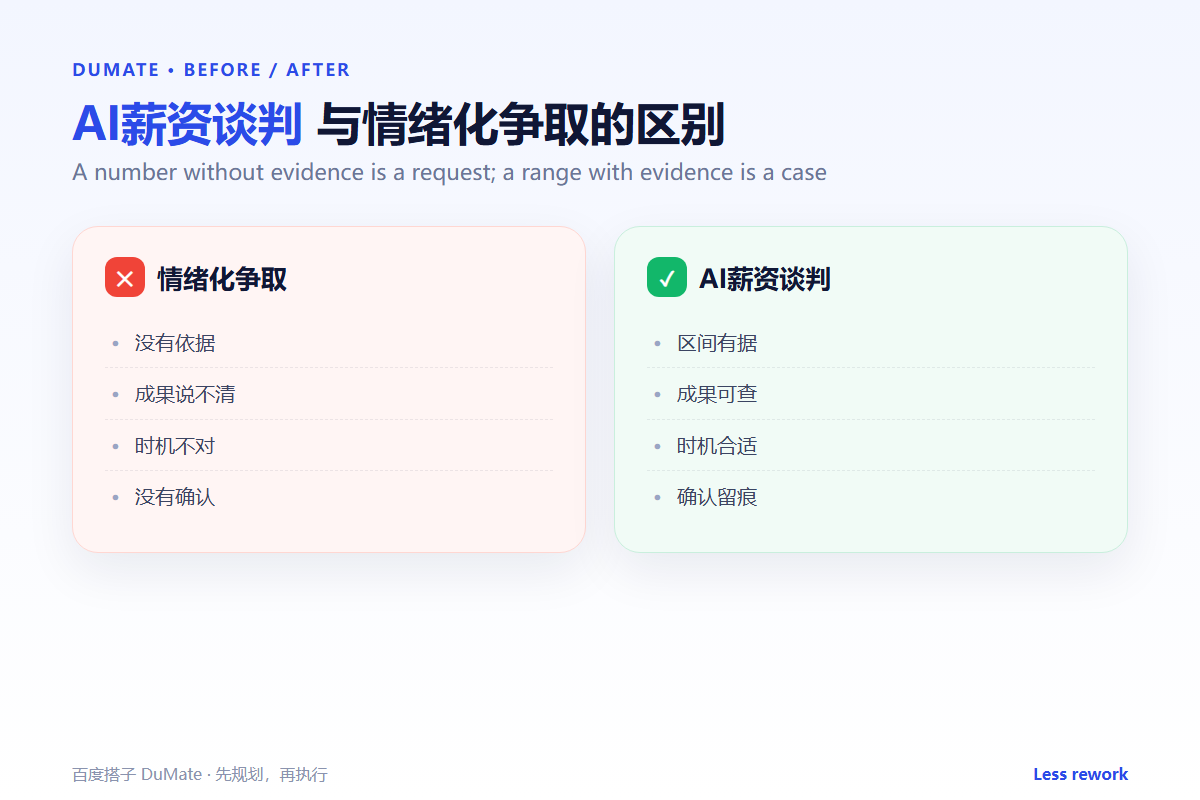
It fails when the candidate negotiates against a number they invented, and it fails when the employer treats a published range as a starting point for a low offer. AI薪资谈判 is a search for a defensible middle, not a contest with a winner.
- A target drawn from one friend’s offer.
- Equity valued at the last round without dilution.
- Promises about title with no date attached.
- Silence treated as agreement.
Before and After
Before, a product manager asked for a 15 percent raise with no market data and one sentence about workload. The manager offered 4 percent, the conversation ended in disappointment, and the review was postponed by six months.
After, she used AI薪资谈判 to bring a band from two surveys, a table of total compensation, and four results with numbers attached. The base rose 11 percent, the bonus target moved up a level, and the review date was written into the letter. The meeting took thirty-five minutes, and nobody had to argue about loyalty.
FAQ
Should I give a number first?
Ask for their range if you can. If they insist, give the top of your researched band and explain the evidence. A vague number invites a low anchor, and AI薪资谈判 cannot repair an anchor you set yourself.
Can AI薪资谈判 help with internal raises?
Yes. The evidence file and the band apply inside a company too. The constraint is the level’s range, which is usually harder to move than the base.
What if the offer is final?
Ask which parts are fixed and which can move: signing bonus, review date, title, or remote days. Then decide against your minimum rather than against the excitement of the moment.
延伸阅读
Pay conversations improve with compensation analysis for the band and performance review evidence for the file. Use career planning to decide which offer serves the next three years, job posting ranges to sanity-check the market, and mock interview practice to rehearse the sentences aloud. External references: NIST AI Risk Management Framework and ISO/IEC 42001.
评论
还没有评论,来说两句吧。