
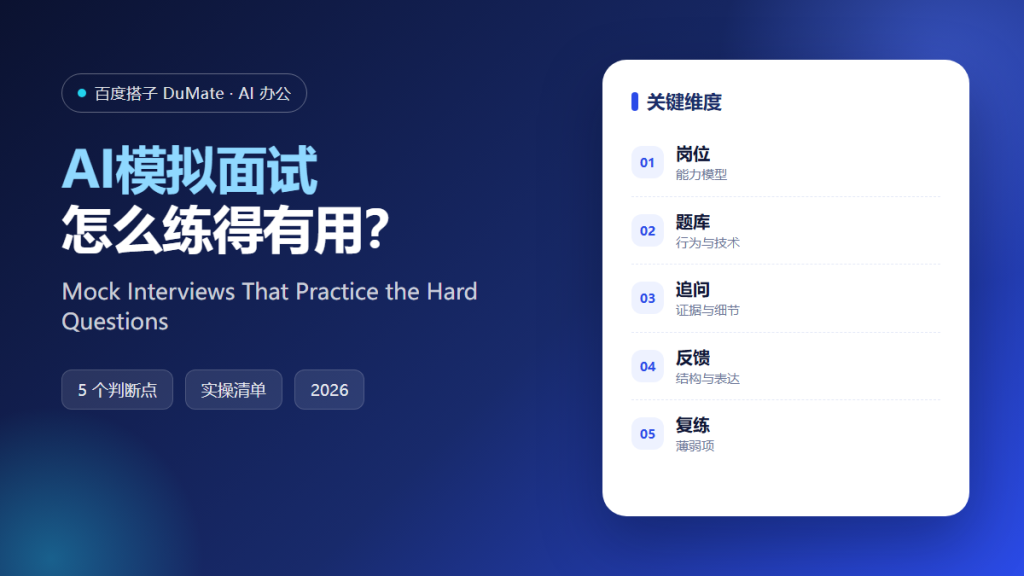
AI模拟面试 gives candidates a low-pressure place to practice the answers they least want to give. Most people rehearse the introduction and hope the difficult question never arrives. The difficult question is exactly where preparation pays, because the first attempt is usually a ramble and the second is a structure.
This guide explains how to run a useful mock interview, how to review the recording without becoming self-critical, and how to tell whether the practice is actually improving the answer. The method is short enough to repeat before every interview.
Key Takeaways
- List the questions you fear most.
- Practice answers aloud, not silently.
- Use a simple structure for each story.
- Record and review one dimension at a time.
- Repeat with new questions and time limits.
Why AI模拟面试 Needs Deliberate Difficulty
Easy practice creates false confidence. If every question is familiar, the candidate rehearses fluency rather than judgment. AI模拟面试 should deliberately include gaps in employment, failed projects, conflicts with a manager, and questions about salary, because these are the moments where preparation is visible.
The second reason is feedback speed. A real interview offers one chance and little explanation. AI模拟面试 can transcribe an answer, mark where the point was buried, and show how long the candidate spoke before reaching the result. That feedback is not a verdict, but it makes the next attempt more focused.
Third, practice reduces the physical signs of anxiety. Speaking aloud repeatedly trains pacing and breath in a way that reading notes cannot. AI模拟面试 should encourage full answers, including the awkward pauses, so the candidate learns to recover instead of restarting. A useful session also includes a short pause after each answer, because the first reaction is often a judgment about tone rather than a note about content that can be checked later.
How AI模拟面试 Works in Five Steps
Step 1: Build a question list
Collect questions from the job description, recent interviews, and your own worries. Group them into experience, behavior, and motivation. AI模拟面试 can add follow-up questions that a real interviewer might ask.
Step 2: Choose a structure
Use a simple pattern: situation, task, action, result. Keep each part to two or three sentences. The structure is not a script; it is a way to avoid losing the point under pressure.
Step 3: Answer aloud
Set a timer and respond without notes. Record the answer if you can. AI模拟面试 should simulate interruptions and follow-ups, because a polished monologue is not the same as a conversation.
Step 4: Review one layer
Listen once for content, once for structure, and once for pace. Do not try to fix everything in one pass. AI模拟面试 can produce a transcript with timestamps, making it easier to find the sentence where the answer lost direction.
Step 5: Repeat under pressure
Run the same question again after a day, then try a new question with a shorter preparation time. The goal is transfer, not memorization. AI模拟面试 can increase difficulty gradually as the answers become steadier.
‘ alt=’AI模拟面试 checklist: question list, structure, recording, review and repetition’ />
A Mock Interview Checklist
- Hard questions are on the list.
- Answers include a concrete result.
- Every answer is spoken aloud.
- Review focuses on one issue at a time.
- AI模拟面试 practice includes follow-up questions.
Where AI模拟面试 Fails
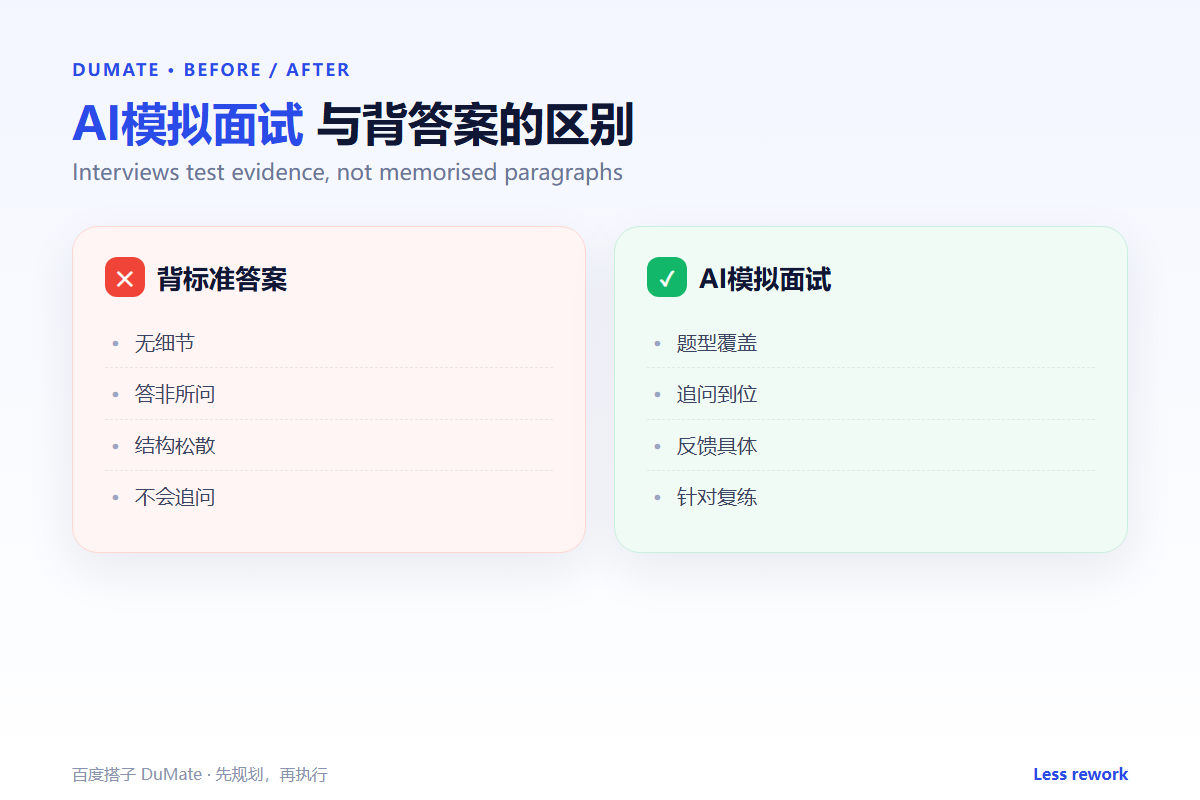
AI模拟面试 fails when the candidate memorizes polished answers and sounds like a recording. Interviewers notice recitation, and it makes genuine conversation harder. It also fails when feedback is treated as a score rather than a set of observations.
- Practicing only friendly questions.
- Writing answers instead of speaking them.
- Rewriting every sentence after one attempt.
- Ignoring the job’s actual requirements.
Before and After
Before, a candidate prepared by reading a list of questions and imagining strong answers. In the interview, the first follow-up exposed a gap, and the answer collapsed into a long explanation with no result. After, AI模拟面试 forced five spoken attempts at the same story, and the final version reached the outcome in under ninety seconds.
Practice does not remove nerves. It gives them somewhere useful to go, and the goal is not a perfect answer but a calmer second attempt.
Keep the first month simple. One task, one owner, and one weekly review are enough to prove the workflow before it spreads across the team.
Write down what changed after each run. A short note is easier to trust than a memory, and it makes the next improvement obvious.
Review the output before it leaves your desk. A two-minute check catches most of the errors that would otherwise come back as questions.
Keep one example of a good result. New team members learn faster from a concrete reference than from a long explanation.
The first version does not need to be perfect. It needs to be complete enough to review, so the team can see the gaps and fix them in the next round.
Write the review notes in the same place as the work. Notes stored somewhere else are rarely read when the next decision arrives.
FAQ
How many mock interviews are enough?
Three to five focused sessions are usually enough for a specific role. More practice helps only if the questions and feedback keep changing.
Should I memorize my answers?
Memorize the structure and two or three facts, not the sentences. A memorized answer sounds stiff when the interviewer asks something unexpected.
Can AI模拟面试 predict the real questions?
No. It can generate plausible questions, but the value is in practicing how you think, not in guessing the exact prompt.
延伸阅读
Improve delivery with speaking practice and voice over. Build a preparation plan with study plan and review weak answers with wrong question review. Practice materials can come from a question bank. External references: NIST AI Risk Management Framework and ISO/IEC 42001.
评论
还没有评论,来说两句吧。