
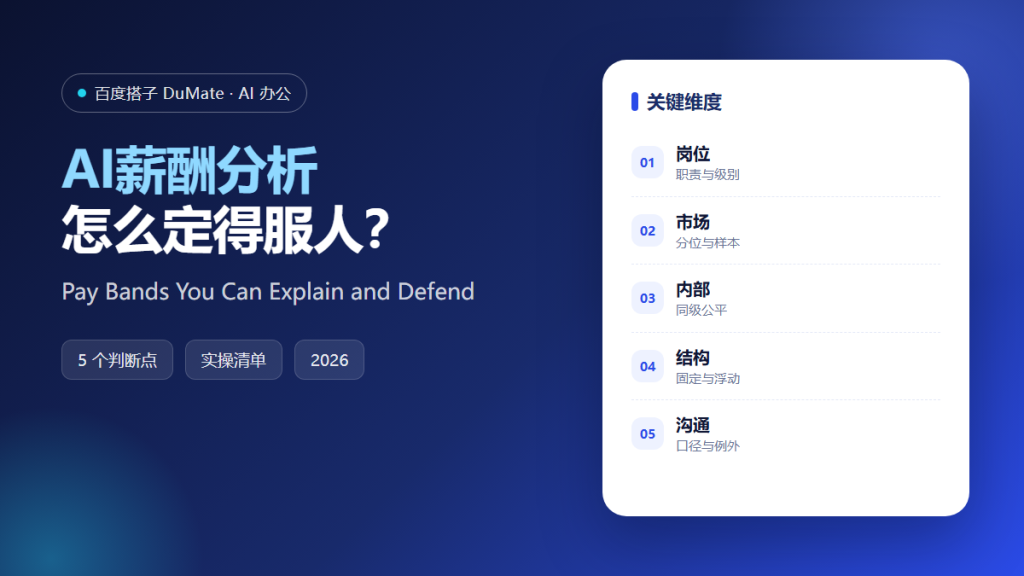
AI薪酬分析 is the work of turning scattered salary numbers into a structure that managers can explain. A pay band is not a secret chart kept by human resources; it is a statement about what the organization values, how it competes for talent, and where it is willing to be flexible.
This guide covers the inputs a band needs, a five-step process for building one, and the exceptions that should be documented rather than hidden.
Key Takeaways
- Define role scope before comparing salaries.
- Use more than one market source.
- Check internal equity across similar jobs.
- Publish the band and the rules.
- Document every exception with a reason.
Why AI薪酬分析 Needs a Clear Job Architecture
Salary data is meaningless without a consistent definition of the job. Two companies may use the same title for roles with different scope, autonomy, and headcount responsibility. AI薪酬分析 should start from a job architecture that describes levels and accountabilities before any market number is matched.
The second requirement is internal equity. A new hire may receive a market rate that is higher than a long-serving employee in the same band. That outcome can be justified, but only if the organization can show the logic and correct the gap over time. AI薪酬分析 can surface these inversions by comparing tenure, performance, and scope. The exercise is not to eliminate every difference, but to make each one visible before it becomes a retention problem, a hiring delay, or an avoidable resignation.
Finally, a band must be explainable to the people inside it. If the rule is secret, employees invent one, and the invented rule is usually less generous than the real one. AI薪酬分析 should produce a short explanation that a manager can deliver without revealing individual salaries.
How AI薪酬分析 Works in Five Steps
Step 1: Map the roles
Write a short description for each level, including decision rights and typical experience. Group jobs with comparable work, not comparable titles. AI薪酬分析 can flag roles that sit ambiguously between two levels.
Step 2: Gather market data
Use at least two sources, note the survey date, and adjust for industry and location. Record the median and the range, not just a single benchmark. AI薪酬分析 can normalize currencies and pay periods so the comparison is consistent.
Step 3: Set the band
Choose a midpoint and a spread that reflect the organization’s hiring strategy. A wide band allows growth without promotion; a narrow band makes progression clearer. AI薪酬分析 can model the cost of each option before a decision is made.
Step 4: Test the exceptions
List anyone paid outside the band and why. Common reasons include scarce skills, retention risk, or a legacy contract. AI薪酬分析 should mark how long each exception has existed and when it will be reviewed.
Step 5: Publish and maintain
Give managers the band, the rules, and three example conversations. Update the data on a fixed schedule. AI薪酬分析 can prepare the annual review, but the compensation committee owns the final judgment.
‘ alt=’AI薪酬分析 checklist: job levels, market sources, band spread and exceptions’ />
A Pay Band Review Checklist
- Roles are grouped by scope, not title.
- Market sources are current and cited.
- AI薪酬分析 keeps bands covering the full salary range.
- Internal inversions are identified.
- Exceptions have owners and review dates.
Where AI薪酬分析 Fails
AI薪酬分析 fails when a single survey is treated as the market. One source may over-represent large employers or a specific region. It also fails when the analysis ignores total compensation, including bonus, equity, and benefits.
- Comparing jobs with different levels of responsibility.
- Using stale data without a date.
- Hiding exceptions from managers.
- Publishing a band with no rule for movement.
Before and After
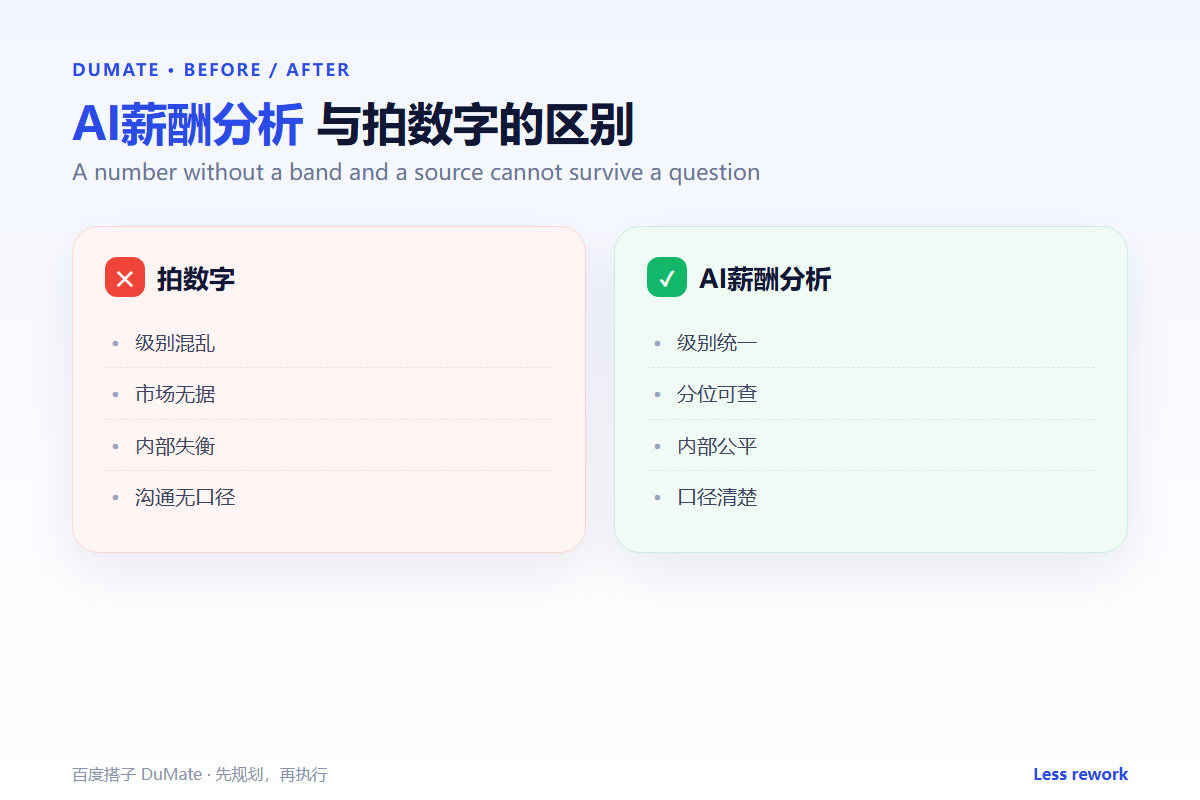
Before, a company negotiated each salary separately and discovered two years later that new hires in the same role earned more than experienced staff. After, AI薪酬分析 produced five levels with defined scope, a documented market range, and a plan to close the inversions over three review cycles.
A pay band is not a promise of equality. It is a promise that differences will have a reason, and it should be reviewed when the strategy changes, not only when the calendar says so.
Keep the first month simple. One task, one owner, and one weekly review are enough to prove the workflow before it spreads across the team.
Write down what changed after each run. A short note is easier to trust than a memory, and it makes the next improvement obvious.
Review the output before it leaves your desk. A two-minute check catches most of the errors that would otherwise come back as questions.
Keep one example of a good result. New team members learn faster from a concrete reference than from a long explanation.
The first version does not need to be perfect. It needs to be complete enough to review, so the team can see the gaps and fix them in the next round.
Write the review notes in the same place as the work. Notes stored somewhere else are rarely read when the next decision arrives.
FAQ
How often should bands be updated?
Once a year for most organizations, and sooner when the labor market moves sharply or a role becomes scarce.
Should employees see the band?
Yes, where law and policy allow. The band explains the range; it does not reveal what a colleague earns.
What about remote employees?
Define the geographic policy in advance. Some employers use one national band; others adjust by location. Either can work if it is stated clearly.
延伸阅读
Connect pay to the plan with budget planning and financial statements. Hiring demand appears in sales forecast, and vendor rates are covered in procurement comparison. Workforce grouping is discussed in user segmentation. External references: NIST AI Risk Management Framework and ISO/IEC 42001.
评论
还没有评论,来说两句吧。