
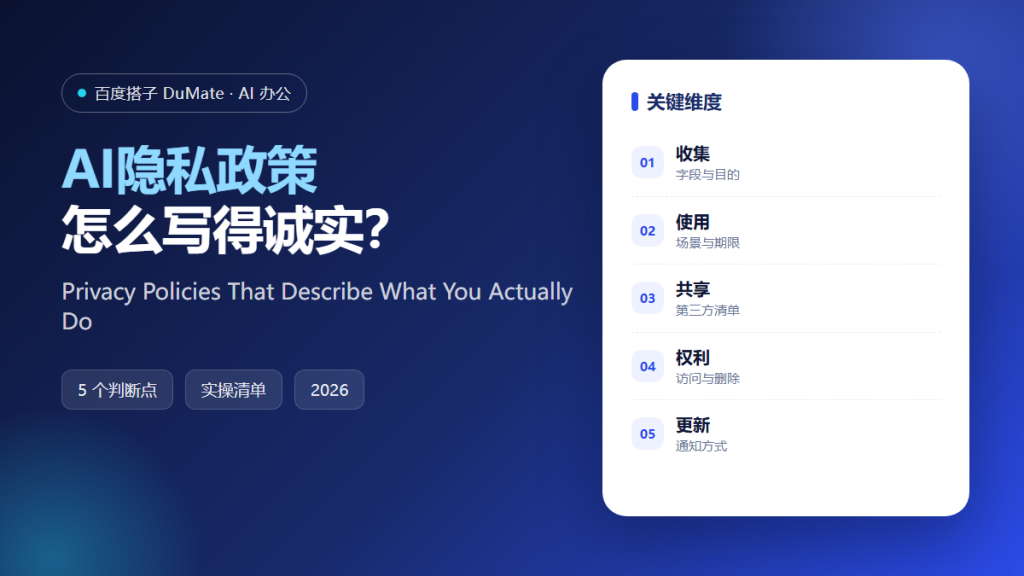
AI隐私政策 is a description of practice, not a legal ornament. If the text says data is kept for thirty days and the database keeps it for a year, the policy is wrong regardless of how carefully it was drafted. AI隐私政策 only earns trust when a reader can check it against something real.
This guide covers a practice-first method: inventory what is collected, tie each purpose to a collection point, and write sentences a customer can verify.
Key Takeaways
- Inventory data flows before editing the text.
- Name each purpose next to the data it uses.
- State retention in months, not in adjectives.
- List sharing categories and the reason for each.
- AI隐私政策 should give a working path to access, correct, and delete.
Why AI隐私政策 Needs to Match the Systems
Policies drift after releases. A new analytics tool, a support widget, or a mobile update can add a data flow that nobody adds to the document. AI隐私政策 written from the old description will keep promising a scope the product no longer respects. The gap is rarely deliberate; it is simply nobody’s task to update the text when a vendor changes.
Vague language creates risk in both directions. Saying that data may be shared with partners gives little useful information and invites a regulator to ask which partners and for what. AI隐私政策 that names categories, purposes, and retention periods answers the question before it is asked. Specific wording also limits what the company can later claim it meant.
Internal consistency matters as much as external wording. Support, sales, and engineering all explain privacy to customers, and they need the same answer. AI隐私政策 that is specific enough to be quoted gives every team one version of the truth.
How AI隐私政策 Works in Five Steps
Step 1: Inventory collection points
List every form, cookie, SDK, and integration that receives personal data, and note what each one collects. AI隐私政策 should be built from this inventory rather than from a template, because the template cannot know about the chat widget added last month. Include the systems that receive data indirectly, such as backup, logging, and analytics.
Step 2: Match purposes to data
For each purpose, state the data it needs and the legal basis. Remove purposes that no longer apply and data that no process uses. AI隐私政策 that lists a purpose with no matching data flow is a leftover, and leftovers are what auditors sample first. Keep the mapping in one table so a change in purpose is a single edit rather than a search through paragraphs.
Step 3: Write retention and sharing in specifics
Give a period in days or months for each category, and explain what happens at the end of it. Name the categories of recipients, such as payment processors or analytics providers, and the reason for the transfer. AI隐私政策 should avoid terms like as long as necessary unless a defined rule sits beside them. Name the countries where data is stored when transfers cross borders, and the safeguard used.
Step 4: Describe rights and the path
Explain how a customer can access, correct, export, or delete their data, and how long the response takes. Test the path yourself before publishing. AI隐私政策 that promises a right without a working form sends people to support, where the request is handled inconsistently.
Step 5: Test with readers and set a review date
Ask a few customers and a new employee to explain what the policy says. Where they hesitate, rewrite. AI隐私政策 should carry a version and a review date, and the review should be triggered by product changes rather than by the calendar alone.
‘ alt=’AI隐私政策 checklist: data inventory, purposes and retention periods’ />
A Privacy Checklist for AI隐私政策
- Every collection point appears in the inventory.
- Each purpose maps to specific data.
- Retention periods are numeric and owned.
- Recipient categories are named with a reason.
- Requests are tested end to end before launch.
Where AI隐私政策 Fails
It fails when it is written once and treated as finished. AI隐私政策 also fails when legal language is copied from another jurisdiction, leaving references to rights and authorities that do not exist for the reader.
- Cookies described generically while the site uses a dozen.
- Retention stated as indefinite without explanation.
- Children, employees, and applicants covered by one paragraph.
- No owner, so updates wait for the next redesign.
Before and After
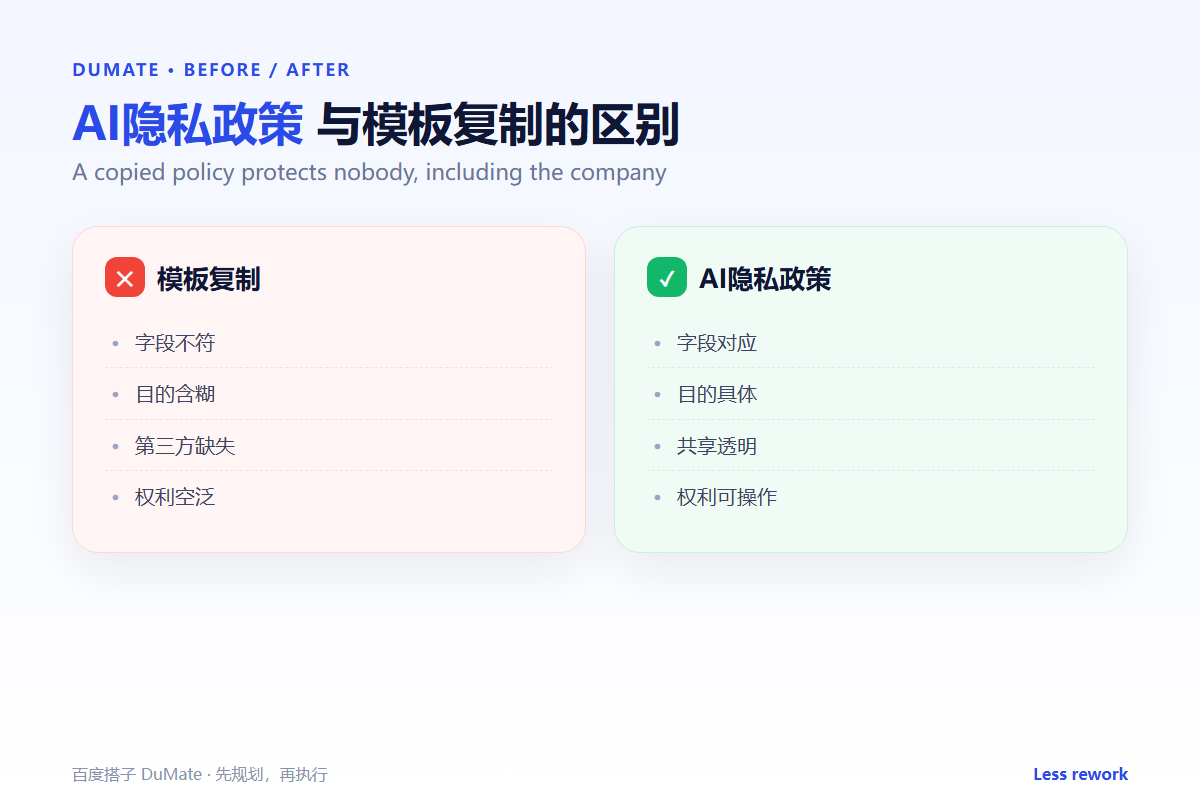
Before, a subscription service used a template policy that promised deletion within thirty days. In practice, backups held records for a year and two vendors received email addresses with no listed purpose.
After, AI隐私政策 was rebuilt from an inventory. Retention matched the backup schedule, vendor categories were named, and the deletion form reached the right system. Support tickets asking what happens to personal data dropped, and the answers became shorter. The policy also stopped promising a deletion window the engineering team could not meet.
FAQ
How long should a privacy policy be?
Long enough to cover every practice, short enough that a reader can find the part they care about. Use headings and tables rather than one dense block. A short summary at the top helps readers who never scroll.
Can AI隐私政策 be generated automatically?
It can draft from an inventory, but the inventory must come from the organization. Generated text without a data map describes an average company, not yours.
How often should it be reviewed?
Whenever a data flow changes, and at least once a year. AI隐私政策 should record the review date so the next owner knows where to start.
延伸阅读
Align the text with your data labeling records and summarize changes in a policy briefing. Interpret unclear duties through legal consultation, and read log analysis to see what systems actually record. Keep the final document consistent with document proofreading standards. External references: NIST AI Risk Management Framework and ISO/IEC 42001.
评论
还没有评论,来说两句吧。以下为本文的引用通告: