
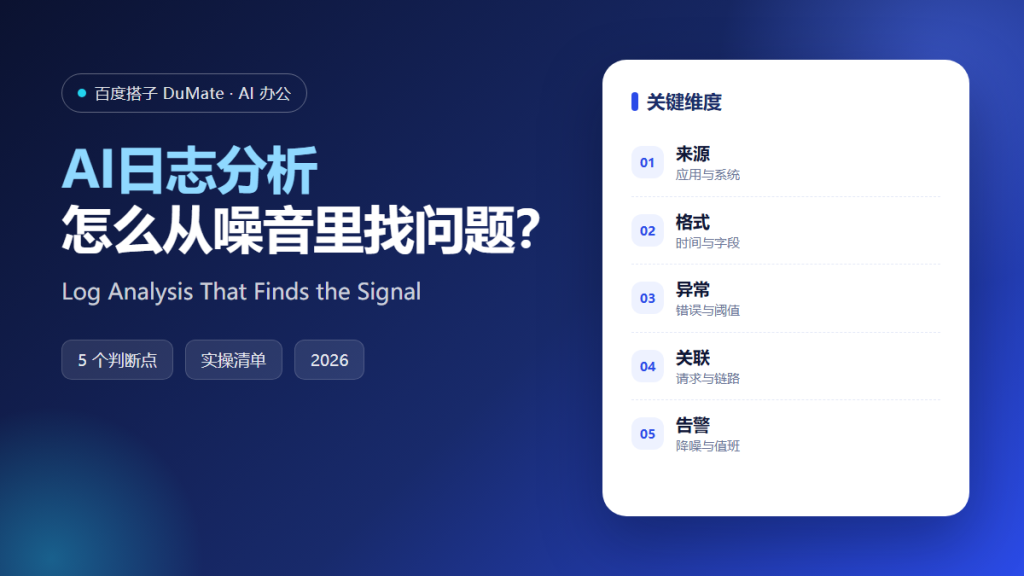
AI日志分析 fails when it is treated as a search box. Searching logs one line at a time works for a single incident and does not scale to a system. The useful approach is aggregation: group errors, link requests, and alert on patterns that require action.
This guide covers a five-step analysis process, the fields that make correlation possible, and the alert design that reduces noise instead of adding to it.
Key Takeaways
- Normalize timestamps and key fields.
- Aggregate errors by type and endpoint.
- Link requests across services.
- Alert on thresholds, not every error.
- Keep a record of investigations.
Why AI日志分析 Needs Correlation
A single error message rarely explains an incident. The useful information is the path: which user, which request, which service, and how long each step took. AI日志分析 can join the records when a request identifier is present.
The second reason is noise. A system can emit thousands of identical warnings an hour. An alert that fires on each one trains the team to ignore alerts.
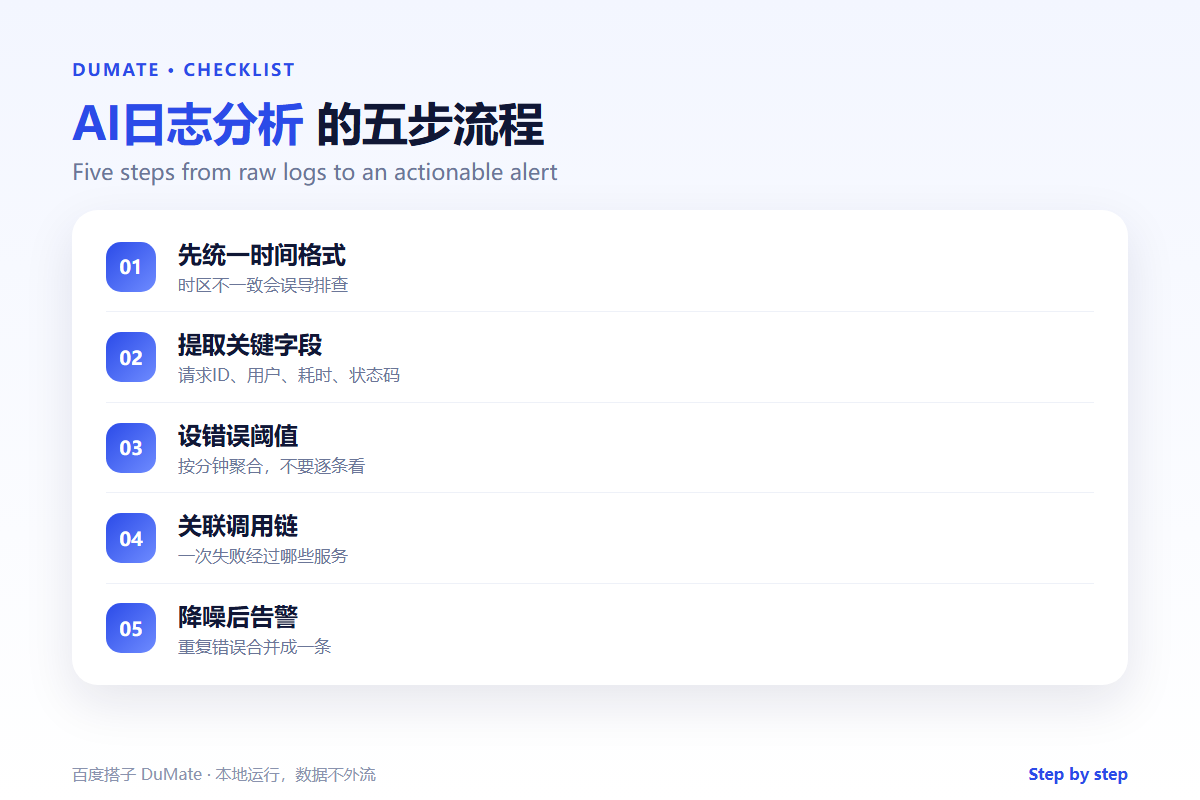
How AI日志分析 Works in Five Steps
Step 1: Normalize the fields
Use one timezone, one timestamp format, and consistent field names. AI日志分析 should reject or flag records that do not match.
Step 2: Aggregate errors
Group by error type, endpoint, and status code. Count per minute. AI日志分析 can surface the top movements rather than the top totals.
Step 3: Link the request path
Use a request or trace identifier to connect services. Show the slowest step. AI日志分析 can build the path if the identifier is propagated.
Step 4: Set actionable thresholds
Alert when the error rate exceeds a normal range or when latency crosses a limit for a sustained period. AI日志分析 should suppress duplicates.
Step 5: Record the investigation
Write what was checked, what was found, and what changed. AI日志分析 can draft the summary from the query and the timeline.
An Analysis Checklist
- Timestamps and fields are consistent.
- Errors are grouped by type.
- Requests are traceable across services.
- Alerts have thresholds and owners.
- Investigations are documented.
Where AI日志分析 Fails
It fails when logs lack a request identifier, which makes correlation impossible. It also fails when retention is too short to investigate an incident reported by a customer.
- Missing trace identifiers.
- Timezones mixed across services.
- Alerts without owners.
- Logs deleted too early.
Before and After
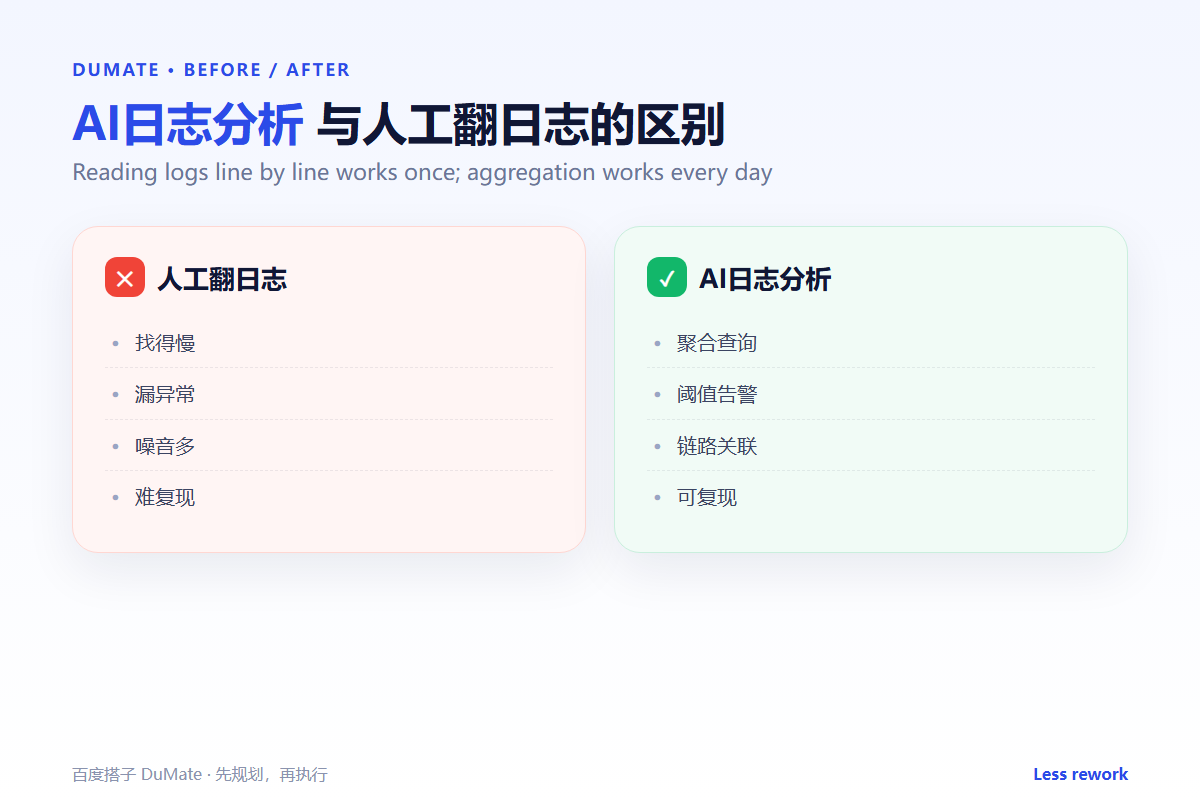
Before, an incident took a day to diagnose because each team searched its own logs. After, AI日志分析 linked the request across three services and found the slow step in twenty minutes.
Logs are a record of behavior. Analysis turns the record into a diagnosis.
Used consistently, AI日志分析 becomes part of the normal review routine rather than a separate project.
A final check with AI日志分析 takes a minute and catches the errors that are easiest to miss.
The same AI日志分析 routine works for small tasks and large ones, which is why teams keep using it.
A Four-Week Rollout
The first week with AI日志分析 should be a small pilot, not a team-wide launch. Choose one recurring task with a clear output and run it end to end. Keep the sample small enough to check by hand. The point is to see where AI日志分析 saves time and where it creates review work.
During the pilot, keep a short log of inputs, outputs, and corrections. Record the time spent before and after. AI日志分析 feels faster even when it is not, so the log matters. At the end of the week, review the log with one colleague and decide whether to continue, change the input, or stop.
In week two, write a one-page standard for input and output. Include what must be checked and who approves the result. AI日志分析 works better when the standard is visible to everyone. In week three, add permissions and a review step. In week four, compare the results and write a short guide. That guide is what makes AI日志分析 survive after the first month.
Keep the pilot narrow. A broad rollout hides which step failed, and a narrow one shows exactly where the workflow needs help. Expand only after the narrow case is stable.
Keep the first month simple. One task, one owner, and one weekly review are enough to prove the workflow before it spreads across the team.
Write down what changed after each run. A short note is easier to trust than a memory, and it makes the next improvement obvious.
Review the output before it leaves your desk. A two-minute check catches most of the errors that would otherwise come back as questions.
Keep one example of a good result. New team members learn faster from a concrete reference than from a long explanation.
The first version does not need to be perfect. It needs to be complete enough to review, so the team can see the gaps and fix them in the next round.
Write the review notes in the same place as the work. Notes stored somewhere else are rarely read when the next decision arrives.
FAQ
How long should we keep logs?
Long enough to investigate slow-reported issues and meet compliance requirements. Thirty days is a common baseline.
Should we log personal data?
Avoid it. If it is necessary, mask it and restrict access.
What is the best first alert?
Error rate and latency for the most important user journey. Start there, not with every service.
延伸阅读
For analysis, see AI数据分析工具. Access rules are in AI权限管理. Automation controls are in AI桌面自动化. Batch work is covered in AI批量处理. Knowledge capture is in AI知识库. External references: NIST AI Risk Management Framework and ISO/IEC 42001.
评论
还没有评论,来说两句吧。