
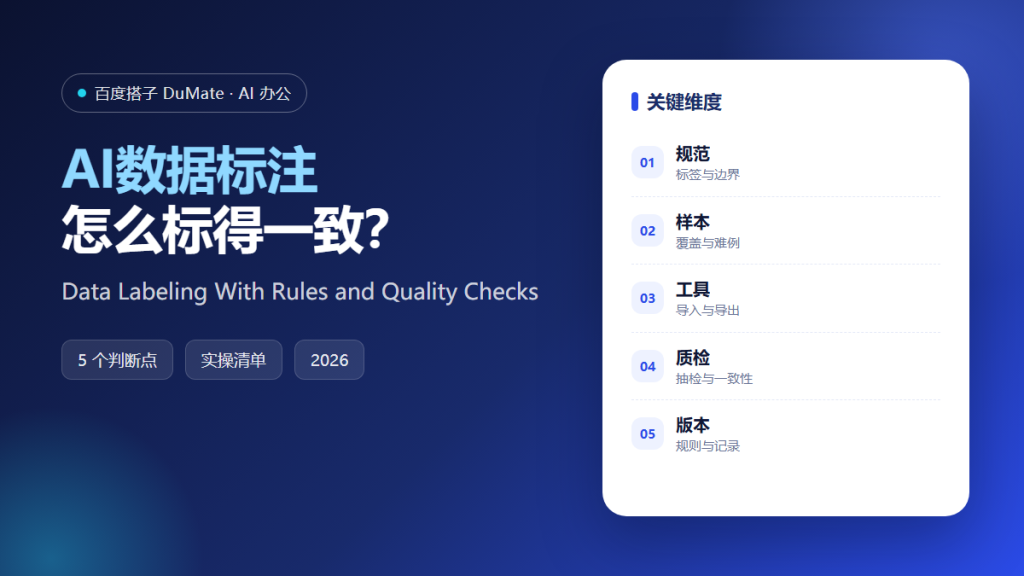
AI数据标注 is a quality problem before it is a volume problem. A model trained on inconsistent labels learns the inconsistency. The work looks simple, which is why teams underestimate the need for rules, calibration, and review.
This guide covers a five-step labeling process, the boundary cases that cause most disagreement, and the quality metrics that show whether the labels are usable.
Key Takeaways
- Write label definitions with examples.
- Run a small pilot before scaling.
- Resolve boundary cases in a shared guide.
- Measure agreement between labelers.
- Version the rules and the dataset.
Why AI数据标注 Needs Written Rules
Two labelers can read the same definition and make different decisions. The gap appears at the boundaries: is a partial match positive, is a sarcastic comment negative, is a duplicate one item or two. AI数据标注 should use a guide that answers these questions with examples.
The second reason is scale. A rule that lives in one person’s head does not survive a new team member or a new batch. Written rules are the only way to keep quality stable.
How AI数据标注 Works in Five Steps
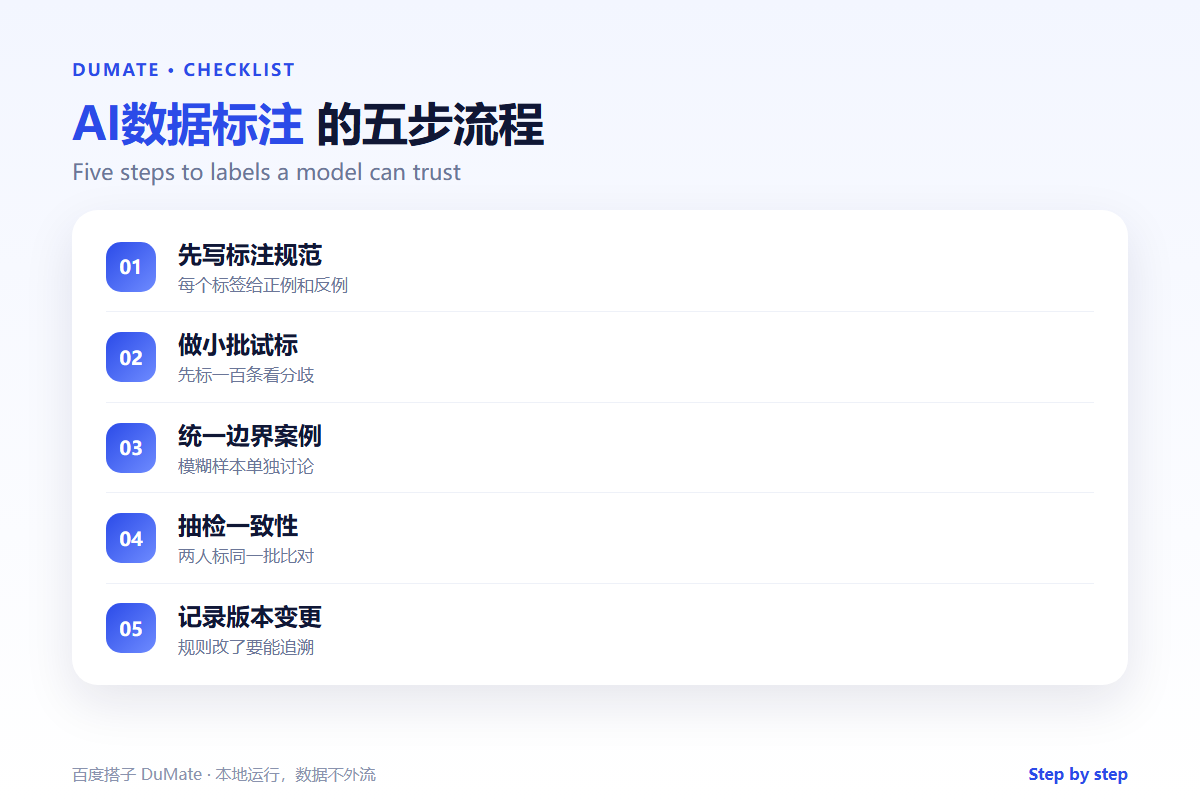
Step 1: Define each label
Write a definition, two positive examples, and two negative examples. Include a note on near-misses. AI数据标注 should be instructed with this guide, not a single sentence.
Step 2: Run a pilot
Label one hundred items with two people. Compare the results and discuss every disagreement. AI数据标注 can highlight likely conflicts, but the discussion sets the standard.
Step 3: Resolve boundary cases
Add the resolved cases to the guide. Keep the examples short and specific. AI数据标注 quality improves fastest at the boundaries.
Step 4: Measure agreement
Calculate agreement on a sample every week. If it drops, stop and recalibrate. AI数据标注 should report agreement, not only volume.
Step 5: Version everything
Record the guide version and the dataset version. When a rule changes, label a sample again. AI数据标注 without versioning cannot be audited.
A Labeling Checklist
- Each label has examples and counterexamples.
- A pilot batch was reviewed.
- Boundary cases are documented.
- Agreement is measured weekly.
- Rules and data are versioned.
Where AI数据标注 Fails
It fails when labelers are paid per item with no quality check, because speed wins over accuracy. It also fails when the guide is updated without re-labeling the sample.
- Rules that exist only in chat.
- No pilot before scaling.
- Ignoring disagreements.
- Datasets without version history.
Before and After
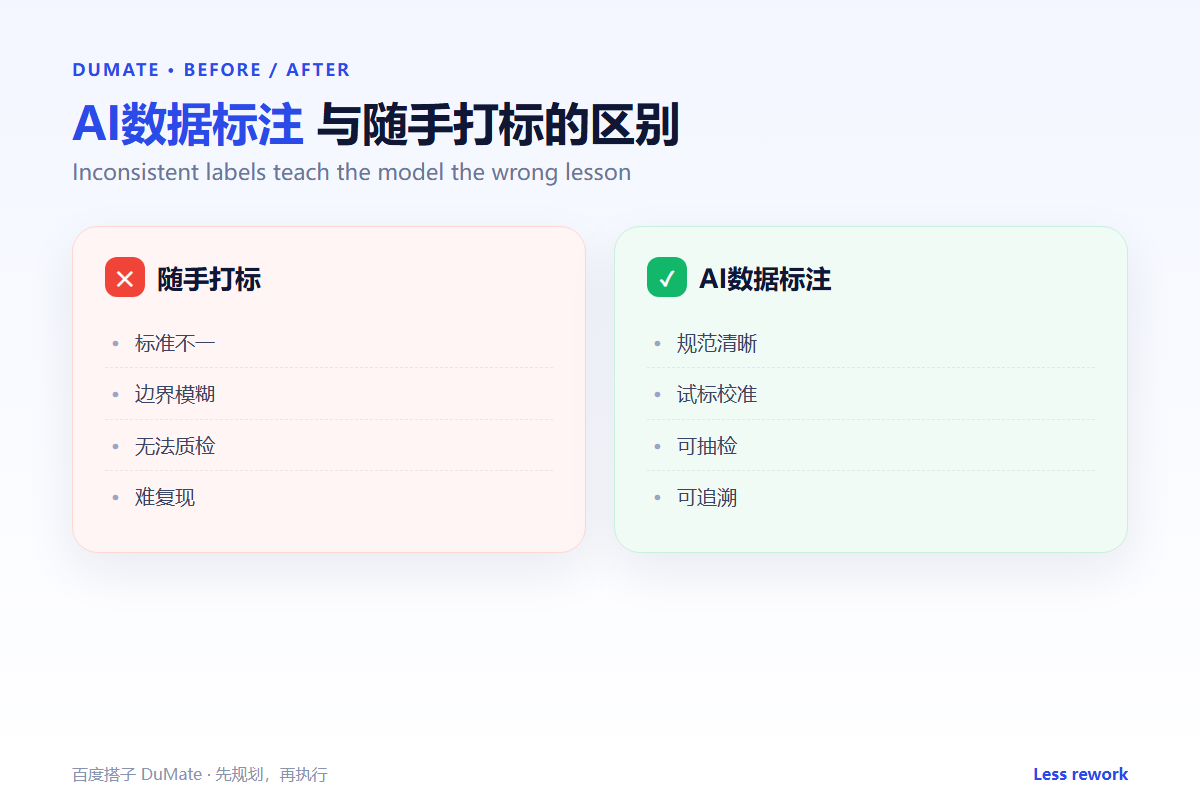
Before, three labelers produced a dataset with inconsistent boundaries, and the model learned to confuse two categories. After, AI数据标注 started with a guide and a pilot, agreement rose, and the next model version improved without more data.
Label quality is model quality. There is no shortcut around it.
Used consistently, AI数据标注 becomes part of the normal review routine rather than a separate project.
A final check with AI数据标注 takes a minute and catches the errors that are easiest to miss.
The same AI数据标注 routine works for small tasks and large ones, which is why teams keep using it.
Measuring Whether It Works
Measure AI数据标注 with three numbers: time spent, rework required, and output accepted without changes. Track them for four weeks before drawing a conclusion. Set a baseline from the manual process, because without a baseline any result looks like progress.
Time alone is misleading. A task that finishes faster but needs a full rewrite is not an improvement. Pair time with rework, and pair both with the quality of the final output. AI数据标注 should be compared with how the work was done before, not with an ideal.
Review the numbers monthly with the people doing the work. They know why a week was slow or why rework increased. AI数据标注 improves when the review includes the operators, not only the managers. Keep the dashboard small: three numbers and one note are enough.
Also record the exceptions. A week with an unusual campaign or a system outage is not a fair test. Note the context next to the numbers so a later reader does not compare incomparable weeks. When the numbers are stable, expand the scope; when they move the wrong way, fix the input before adding more use cases. The goal is not to prove that AI数据标注 works, but to know when it works and when it does not.
Keep the first month simple. One task, one owner, and one weekly review are enough to prove the workflow before it spreads across the team.
Write down what changed after each run. A short note is easier to trust than a memory, and it makes the next improvement obvious.
Review the output before it leaves your desk. A two-minute check catches most of the errors that would otherwise come back as questions.
Keep one example of a good result. New team members learn faster from a concrete reference than from a long explanation.
The first version does not need to be perfect. It needs to be complete enough to review, so the team can see the gaps and fix them in the next round.
FAQ
How many examples should a guide have?
At least two positive and two negative per label, plus the boundary cases found in the pilot.
What agreement score is acceptable?
It depends on the task. Track the trend and investigate any drop.
Should labelers see each other’s work?
During calibration, yes. During production, independent labeling gives a cleaner quality signal.
延伸阅读
Clean data first with AI数据清洗. Access rules are in AI权限管理. Keep guidelines in an AI知识库. Batch work is covered in AI批量处理. For analysis, read AI数据分析工具. External references: NIST AI Risk Management Framework and ISO/IEC 42001.
评论
还没有评论,来说两句吧。