
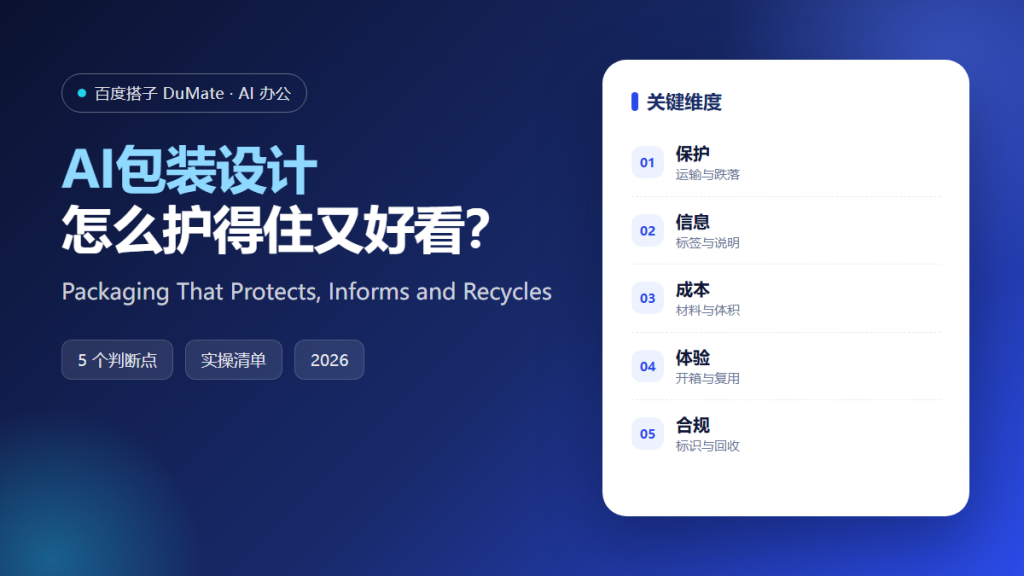
AI包装设计 has three jobs and no fourth: protect the product, tell the buyer what they need to know, and leave a material stream that can be recycled. Most packaging fails one of the three because a decision was made for looks alone. AI包装设计 is useful when it holds all three constraints in view at the same time.
This guide covers a five-step method for AI包装设计, the tests that reveal a weak structure before a print run, and the habits that turn a packaging brief into a folder of pretty renders nobody can ship.
Key Takeaways
- Start from the journey, not the shelf.
- Size the pack to the product and the courier.
- Put legal and use information in a fixed order.
- Test a prototype before approving artwork.
- Choose a material with a real recycling path.
Why AI包装设计 Needs a Journey Map
A box is dropped, stacked, and stored before anyone sees it on a shelf. Packaging that looks elegant in a photo may crush at the bottom of a pallet. AI包装设计 should begin with the route: how many touches, what weight sits on top, how long the carton waits in a humid warehouse.
The second reason is information. Regulators, retailers, and customers all ask for text on the pack, and the order of that text decides whether it is read. AI包装设计 can arrange warnings, ingredients, and instructions into a hierarchy that survives a small label.
The third reason is material. A mixed-material pack that cannot be separated is landfill with good intentions. AI包装设计 should propose a construction that a household can actually dismantle, and say so on the pack.
How AI包装设计 Works in Five Steps
Step 1: Describe the journey
List every touch from factory to doorstep, with the maximum stack weight and the longest storage time. Two sentences are enough if they are true. AI包装设计 should start from this route rather than from a render, because a pack designed for a dry pallet will fail the first time it meets a courier’s van in the rain. A route that changes by season needs two versions, not one average. Write down who owns each touch, because an unowned handoff is where damage happens.
Step 2: Size to the product
Reduce empty space, but leave room for the cushion. A pack that fits too tightly transfers every impact straight to the product. Measure the void and write it down, because a millimetre saved on the dieline is often a return created at the door. The cushion should be part of the design, not an extra purchased at the end. Measure the courier’s maximum size before the dieline is drawn.
Step 3: Set the information hierarchy
Brand, product name, variant, quantity, warnings, use instructions, disposal. AI包装设计 should keep the order stable across the range so a customer learns it once. Place the warning where the hand goes when the pack is opened, not where the artwork happens to have a convenient gap. Put the variant where the eye lands first, not where the barcode has to go. Legal text can be small, but it cannot be hidden behind a fold.
Step 4: Build and test a prototype
Drop, compress, and vibrate a physical sample. Photograph the failure. A test that passes on a sample of one is an anecdote, not a result. Run the test at the weight and the temperature the parcel will actually meet, and keep the record beside the approved artwork. Test the pack after the artwork is printed, since ink and varnish change how board folds.
Step 5: Choose the material path
Prefer mono-material and a label that washes off. AI包装设计 can compare options, but the local recycling stream decides what is actually true. Ask the waste contractor before the claim goes on the pack, and print the instruction in the language of the market that sells it. A pack that needs a knife to open is a pack that gets torn. Ask for the recyclability note in writing, so the claim can be defended.
‘ alt=’AI包装设计 checklist: journey, information order and material path’ />
A Packaging Checklist
- The journey is written down.
- Empty space is measured, not guessed.
- Warnings appear in the same place on every variant.
- A prototype survived a drop test.
- The material can be separated by hand.
Where AI包装设计 Fails
Renders are the usual trap. A model can produce a beautiful dieline that cannot be folded, glued, or filled at line speed. The second trap is a sustainability claim with no local facility behind it, which is a legal risk dressed as marketing.
- Artwork approved before a physical sample.
- Copy that promises recyclability without a route.
- One pack size stretched across a whole range.
- No cost comparison between materials.
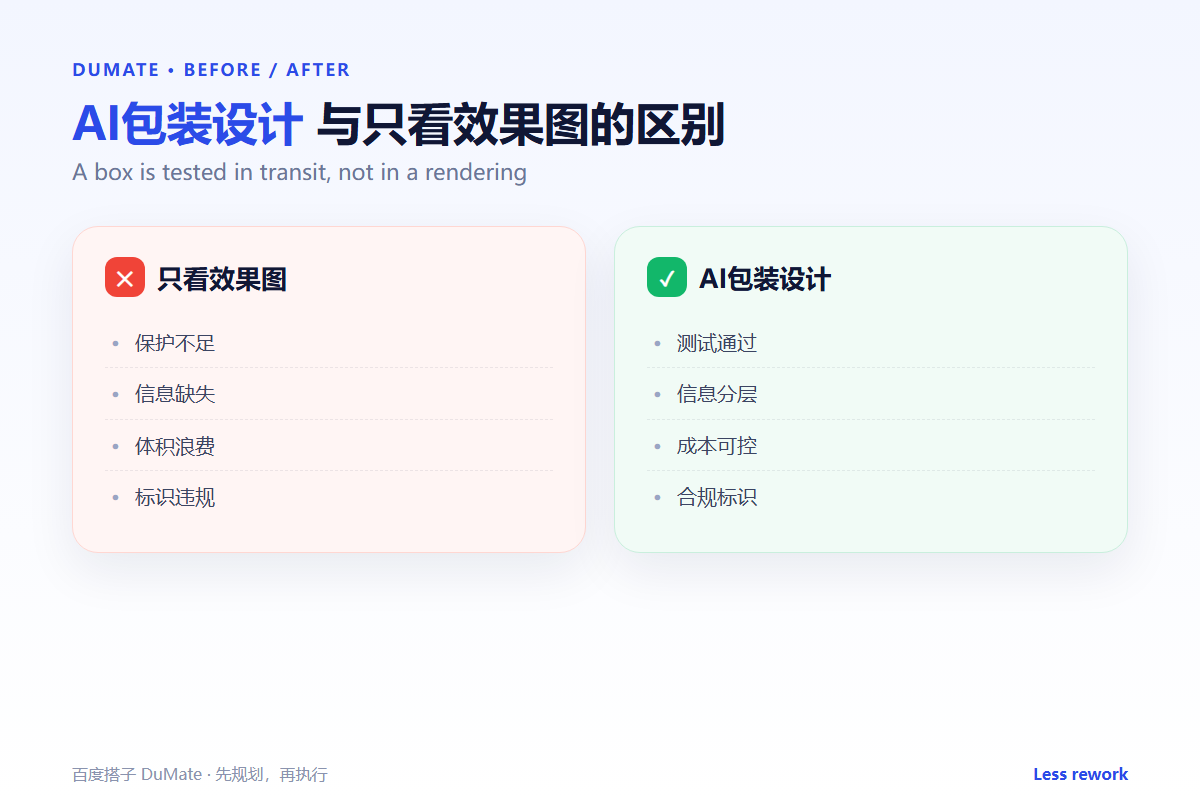
Before and After
Before, a skincare brand shipped a rigid box inside a mailer, and one in forty arrived with a cracked lid. The packaging won a design award and lost money on replacements.
After, AI包装设计 mapped the courier route, removed the rigid shell, and moved the product into a molded pulp tray with a mono-material film. Damage fell, pack weight fell, and the recycling instruction fit on the base.
FAQ
Can this replace a structural engineer?
No. AI包装设计 can propose and compare, but load calculations and line trials still belong to specialists.
Is recycled board always better?
Not automatically. A recycled board that fails in transit creates more waste than a stronger virgin board used once.
How much copy is too much?
If the customer cannot find the variant and the warning in three seconds, the hierarchy has failed.
延伸阅读
For pack photography, see product image, and for the selling text, product copy. Naming conventions are covered in brand naming, retail display in poster design, and material sourcing in supplier evaluation. External references: NIST AI Risk Management Framework and ISO/IEC 42001.
评论
还没有评论,来说两句吧。以下为本文的引用通告: