
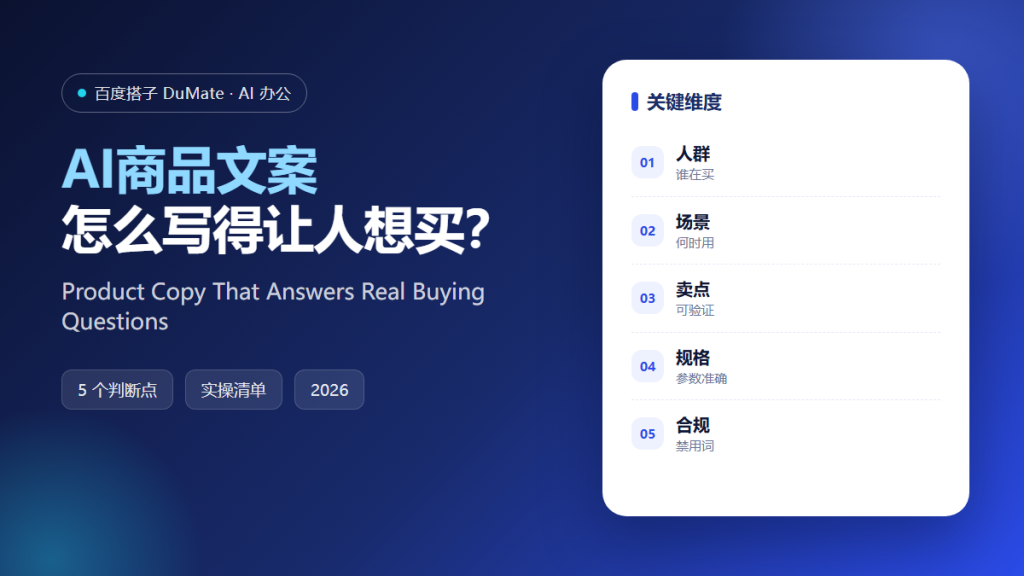
AI商品文案 is easy to generate and hard to make persuasive. The reason is simple: most product descriptions describe the seller’s excitement rather than the buyer’s decision. A shopper wants to know whether this item solves a specific problem, whether the size is right, and whether the claims are true.
This guide covers a five-step method for writing product copy that answers those questions, the specification checks that prevent returns, and the compliance rules that keep a listing live.
Key Takeaways
- Name the buyer and the situation first.
- Limit the copy to three provable benefits.
- Support every claim with a specification.
- Add one sentence that shows the product in use.
- Remove prohibited and absolute claims.
Why AI商品文案 Needs Buyer Context
A product description without an audience becomes a list. It mentions materials, dimensions, and features, but never explains why any of them matter. AI商品文案 can produce that list in seconds, which makes the lack of context more visible, not less.
Buyer context changes the selection. A backpack for commuters needs a laptop sleeve and a water-resistant base. The same backpack for hikers needs strap comfort and weight. The features may overlap, but the order and the emphasis do not.
Context also improves search. Buyers type the problem, not the product category. AI商品文案 that uses the language of the use case matches more queries and reads more naturally.
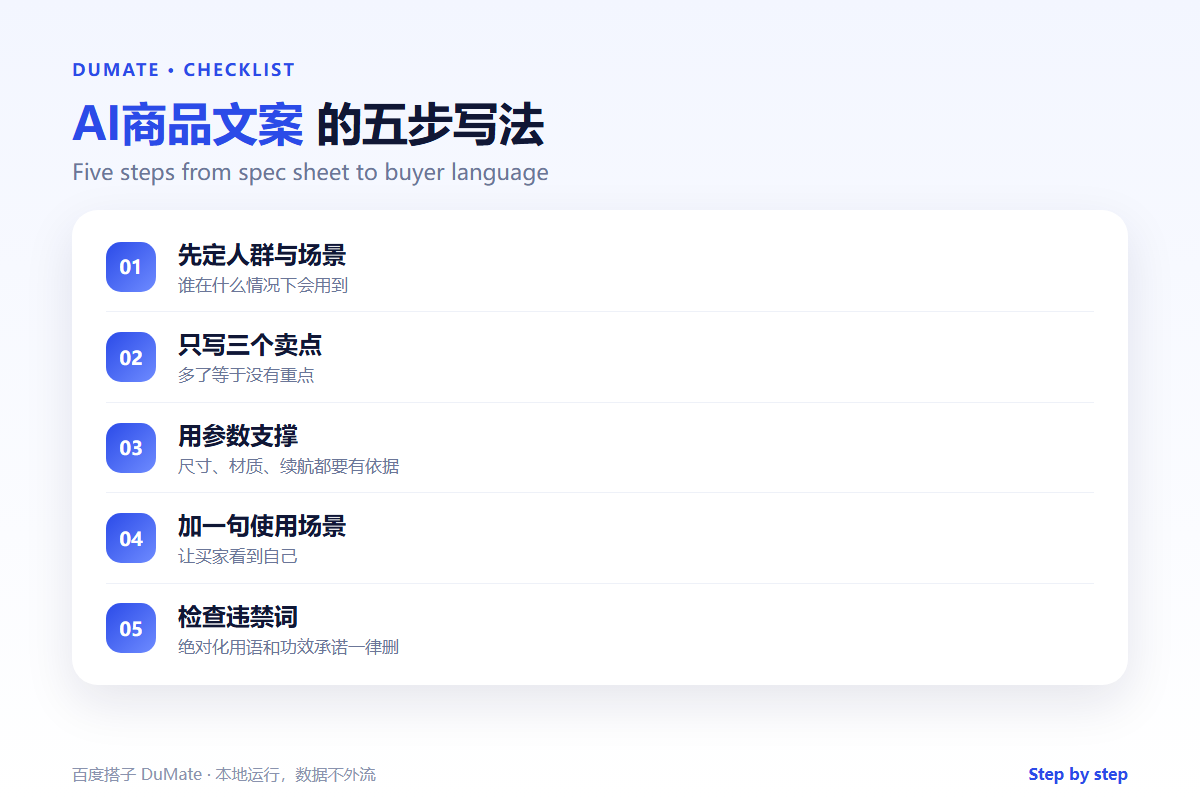
How AI商品文案 Works in Five Steps
Step 1: Define the buyer and the moment
Write one line: this is for a person who is doing what, and struggling with what. AI商品文案 should be given this line before any feature list.
Step 2: Choose three benefits
Pick the three that matter most to that buyer. For each, write the feature behind it. If a benefit has no feature, delete it. AI商品文案 tends to add more; the writer’s job is to cut.
Step 3: Support claims with specifications
Use numbers: capacity, weight, dimensions, battery life, material grade. Vague words such as premium or durable mean nothing without a reference. AI商品文案 should be instructed to include only verified specifications.
Step 4: Show the product in use
Add one sentence that places the product in a real scene. This is where the buyer sees themselves. AI商品文案 can draft it, but the scene must match the actual product.
Step 5: Run a compliance check
Remove absolute terms, medical claims, and guarantees the company cannot honor. Check platform rules for the category. AI商品文案 must be reviewed by a person before publishing.
A Product Copy Checklist
- The buyer and use case are explicit.
- No more than three main benefits.
- Every benefit has a specification.
- The scene matches the real product.
- Prohibited claims are removed.
Where AI商品文案 Fails
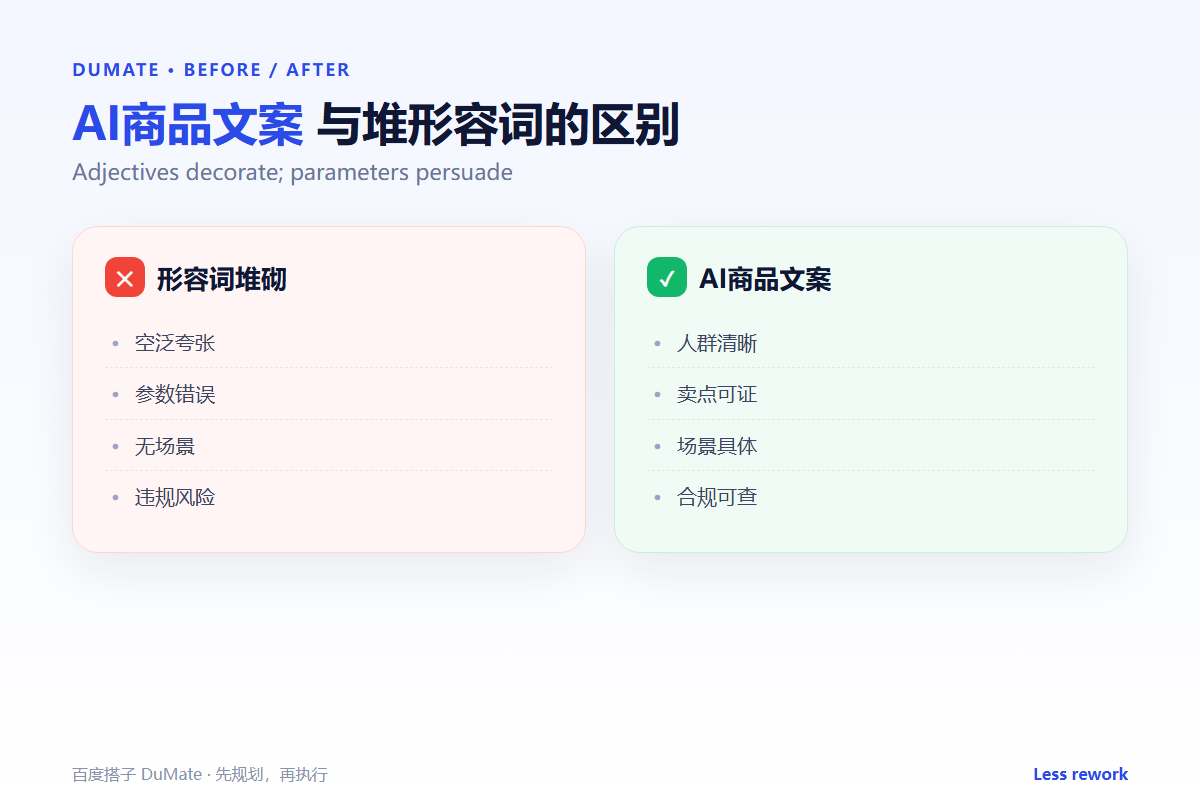
It fails when the source material is a feature list with no customer research. It also fails when it invents a use case that the product cannot support, which leads to returns and bad reviews. Finally, it fails when the copy is duplicated across variants without adjusting the details.
- Adjectives without evidence.
- Specifications copied from a different model.
- Scenes the product cannot deliver.
- Absolute claims that violate policy.
Before and After
Before, a listing described the product as high quality and easy to use, and shoppers asked the same three questions in the reviews. After, AI商品文案 led with the buyer, named three benefits, and attached a number to each. The questions moved from the reviews to the specification table, where they belong.
Good copy does not exaggerate. It removes uncertainty.
Used consistently, AI商品文案 becomes part of the normal review routine rather than a separate project.
A final check with AI商品文案 takes a minute and catches the errors that are easiest to miss.
Measuring Whether It Works
Measure AI商品文案 with three numbers: time spent, rework required, and output accepted without changes. Track them for four weeks before drawing a conclusion. Set a baseline from the manual process, because without a baseline any result looks like progress.
Time alone is misleading. A task that finishes faster but needs a full rewrite is not an improvement. Pair time with rework, and pair both with the quality of the final output. AI商品文案 should be compared with how the work was done before, not with an ideal.
Review the numbers monthly with the people doing the work. They know why a week was slow or why rework increased. AI商品文案 improves when the review includes the operators, not only the managers. Keep the dashboard small: three numbers and one note are enough.
Also record the exceptions. A week with an unusual campaign or a system outage is not a fair test. Note the context next to the numbers so a later reader does not compare incomparable weeks. When the numbers are stable, expand the scope; when they move the wrong way, fix the input before adding more use cases. The goal is not to prove that AI商品文案 works, but to know when it works and when it does not.
FAQ
How long should product copy be?
Long enough to answer the buying questions and short enough to scan. A short paragraph plus a specification list works for most categories.
Can I reuse copy across marketplaces?
Reuse the facts, rewrite the opening and the length. Each platform has its own rules and reading behavior.
What if the product has no measurable advantage?
Say what it is good for and what it is not. Honest positioning reduces returns more than invented superiority.
延伸阅读
For campaign messaging, see AI广告文案. Visual assets are covered in AI商品图生成 and AI海报设计. Use AI数据分析工具 to find which claims correlate with returns. For drafting style, read AI写作助手. External references: NIST AI Risk Management Framework and ISO/IEC 42001.
评论
还没有评论,来说两句吧。以下为本文的引用通告: