
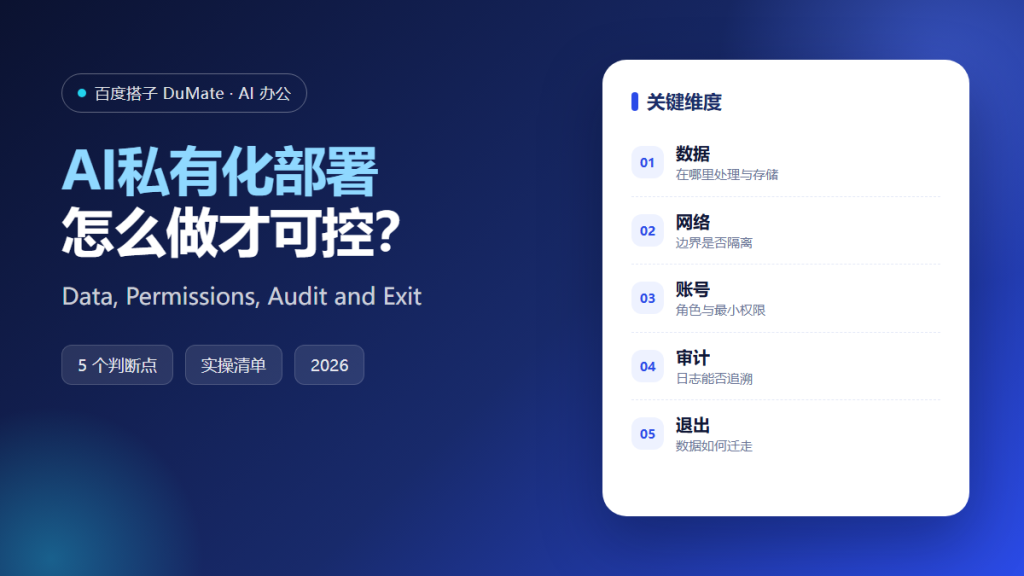
What AI私有化部署 Really Changes
AI私有化部署 is not just “install it on our servers”. It changes where data is processed, who can access it, how actions are logged, and how the system is removed when the contract ends. A team that answers only the first question ends up with a local box and the same governance gaps as before.
- Map every data path, including cloud calls.
- Define which folders may leave the network.
- Separate admin, department, and user roles.
- Log access and high-risk actions.
- Plan data export and deletion before rollout.
- Test the exit, not just the install.
The Five Questions of AI私有化部署
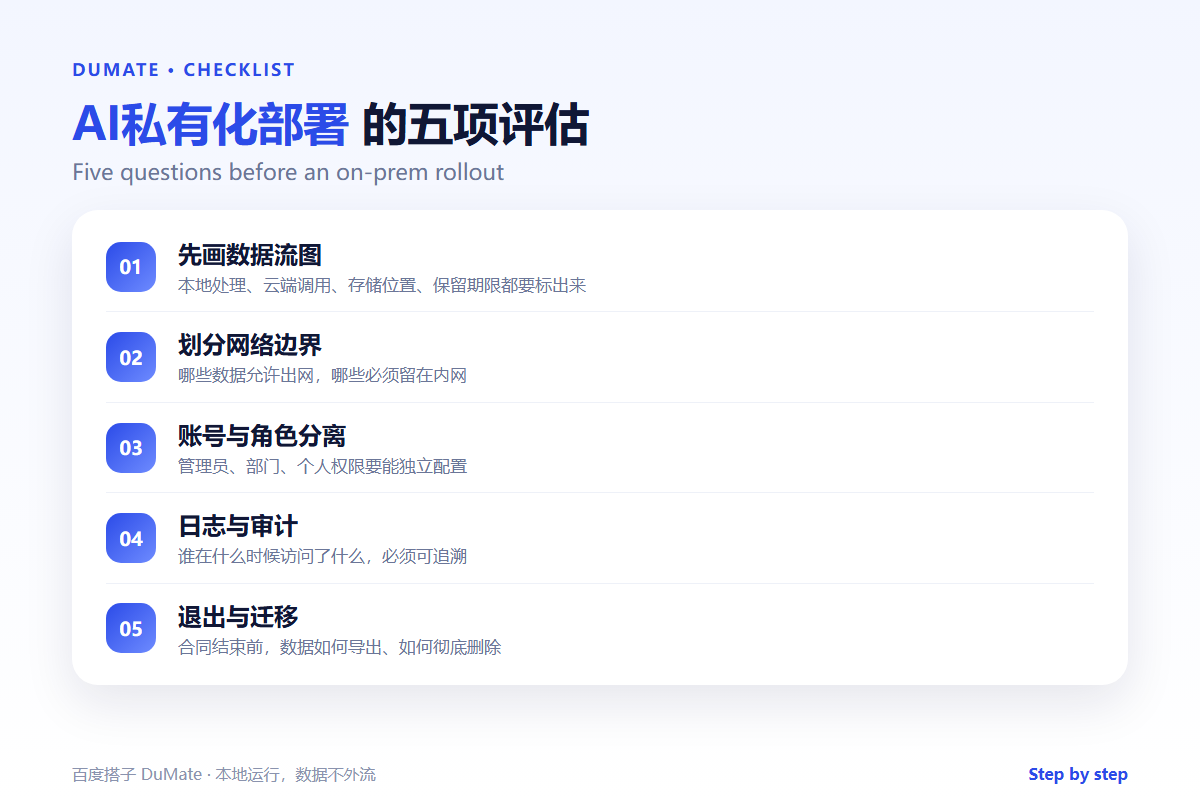
The evaluation should start with a data-flow diagram. It should show local processing, any external API calls, storage locations, and retention periods. If the vendor cannot provide the diagram, treat the answer as unknown. Unknown is a risk, not a feature.
- Where is data processed and stored?
- Which network boundaries are enforced?
- How are roles and permissions separated?
- What is logged, and for how long?
- How does data leave the system at exit?
Data paths include the small calls
A local client may still call a cloud model, a license server, or a telemetry endpoint. AI私有化部署 has to account for each one. List the destinations, the data sent, and the purpose. Then decide whether each call is acceptable under your policy.
Permissions and Audit
Role separation is the core control. An admin should be able to grant a department access to one knowledge base without exposing another. Shared accounts destroy accountability. Review permissions quarterly, and remove access when a project ends.
| Control | Question | Evidence |
|---|---|---|
| Identity | Can SSO or directory groups be used? | Admin console demo |
| Folder access | Can permissions follow existing folders? | Role matrix |
| Actions | Are deletes and sends confirmed? | Policy and logs |
| Audit | Who accessed what, and when? | Sample export |
Audit logs are only useful if someone reads them. Define the events that matter: permission changes, bulk exports, failed logins, and destructive actions. Then set a review cadence. An AI私有化部署 without an audit routine is a black box with a local IP address.
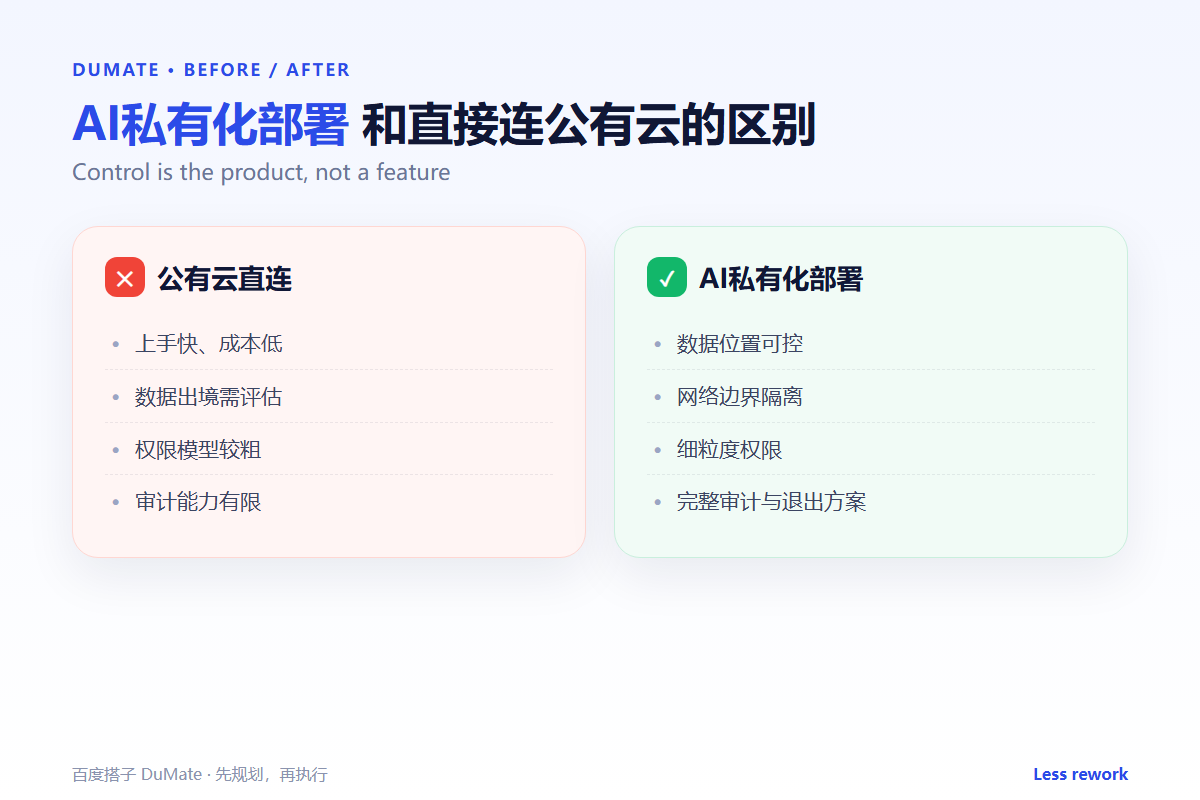
Public Cloud vs AI私有化部署
Public cloud is faster to start and easier to scale. Private deployment offers more control, but it shifts operational work to your team. The right choice depends on data sensitivity, regulatory obligations, and the cost of downtime. A hybrid model is common: sensitive data stays local, while low-risk tasks use a cloud service.
Do not treat the decision as permanent. Revisit it when the data classification changes or the vendor updates its architecture. The 本地AI助手 guide explains the local-processing baseline, while the 企业AI助手 rollout guide covers procurement questions.
Exit is part of the design
Ask how data is exported, in what format, and how deletion is verified. A vendor that cannot answer the exit question has not finished the design. For an AI私有化部署, the exit plan should include the model, the index, the logs, and any fine-tuned artifacts.
Common Mistakes
Teams often mistake “local” for “secure”. Local systems still have misconfigured permissions, unpatched services, and unprotected backups. Others forget the human process: who approves a new connector, who reviews logs, who owns the knowledge base. Technology alone does not create control.
- Assuming local means no data leaves.
- Giving every user admin rights.
- Turning on logging without a review routine.
- Ignoring backups and disaster recovery.
- No exit or deletion test.
FAQ
Is AI私有化部署 required for sensitive data?
Often it is the safer option, but the requirement depends on your legal and regulatory context. Document the decision and the controls either way.
Does it cost more?
Usually. You trade subscription simplicity for infrastructure and operations. Compare the total cost, including staff time and upgrades.
Can we start small?
Yes. Begin with one department and one data class, then expand after the audit and exit plans are proven.
References
评论
还没有评论,来说两句吧。