
What Makes an AI知识库 Useful
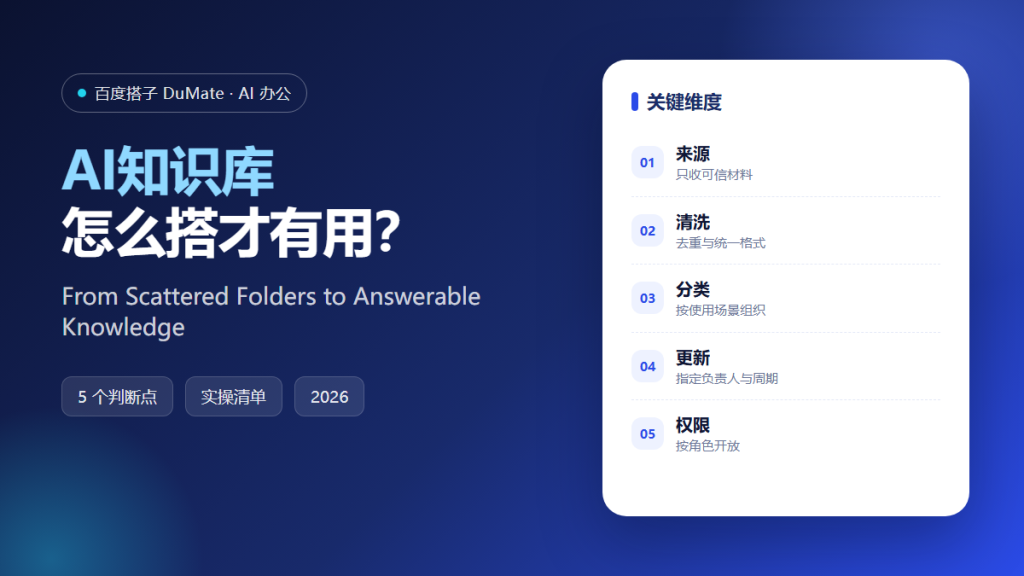
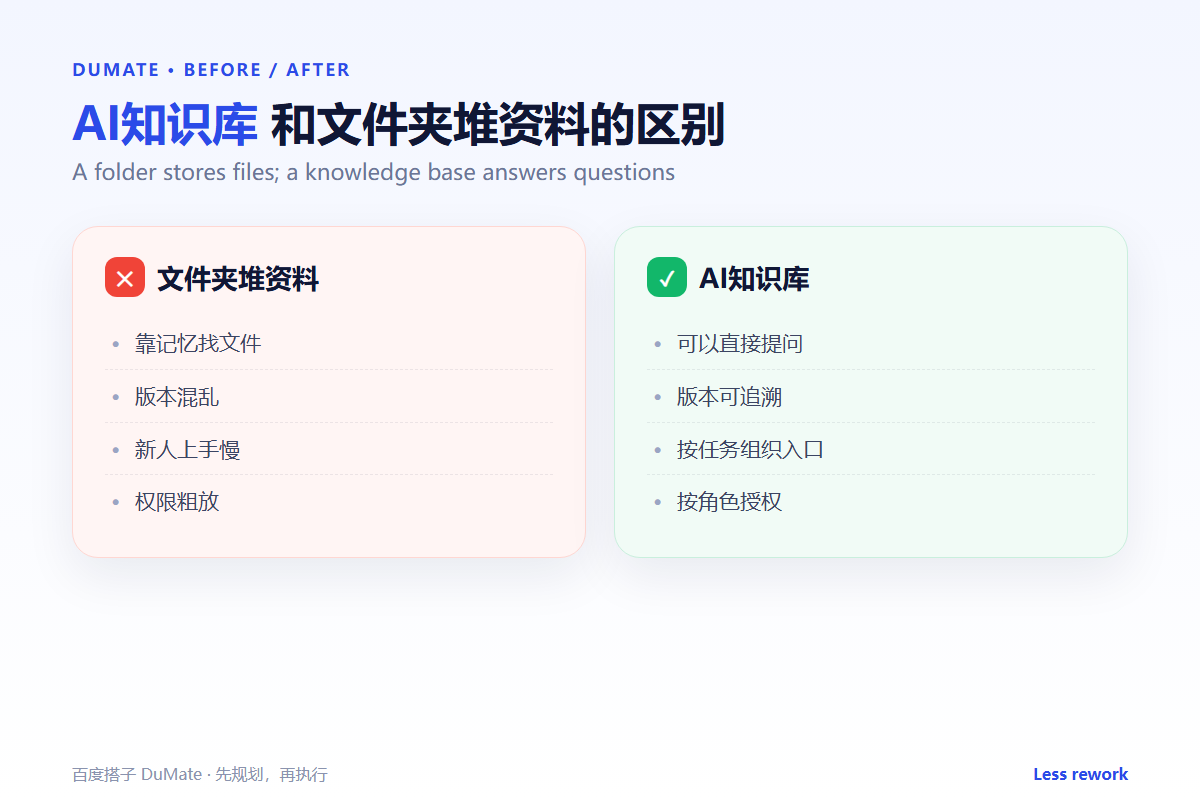
An AI知识库 is not a folder with a search box. It is a curated set of sources that can answer questions with a traceable reference. The difference matters when a new colleague asks how to submit an expense report: a folder makes them guess which file is current, while an AI知识库 points to the approved policy and the date it changed.
- Every answer should link to a source.
- Each section needs an owner and an update cycle.
- Organize by task, not by department.
- Remove duplicates before adding volume.
- Set permissions by role, not by convenience.
- Review outdated content on a schedule.
The Five-Step AI知识库 Build
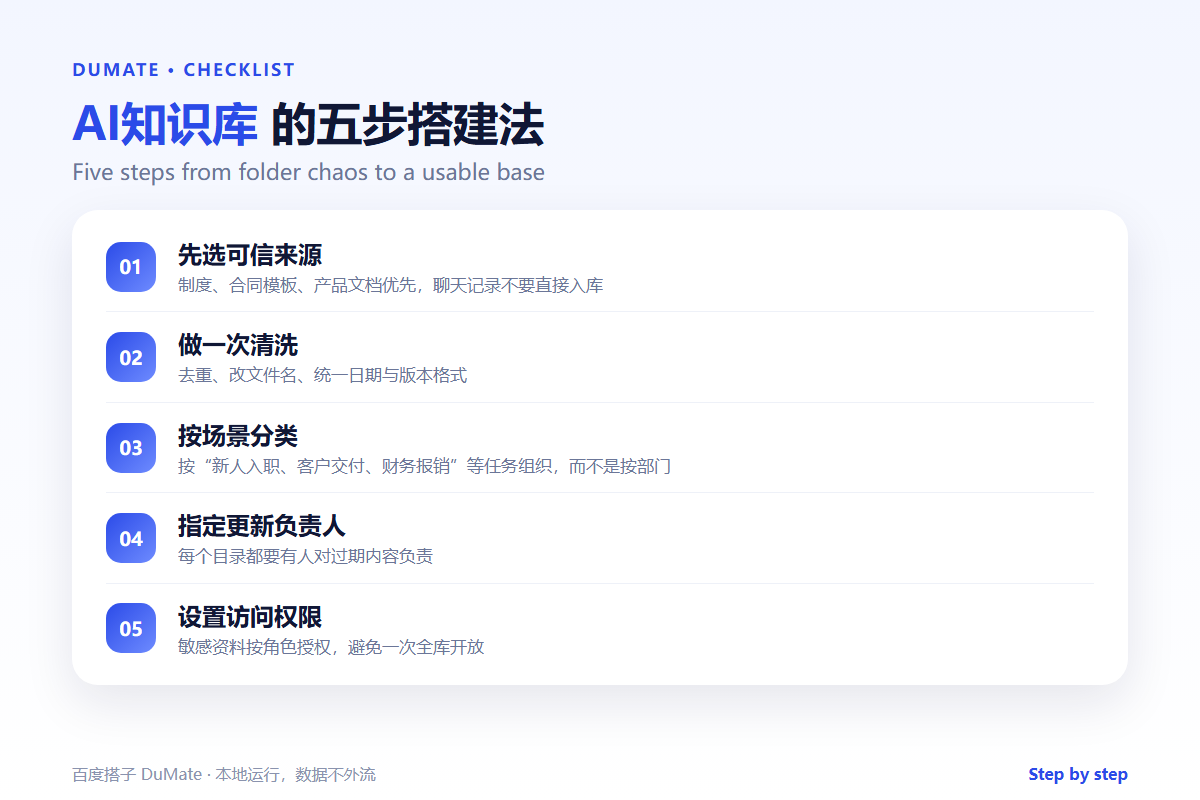
The build starts with a narrow scope. Pick one workflow, such as onboarding or customer delivery, and collect the documents people actually open. This avoids the common failure where a team uploads everything and creates a second, messier archive.
- Choose trusted sources for one workflow.
- Clean names, dates, and duplicate versions.
- Group content by the task it supports.
- Assign an owner and a review cycle.
- Set access rules and test with real questions.
Sources decide the ceiling
An AI知识库 cannot be more reliable than its inputs. Policies, approved templates, product documentation, and signed contracts are good sources. Chat logs, personal notes, and outdated slides are not, unless they are cleaned and labeled. The first question is therefore not “which tool?” but “which documents do we trust?”
Organize by Task, Not by Department
Department folders mirror the org chart, not the work. A person looking for a contract needs the template, the approval rule, and the signature process, even if those live in three teams. Task-based sections reduce that friction and make the AI知识库 easier to navigate.
| Task section | What belongs there | Owner |
|---|---|---|
| New hire | Accounts, policies, first-week checklist | People team |
| Customer delivery | Templates, acceptance forms, FAQs | Delivery lead |
| Finance | Expense rules, approval limits, forms | Finance lead |
| Security | Access rules, incident steps, contacts | Security lead |
This structure also gives the AI知识库 a clean evaluation set. Ask five real questions from each section; if the answers are wrong or unsupported, the sources need work, not a new prompt. The AI自动整理文件 workflow is a practical first step before ingestion.
Updates, Versions and Permissions
Knowledge decays. A policy changes, a price list expires, a product feature is renamed. Without an owner, the AI知识库 becomes a museum of old answers. Set a monthly review for high-change sections and a quarterly review for stable ones. Mark the last reviewed date where users can see it.
Permissions are the second control. A single shared account destroys accountability. Role-based access lets a team open its own section without exposing another. For enterprise deployments, the 企业AI助手 rollout guide covers the governance questions in more detail.
Test the AI知识库 with unanswered questions
The best test is a question the base cannot answer. Does it say “I do not know” and show the nearest source, or does it invent a policy? A trustworthy AI知识库 admits gaps. That behavior is more valuable than a confident wrong answer.
Common Failure Modes
Most knowledge projects fail for organizational reasons, not technical ones. Nobody owns the content, nobody removes old versions, and nobody checks the answers. The tool then gets blamed for a data problem. Avoid this by treating the AI知识库 as a product with a roadmap, not as a one-time upload.
- Uploading everything without a scope.
- Keeping three versions of the same policy.
- Letting chat logs become official sources.
- Giving everyone admin access.
- Never reviewing the top queries.
FAQ
How many documents do I need to start an AI知识库?
Start with one workflow and twenty to fifty trusted documents. A small, clean base beats a large, inconsistent one.
Can it replace a search tool?
They solve different problems. Search finds files; an AI知识库 answers questions and cites the source. The AI文件搜索 guide covers retrieval.
Should the base be local?
For sensitive policies or customer data, use an approved local or private deployment and enforce folder-level permissions.
References
Related reading: AI文件搜索 怎么用.
评论
还没有评论,来说两句吧。以下为本文的引用通告: