
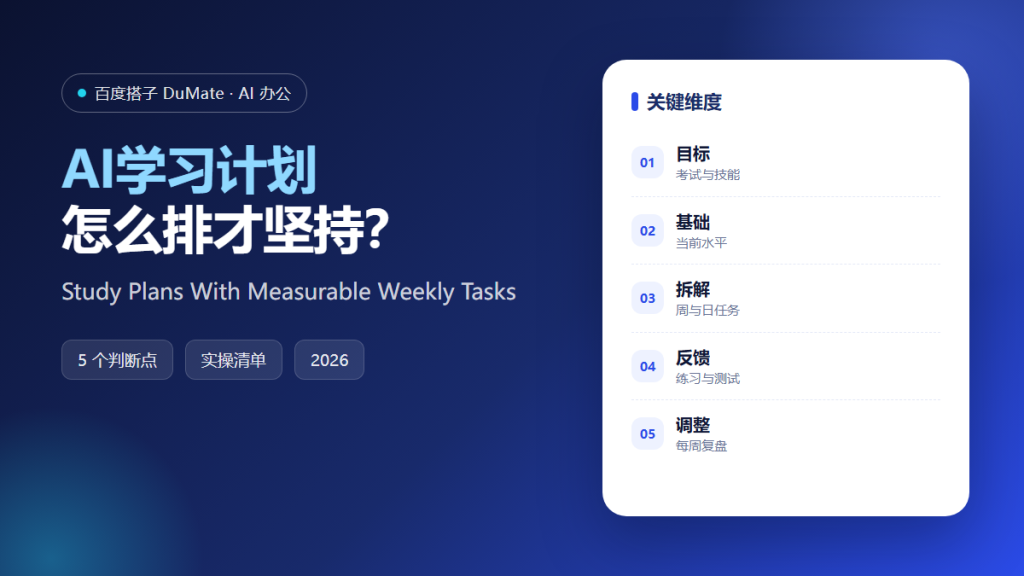
AI学习计划 fails when it produces a beautiful schedule that nobody follows. The usual reason is that the plan is built around content to consume rather than tasks to complete. A useful plan fits into a real week and survives a busy Wednesday.
This guide covers a five-step planning method, the practice rhythm that makes progress visible, and the weekly review that adjusts the plan before it collapses.
Key Takeaways
- Set one measurable goal.
- Assess the current level honestly.
- Plan weekly tasks, not daily hours.
- Practice more than you read.
- Review and adjust every week.
Why AI学习计划 Needs Measurable Goals
Understand a topic is not a goal. Pass an exam, build a working prototype, or hold a ten-minute conversation are goals. AI学习计划 can organize content for either, but only the measurable version tells you when to stop or change course.
The second reason is time. A plan that assumes two free hours a day will fail in the first busy week. AI学习计划 should start from the time actually available.
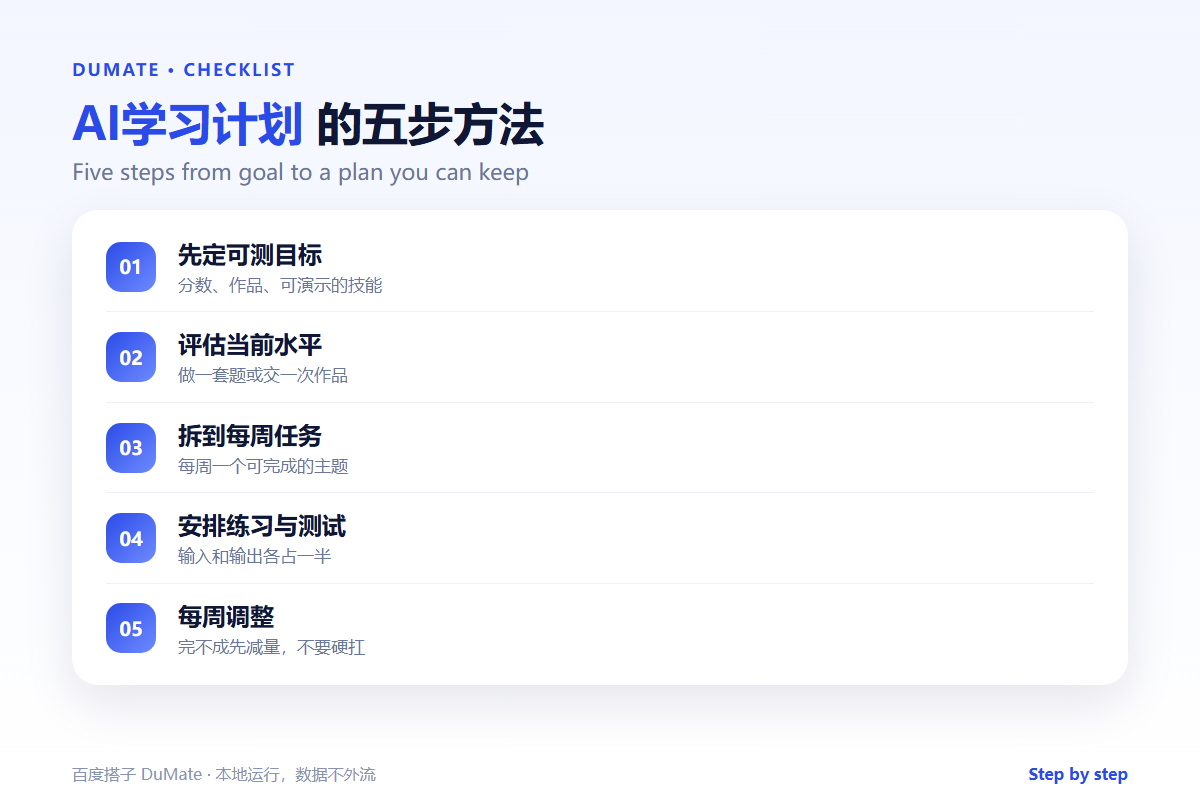
How AI学习计划 Works in Five Steps
Step 1: Define the outcome
Write what you will be able to do, and how it will be checked. AI学习计划 should use this outcome as the filter for every task.
Step 2: Assess the starting point
Take a test, review a sample, or complete a small project. The gap between the current level and the goal determines the plan. AI学习计划 can design the assessment.
Step 3: Break into weekly tasks
Give each week one theme and one deliverable. Keep the daily load flexible. AI学习计划 should leave one buffer day per week.
Step 4: Practice and test
Spend at least half the time producing something: exercises, notes, code, or conversation. AI学习计划 can generate practice sets and review questions.
Step 5: Review weekly
Ask what was completed, what was skipped, and why. Adjust the next week rather than abandoning the plan. AI学习计划 improves when the review is honest.
A Study Plan Checklist
- The goal is measurable.
- The starting level is assessed.
- Each week has one deliverable.
- Practice takes at least half the time.
- A buffer day exists.
Where AI学习计划 Fails
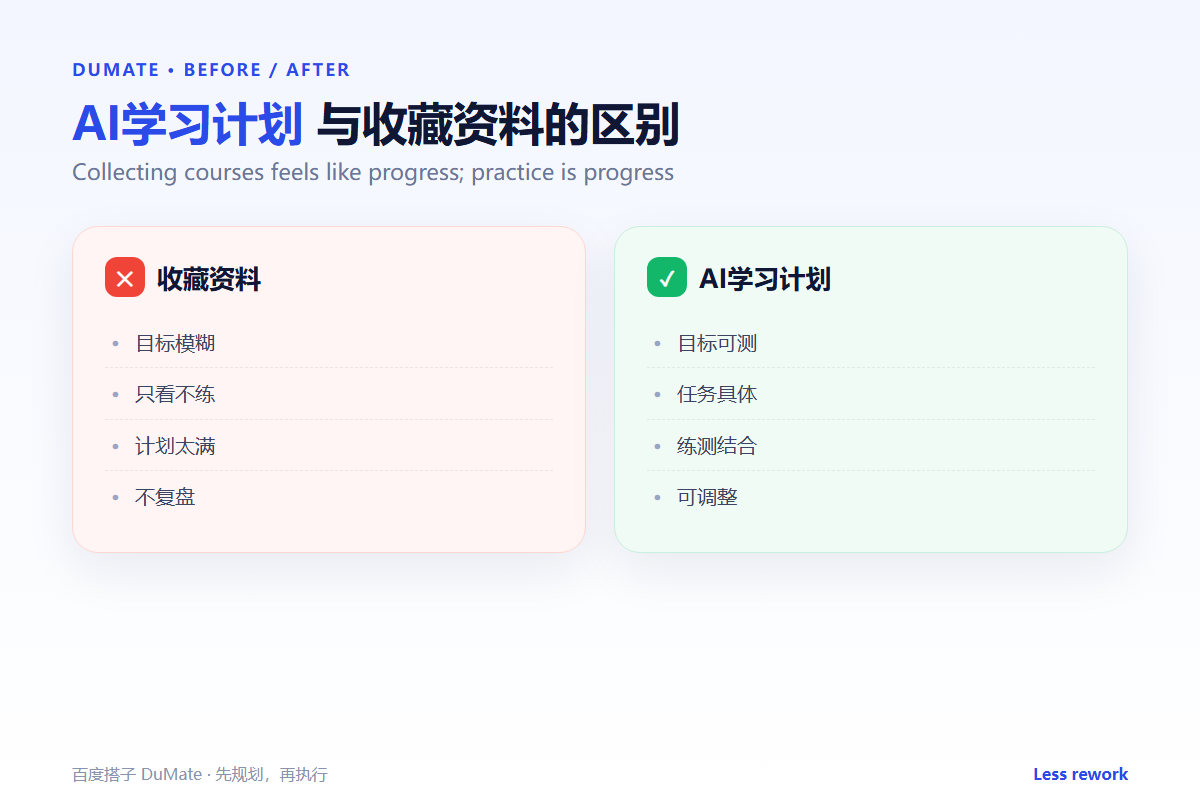
It fails when it fills every hour, leaving no room for work and life. It also fails when it counts reading as practice, which creates familiarity without skill.
- Plans that assume perfect weeks.
- Too many resources.
- No testing.
- No review or adjustment.
Before and After
Before, a learner collected twelve courses and finished none. After, AI学习计划 set one outcome, one weekly deliverable, and a buffer day, and the learner completed eight weeks without falling behind.
A plan is a tool for keeping promises to yourself. It should be small enough to keep.
Used consistently, AI学习计划 becomes part of the normal review routine rather than a separate project.
A final check with AI学习计划 takes a minute and catches the errors that are easiest to miss.
A Four-Week Rollout
The first week with AI学习计划 should be a small pilot, not a team-wide launch. Choose one recurring task with a clear output and run it end to end. Keep the sample small enough to check by hand. The point is to see where AI学习计划 saves time and where it creates review work.
During the pilot, keep a short log of inputs, outputs, and corrections. Record the time spent before and after. AI学习计划 feels faster even when it is not, so the log matters. At the end of the week, review the log with one colleague and decide whether to continue, change the input, or stop.
In week two, write a one-page standard for input and output. Include what must be checked and who approves the result. AI学习计划 works better when the standard is visible to everyone. In week three, add permissions and a review step. In week four, compare the results and write a short guide. That guide is what makes AI学习计划 survive after the first month.
Keep the pilot narrow. A broad rollout hides which step failed, and a narrow one shows exactly where the workflow needs help. Expand only after the narrow case is stable.
Keep the first month simple. One task, one owner, and one weekly review are enough to prove the workflow before it spreads across the team.
Write down what changed after each run. A short note is easier to trust than a memory, and it makes the next improvement obvious.
Review the output before it leaves your desk. A two-minute check catches most of the errors that would otherwise come back as questions.
Keep one example of a good result. New team members learn faster from a concrete reference than from a long explanation.
The first version does not need to be perfect. It needs to be complete enough to review, so the team can see the gaps and fix them in the next round.
FAQ
How many hours a week do I need?
Start with the time you actually have. Five focused hours beat fifteen planned hours that never happen.
Should I follow one resource?
Choose one main resource and use others for reference. Switching wastes time.
What if I fall behind?
Reduce the scope of the week, not the number of weeks. Consistency matters more than coverage.
延伸阅读
For drafting notes, see AI写作助手. Organize material in an AI知识库. For tasks, read AI待办事项. Tool selection is in AI效率工具. Presentation is covered in AI生成PPT. External references: NIST AI Risk Management Framework and ISO/IEC 42001.
评论
还没有评论,来说两句吧。以下为本文的引用通告: