

Most course outlines are assembled from topics the instructor enjoys teaching, arranged in the order the textbook presents them. The result covers the subject and changes very little. A course is judged by what a learner can do on Friday that they could not do on Monday, and that sentence should be written before the first chapter is chosen. AI课程大纲 helps when it works backwards from that sentence.
What follows is a working sequence for AI课程大纲, from the outcome statement to a timed pilot, together with the checks that reveal whether the design holds.
Key Takeaways
- Write the outcome as an observable task with a standard.
- AI课程大纲 should place the final assessment before the content.
- Each module carries one capability and one prerequisite.
- Time every activity, including the feedback.
- Pilot one module with six learners before building the rest.
Why AI课程大纲 Needs an Observable Outcome
Understanding cannot be observed, so it cannot be assessed or taught precisely. A statement such as explain the difference between two contract types is observable, and it implies a task, a standard, and a set of examples. AI课程大纲 built on verbs of that kind gives every later decision a reference point, including what to leave out.
Assessment alignment follows. If the final test asks learners to recall definitions, they will memorize definitions, whatever the outline claims. Writing the assessment early forces the designer to decide what performance matters, and the content then organizes itself around practice rather than around coverage. The order of chapters stops being a matter of taste.
Time is the third constraint. A ninety-minute session holds roughly forty minutes of new input once questions, transitions, and a break are counted. An outline that lists twelve topics for that session is a wish, not a plan. AI课程大纲 becomes honest when each objective carries an estimated minutes figure, because the total either fits or it does not.
How AI课程大纲 Works in Five Steps
Step 1: Write one outcome sentence
Complete this line: by the end, a learner can do something, to a stated standard, without help. Keep it to one sentence and one task. If two tasks appear, the course is probably two courses, and splitting it early prevents a crowded middle.
Step 2: Design the final assessment
Write the task learners will perform and the rubric a reviewer will apply. Include the conditions: time allowed, materials permitted, and what counts as a pass. AI课程大纲 should copy the rubric language into each module, so practice and grading use the same words.
Step 3: Chunk into four to six modules
Give each module one capability that the next module assumes. Order them by dependency rather than by topic similarity, and name the prerequisite at the top of each. A module that cannot state its prerequisite is usually a lecture rather than a step.
Step 4: Time every activity
Assign minutes to input, guided practice, independent practice, and feedback. Keep input below half of the session. AI课程大纲 should show the arithmetic, because a plan that totals ninety-five minutes for a ninety-minute class will lose the feedback block first, and feedback is where learning consolidates.
Step 5: Pilot one module
Run the first module with six learners and record where they stop. Note the moment the exercise needs a hint, and the question nobody asks. Revise the instructions, then run it again with a second group before writing the remaining modules. AI课程大纲 earns its confidence from that second run, not from the first.

A Design Checklist for AI课程大纲
- The outcome names a task, a standard, and a condition.
- The rubric exists before the reading list.
- Every module has one capability and one prerequisite.
- Minutes add up to the session length, with feedback included.
- AI课程大纲 is revised after a pilot, not after a semester.
Where AI课程大纲 Fails
It fails when coverage is mistaken for design. An outline that lists everything the field contains gives the learner a tour and no practice. AI课程大纲 also fails when the assessment is written last, because the test then measures whatever the content happened to include.
- Objectives written with verbs nobody can observe.
- Twelve topics scheduled for a two-hour session.
- Exercises that test recall instead of performance.
- No prerequisite, so half the room is lost in module two.
Before and After
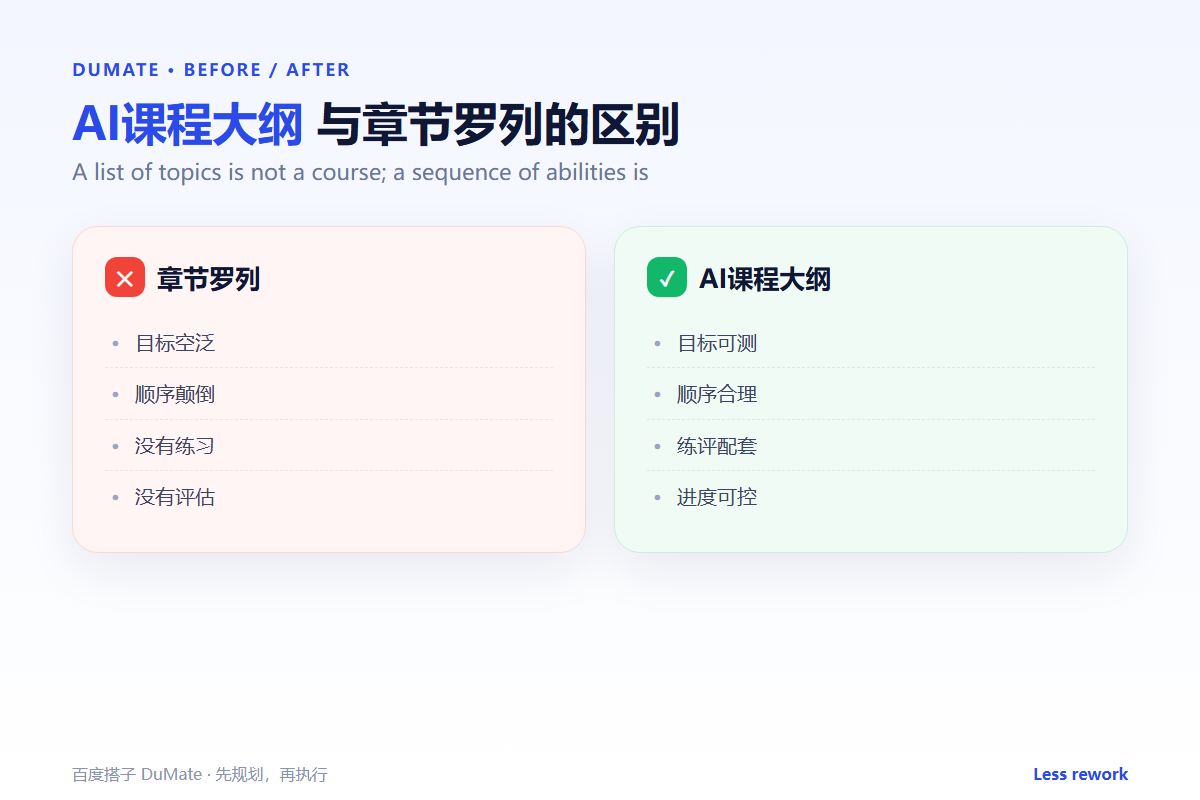
Before, a compliance course ran for two days and covered nineteen topics. The final quiz asked learners to select definitions, and the pass rate was high. Three months later, only four of thirty staff could complete the required report correctly.
After, AI课程大纲 set one outcome, produce a complete incident report within forty minutes, and built four modules around it. The assessment became the report itself, graded with a six-line rubric. The course ran for one day, and twenty-three of thirty staff passed on the first attempt.
FAQ
How many outcomes should a course have?
One primary outcome, with two or three supporting capabilities inside it. More than that usually means the course is trying to serve different audiences at once.
Can AI课程大纲 write the exercises?
It can draft them, but a subject expert must test each one. An exercise that looks reasonable on paper often fails when a learner tries it without the missing context.
How long should a module be?
Short enough to finish in one sitting, usually forty-five to ninety minutes. A module that needs a break in the middle should become two modules with a clear boundary and a short recap at the start of the second.
延伸阅读
Turn the outline into sessions with lesson plan and build the materials in courseware making. Use question bank for aligned practice, training material design for workplace programs, and study plan to pace learners between sessions. External references: NIST AI Risk Management Framework and ISO/IEC 42001.
评论
还没有评论,来说两句吧。