

AI培训材料 usually fails for the same reason corporate slides fail: it describes the organization instead of teaching a task. A new hire does not need a tour of every department. They need to complete five tasks correctly by Friday. Material designed around tasks is shorter, faster to produce, and far more likely to change behavior.
This guide covers the five-step method for building training that people can use, the practice design that makes it stick, and the maintenance habits that keep it current.
Key Takeaways
- Define what learners must do, not what they must know.
- Organize by workflow, not by department.
- Use real examples from the team.
- Add practice with feedback.
- Version the material with the process.
Why AI培训材料 Should Start With Tasks
A learning objective such as understand our approval process is hard to test and easy to forget. A task objective such as submit an approval request with the correct cost center is testable and immediately useful. AI培训材料 can generate explanations quickly, which makes it tempting to produce more content than learners need.
Task-based design fixes that temptation. Each module answers one question: what will the learner be able to do after this? If the answer is vague, the module is not ready. If the answer is specific, the assessment writes itself.
The second benefit is speed of onboarding. New hires can start with the tasks they need this week and learn the rest later. That sequencing reduces anxiety and gets work done sooner.
How AI培训材料 Works in Five Steps
Step 1: Define the audience and the outcome
Write one sentence: after this module, a new hire can do X without help. Different audiences need different starting points, so do not combine new hires and experienced staff in one track.
Step 2: Map the workflow
List the steps in the order the work happens. Include the inputs, the system, the approval, and the output. AI培训材料 should follow the process, not the org chart, because learners experience the process.
Step 3: Write with real examples
Use anonymized tickets, documents, and screenshots from actual work. Real examples carry the details that generic examples miss, such as which field people usually get wrong. This is where AI培训材料 becomes credible.
Step 4: Add practice and feedback
Give learners a scenario and ask them to complete it. Provide a model answer and a short checklist for self-review. Practice is what turns reading into skill, and it is the part most training programs skip.
Step 5: Version and maintain
Put a date and an owner on every module. Review it when the process changes. AI培训材料 that is not maintained becomes a source of outdated instructions, which is worse than no material at all.

A Module Template
- One task outcome in one sentence.
- Five to seven workflow steps with screenshots.
- One worked example and one practice scenario.
- A short self-check list.
- Owner, date, and change log.
Where AI培训材料 Fails
It fails when it explains everything and teaches nothing. It also fails when the examples are too clean, because real work has exceptions. Finally, it fails when there is no practice, since reading creates familiarity rather than competence.
- Objectives that cannot be assessed.
- Slides with no workflow.
- No practice or feedback.
- Material that is never updated.
Before and After
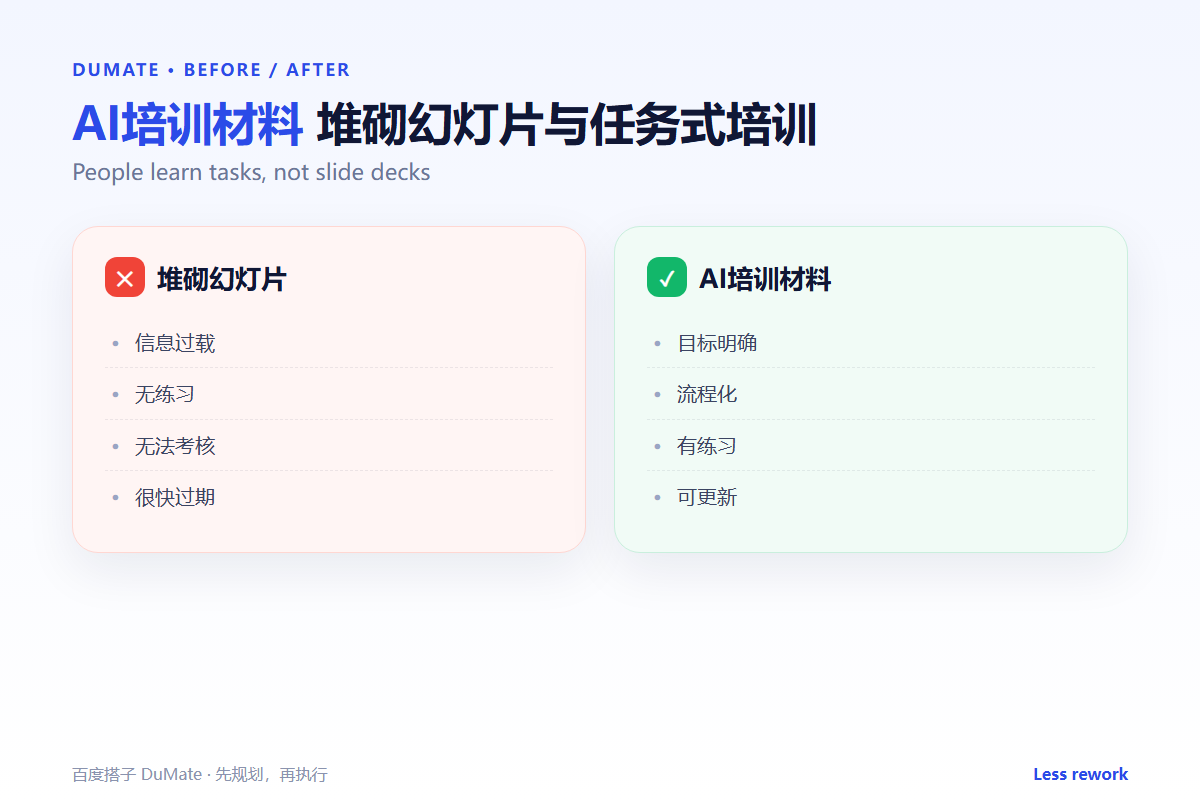
Before, onboarding was a two-hour slide deck and a folder of PDFs. New hires asked the same five questions for a month. After, AI培训材料 is organized into five task modules with practice scenarios, and new hires complete real work in the first week. The same questions still appear, but the material answers them before anyone has to ask.
Good training is not a performance. It is a transfer of capability, and capability is visible in what people can do without help.
Keep a short feedback loop. After each cohort, ask which module was confusing and which example was unrealistic. Update the AI培训材料 within a week, while the feedback is specific. Small, frequent edits keep the material alive far better than an annual rewrite.
Measure transfer, not satisfaction. A smiling learner is not evidence of skill. Use a short task after each module, and check whether the learner can complete it without help. That result tells you whether the AI培训材料 did its job.
Keep a list of the questions learners ask most often. Each repeated question is a gap in the material. Add the answer to the AI培训材料, and tell the mentor to stop answering it verbally, so the knowledge lands in the shared document.
Pair every module with a short job aid: a one-page checklist that people can use while working. The AI培训材料 teaches the task; the job aid supports it on a busy day. Together they reduce the gap between training and practice.
Finally, connect each module to a real deliverable. A learner who produces a correct ticket, report, or checklist has evidence of transfer. That artifact is more convincing than a quiz, and it gives the AI培训材料 a clear success criterion. When the deliverable is correct, the AI培训材料 worked; when it is not, the module needs another example or another practice round.
FAQ
How long should a module be?
Fifteen to twenty minutes of reading plus thirty minutes of practice. Longer modules are usually two modules.
Can AI培训材料 replace a mentor?
No. It replaces the repetitive explanations, which frees the mentor for judgment and context.
How often should we update it?
Whenever the process changes, and at least once a quarter. Put the review date on the first page.
延伸阅读
Turn modules into slides with AI生成PPT. Keep material searchable in an AI知识库. Improve the writing with AI写作助手. Package repeatable lessons as AI技能. Record walkthroughs with AI会议纪要. External references: NIST AI Risk Management Framework and W3C Web Accessibility Initiative.
评论
还没有评论,来说两句吧。