
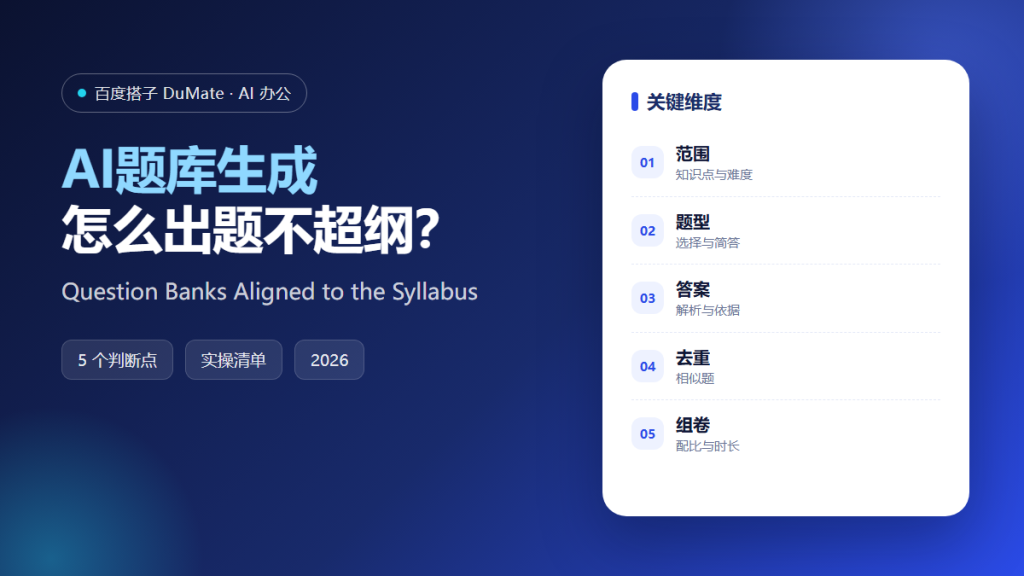
AI题库生成 is easy to do badly. A model can produce a hundred questions in a minute, including duplicates, ambiguous wording, and answers that are subtly wrong. A question bank is a measurement instrument, and a bad instrument produces confident wrong conclusions.
This guide covers a five-step generation process, the checks that catch bad items, and the assembly rules that produce a balanced paper.
Key Takeaways
- Map questions to knowledge points.
- Set a difficulty ratio before generating.
- Require an explanation for every answer.
- Deduplicate and review.
- Assemble by blueprint, not by feel.
Why AI题库生成 Needs a Blueprint
A bank without a blueprint drifts toward easy recall questions, because they are easy to generate. The result looks comprehensive and tests little. AI题库生成 should work from a table of knowledge points, question types, and target difficulty.
The second reason is fairness. Two papers used in the same term should cover the same objectives with comparable difficulty. A blueprint makes that comparison possible.
How AI题库生成 Works in Five Steps
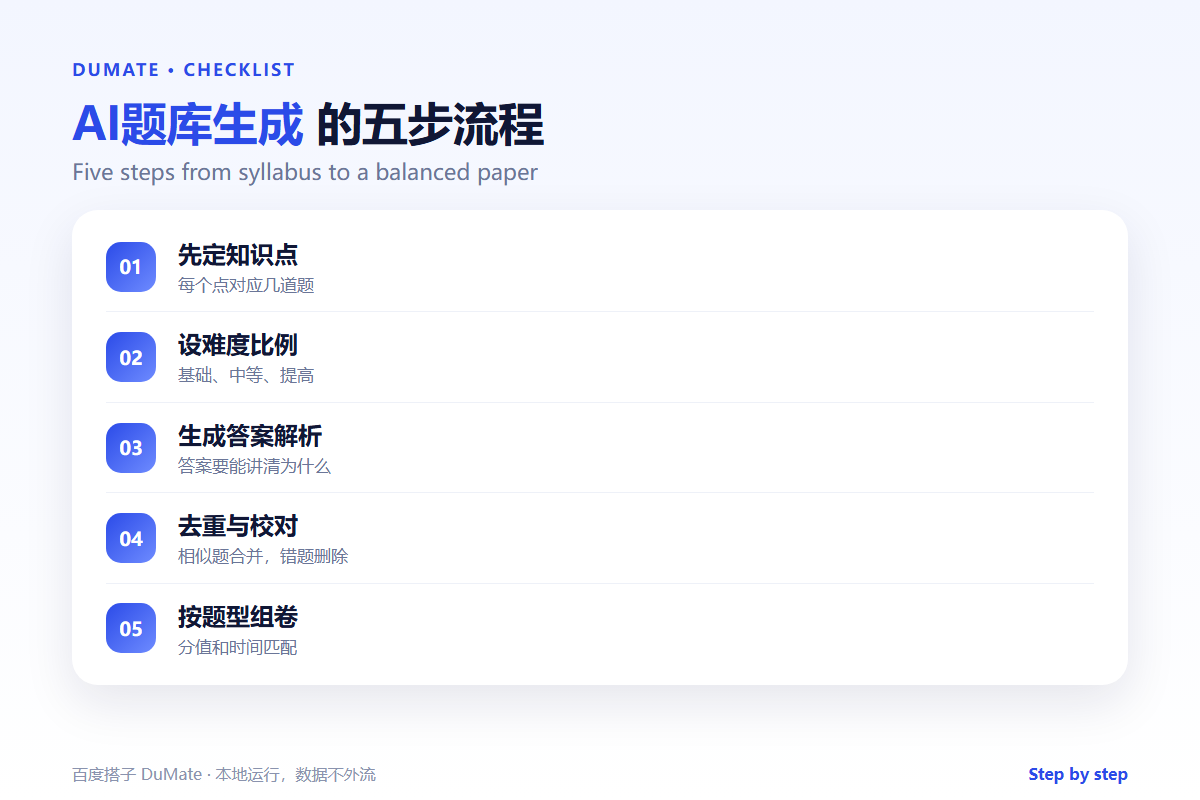
Step 1: Map the knowledge points
List the objectives and the number of questions for each. AI题库生成 should tag every item with a knowledge point.
Step 2: Set the difficulty mix
Decide the share of basic, medium, and advanced items. Generate to that ratio. AI题库生成 can estimate difficulty, but a teacher should confirm.
Step 3: Require explanations
Every answer needs a reason and, where relevant, a reference. An answer key without explanations cannot be reviewed. AI题库生成 should produce the explanation with the item.
Step 4: Deduplicate and review
Remove near-duplicates and fix ambiguous wording. Read each item aloud to catch double meanings. AI题库生成 can flag similarity, but a person must approve.
Step 5: Assemble by blueprint
Build the paper from the blueprint, then check the total score and time. AI题库生成 can produce multiple versions with the same structure.
A Question Bank Checklist
- Every item maps to an objective.
- The difficulty ratio is met.
- Answers have explanations.
- Duplicates are removed.
- The paper matches the blueprint.
Where AI题库生成 Fails
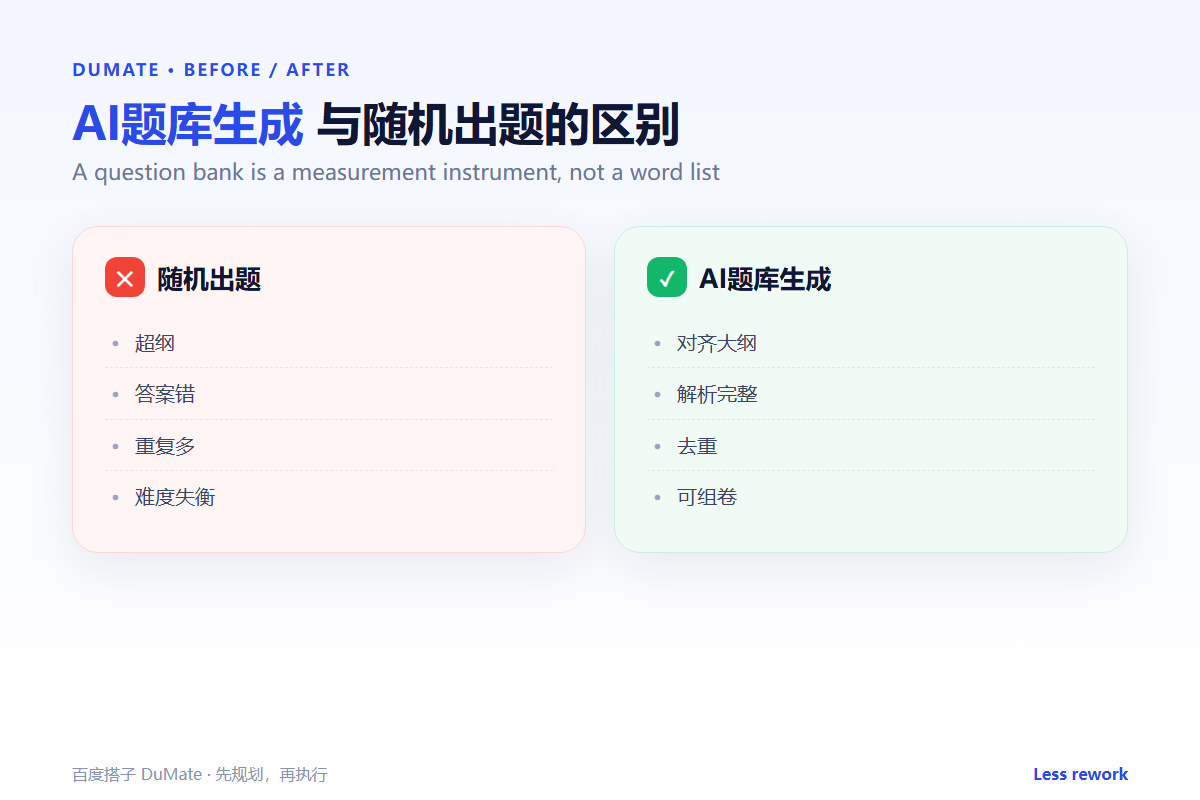
It fails when the prompt asks for questions without specifying the level or the source. It also fails when the explanation is a restatement of the answer rather than a reason.
- Ambiguous wording.
- More than one defensible answer.
- Difficulty labels that are guesses.
- Items that test trivia.
Before and After
Before, a teacher generated a hundred questions and spent two days fixing duplicates and unclear options. After, AI题库生成 used a blueprint and produced sixty items with explanations, and the review focused on quality rather than cleanup.
Volume is not the value. Alignment is.
Used consistently, AI题库生成 becomes part of the normal review routine rather than a separate project.
A final check with AI题库生成 takes a minute and catches the errors that are easiest to miss.
The same AI题库生成 routine works for small tasks and large ones, which is why teams keep using it.
A Four-Week Rollout
The first week with AI题库生成 should be a small pilot, not a team-wide launch. Choose one recurring task with a clear output and run it end to end. Keep the sample small enough to check by hand. The point is to see where AI题库生成 saves time and where it creates review work.
During the pilot, keep a short log of inputs, outputs, and corrections. Record the time spent before and after. AI题库生成 feels faster even when it is not, so the log matters. At the end of the week, review the log with one colleague and decide whether to continue, change the input, or stop.
In week two, write a one-page standard for input and output. Include what must be checked and who approves the result. AI题库生成 works better when the standard is visible to everyone. In week three, add permissions and a review step. In week four, compare the results and write a short guide. That guide is what makes AI题库生成 survive after the first month.
Keep the pilot narrow. A broad rollout hides which step failed, and a narrow one shows exactly where the workflow needs help. Expand only after the narrow case is stable.
Keep the first month simple. One task, one owner, and one weekly review are enough to prove the workflow before it spreads across the team.
Write down what changed after each run. A short note is easier to trust than a memory, and it makes the next improvement obvious.
Review the output before it leaves your desk. A two-minute check catches most of the errors that would otherwise come back as questions.
Keep one example of a good result. New team members learn faster from a concrete reference than from a long explanation.
The first version does not need to be perfect. It needs to be complete enough to review, so the team can see the gaps and fix them in the next round.
Write the review notes in the same place as the work. Notes stored somewhere else are rarely read when the next decision arrives.
FAQ
How many questions do I need?
Enough to cover the blueprint with a few spares. More items increase review cost without improving measurement.
Should students see the explanations?
After the assessment, yes. During practice, explanations help; during an exam, they do not.
How do I check difficulty?
Use historical performance if available. Otherwise, have two teachers rate each item independently.
延伸阅读
For lesson design, see AI教案生成 and AI课件制作. Organize banks in an AI知识库. For drafting, read AI写作助手. Tool selection is in AI效率工具. For data, see AI数据分析工具. External references: NIST AI Risk Management Framework and ISO/IEC 42001.
评论
还没有评论,来说两句吧。以下为本文的引用通告: