A patent application is often drafted to sound impressive, with broad adjectives and a claim that tries to cover every future version of the idea. Examiners are not impressed by adjectives; they search for prior art and read the claims literally. AI专利撰写 helps most when it tightens language and checks support, not when it invents scope.
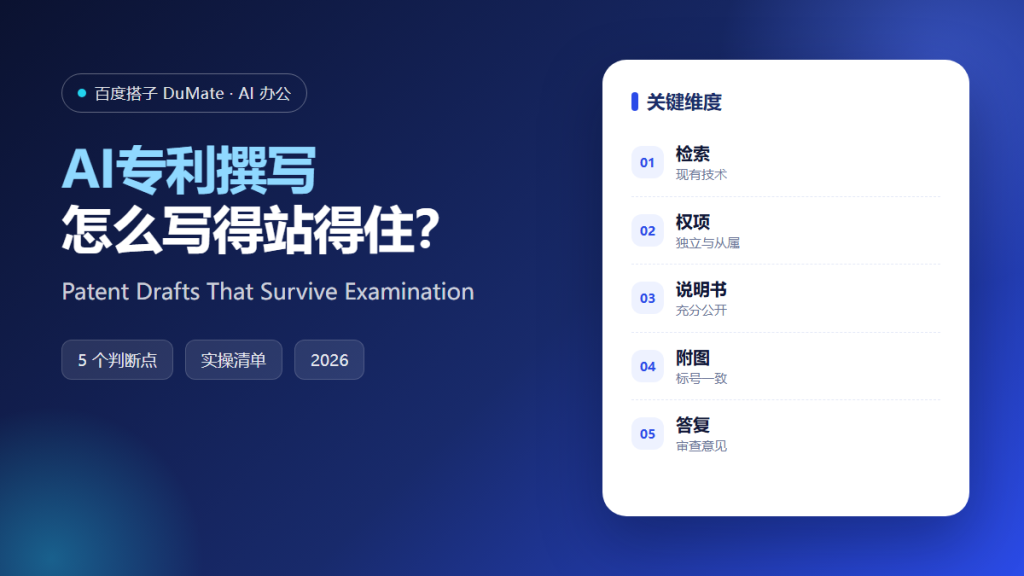
The five steps below cover the invention record, the claim structure, the description that supports it, the prior-art comparison, and the review with the inventor before filing.
Key Takeaways
- Describe the invention in plain terms before writing claims.
- AI专利撰写 should narrow language, not widen it.
- Every claim limitation needs support in the description.
- Prior art is read claim by claim, not by title.
- The inventor signs off on claims and drawings.
Why AI专利撰写 Needs a Claim-First Habit
Claims define the right; the description explains and supports it. Teams that draft the description first often produce a beautiful document with claims that borrow words the description never defined. AI专利撰写 should work from a claim skeleton: the independent claim, the dependent fallbacks, and the feature that makes each one different. A claim written before the description is a list of wishes, and examiners read it that way.
Examination is a conversation about language. An examiner will find a document that discloses most of a claim and ask why the remaining feature is inventive. If the answer is not in the description, the claim narrows or falls. AI专利撰写 helps by flagging terms that appear once, undefined, in a paragraph that carries the whole argument.
The third reason is cost. Each round of examination consumes fees, attorney time, and months. A draft that anticipates the obvious objections reduces those rounds. AI专利撰写 cannot guarantee a grant, and any tool that promises one is selling a story rather than a service.
How AI专利撰写 Works in Five Steps
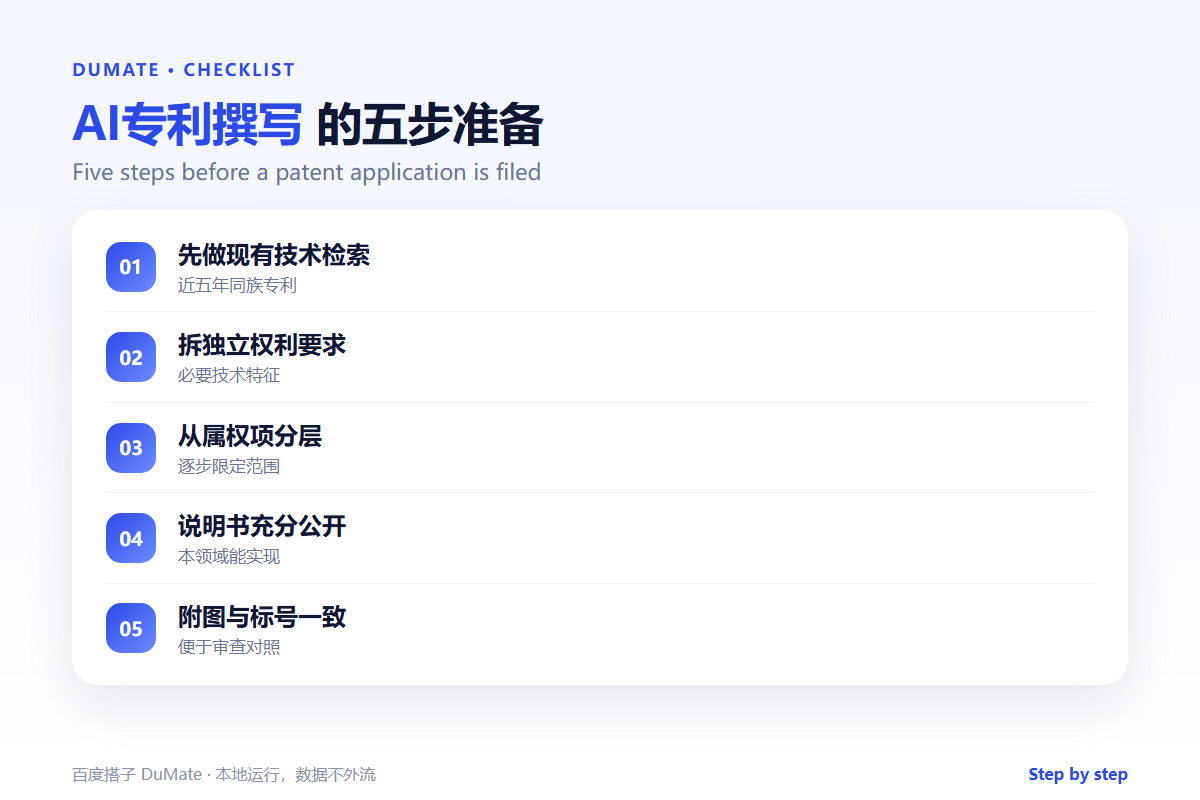
Step 1: Record the invention before drafting
Ask the inventor to describe the problem, the existing approach, the change, and the result, with numbers where possible. Include the failed attempts, because they often explain why the obvious solution did not work. AI专利撰写 uses that record to keep the draft anchored to something concrete.
Step 2: Build the claim skeleton
Write one independent claim with the fewest features that still define the invention, then dependent claims for each fallback. Keep the vocabulary consistent across claims. A dependent claim that introduces a new term without a definition creates a support problem that is expensive to repair later. Name each part the same way in the claims, the drawings, and the summary.
Step 3: Make the description earn the claims
For every feature in every claim, write a paragraph that explains how it works and why it matters. Add two embodiments: one narrow, one broader. AI专利撰写 should check that each claim term appears in the description with the same meaning, because a mismatch is the most common self-inflicted wound.
Step 4: Compare against prior art
Search by feature, not by product name. Read the closest references claim by claim and write the difference in one sentence. If the difference is a routine choice, the claim is probably too broad. AI专利撰写 is useful here for organizing references, not for judging novelty on its own. Keep a table of references with the feature each one discloses, so the comparison can be repeated by someone else.
Step 5: Review with the inventor and file
Read the claims aloud to the inventor and ask whether each one covers the product they plan to ship. Check the drawings against the reference numerals. Fix small inconsistencies before filing, since corrections after filing are limited and sometimes impossible. A short walkthrough of the drawings catches missing reference numerals before a formal objection does.
A Filing Checklist for AI专利撰写
- The problem and the failed attempts are recorded.
- One independent claim carries the invention.
- Every claim term is defined in the description.
- The closest prior art is summarized in a sentence.
- The inventor has read the claims aloud.
Where AI专利撰写 Fails
It fails when the draft is fluent but unsupported, and it fails when a team files before checking who owns the invention. AI专利撰写 makes drafting faster; it does not make the legal judgment for you.
- Claims broader than anything the description teaches.
- Terms that shift meaning between paragraphs.
- Prior art cited by title only.
- Inventorship decided after the draft is finished.
Before and After
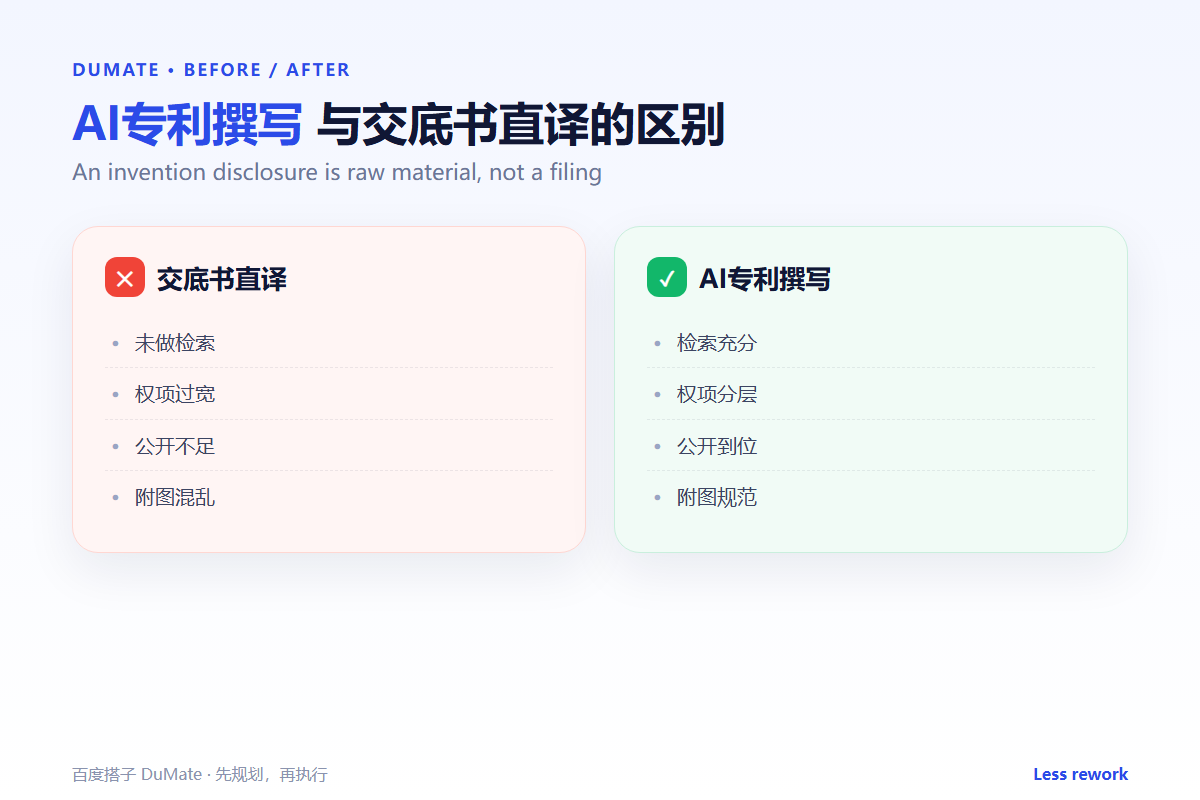
Before, a hardware startup drafted 20 claims around a battery mount, using three different words for the same bracket. Examination raised a support objection, the team narrowed to 12 claims, and the grant arrived nineteen months later. The attorney later estimated that the inconsistent vocabulary alone caused two extra rounds.
After, with AI专利撰写 and a claim skeleton, the same team filed 14 claims with one vocabulary and a description paragraph for each feature. The first office action raised only formal issues, and the grant came in eleven months. The examiner’s search report cited four documents, all of which the team had already listed.
FAQ
Can AI专利撰写 replace a patent attorney?
No. It can speed up drafting and catch inconsistencies, but strategy and legal responsibility stay with a qualified professional.
Should we file a provisional first?
Sometimes. A provisional buys twelve months and a filing date, but it only helps if it describes the invention well enough to support the later claims. AI专利撰写 can draft it from the same invention record.
How broad should the independent claim be?
Broad enough to cover the commercial version, narrow enough to avoid the closest prior art. Test it against both before filing.
延伸阅读
Drafting improves when patent search maps the closest references and legal consultation reviews the strategy before filing. Use document proofreading to catch inconsistent terms, policy briefing to follow examination practice, and literature review to understand the technical field. External references: NIST AI Risk Management Framework and ISO/IEC 42001.
评论
还没有评论,来说两句吧。