
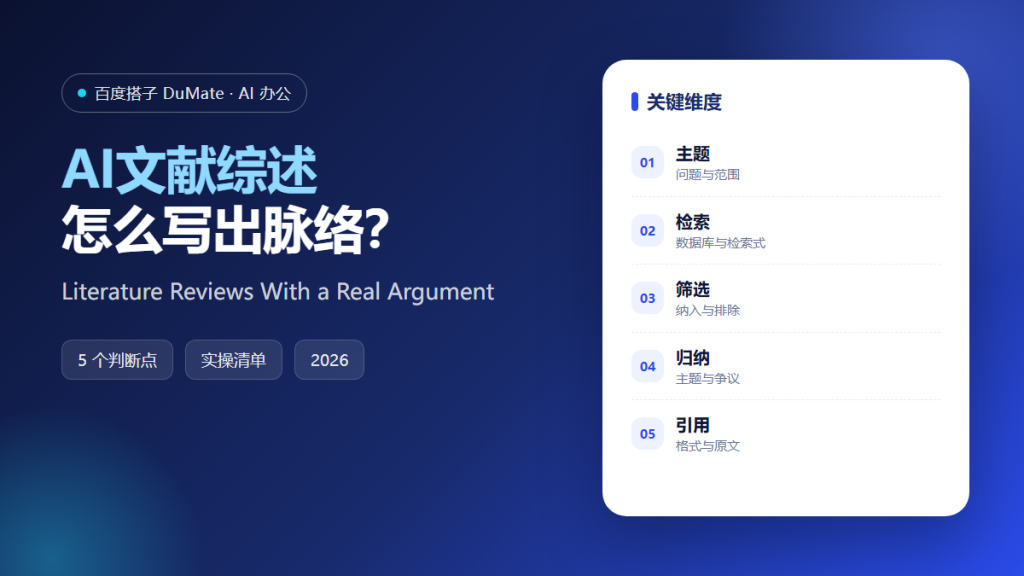
AI文献综述 is often a stack of paraphrased abstracts with a thin introduction. That is not a review. A review organizes what the field knows, where it disagrees, and what remains unanswered. The value is in the synthesis, not in the summary.
This guide covers a five-step review process, the search record that makes it reproducible, and the synthesis structure that turns reading into an argument.
Key Takeaways
- Define the research question and scope.
- Write and save the search query.
- Record inclusion and exclusion reasons.
- Synthesize by theme and conflict.
- Cite the original source, not a summary.
Why AI文献综述 Needs a Narrow Question
A broad question produces a broad list. AI文献综述 can summarize hundreds of papers, but a review that covers everything explains nothing. A narrow question tells the reader what is inside and what is outside.
The second reason is reproducibility. A review should allow another researcher to repeat the search. Saving the databases, the query, and the date is a basic requirement.
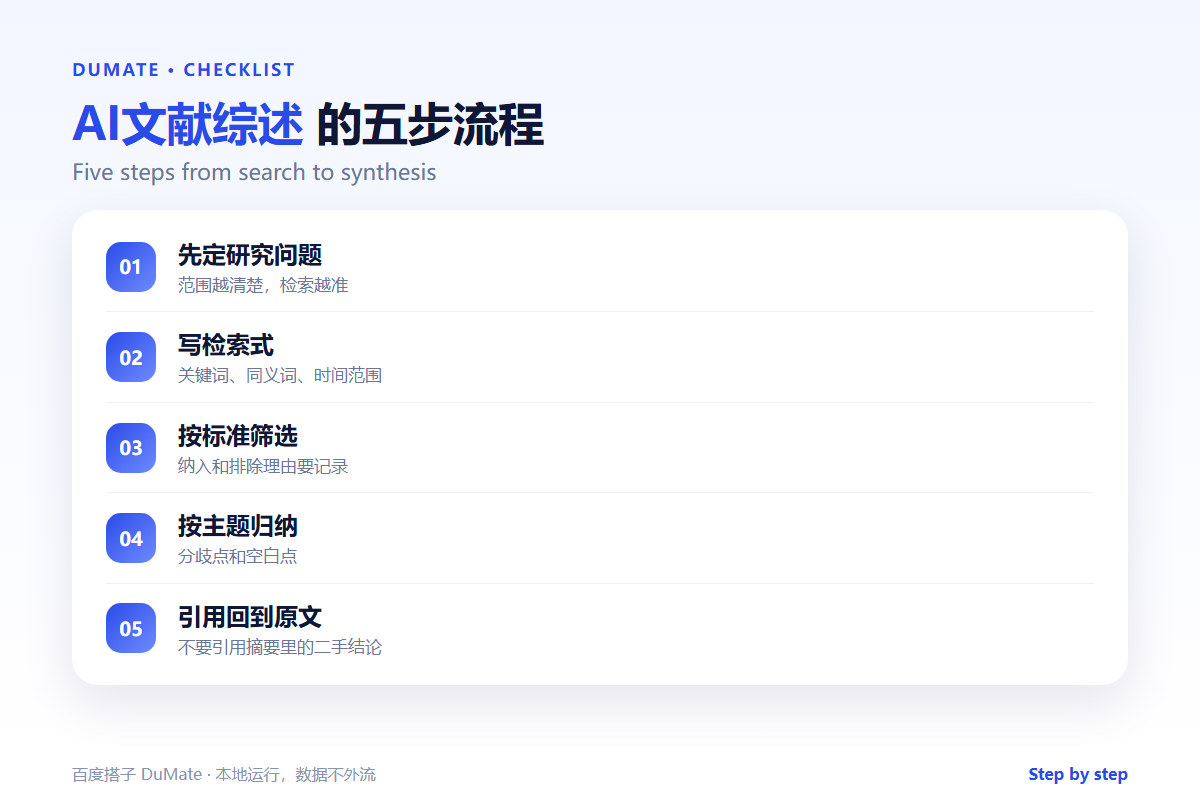
How AI文献综述 Works in Five Steps
Step 1: Define the question
State the population, the intervention or phenomenon, and the outcome. Keep the scope to what one review can handle. AI文献综述 should use the question as a filter for every source.
Step 2: Run a reproducible search
Choose two or three databases and write the query. Record synonyms and limits. AI文献综述 can propose search terms, but the final query should be documented.
Step 3: Screen with reasons
Record why a paper was included or excluded. This makes the selection transparent and reduces bias. AI文献综述 can help sort, but the criteria must be written first.
Step 4: Synthesize by theme
Group findings into themes, then describe agreements, conflicts, and gaps. Do not list papers one by one. AI文献综述 can draft the themes from a table of findings.
Step 5: Verify citations
Return to the original paper for every key claim. Check the sample, the method, and the effect size. AI文献综述 can misattribute a finding to the wrong study.
A Review Checklist
- The question is narrow and stated.
- The search is recorded and repeatable.
- Exclusion reasons are documented.
- Themes include conflicts and gaps.
- Key claims cite the original source.
Where AI文献综述 Fails
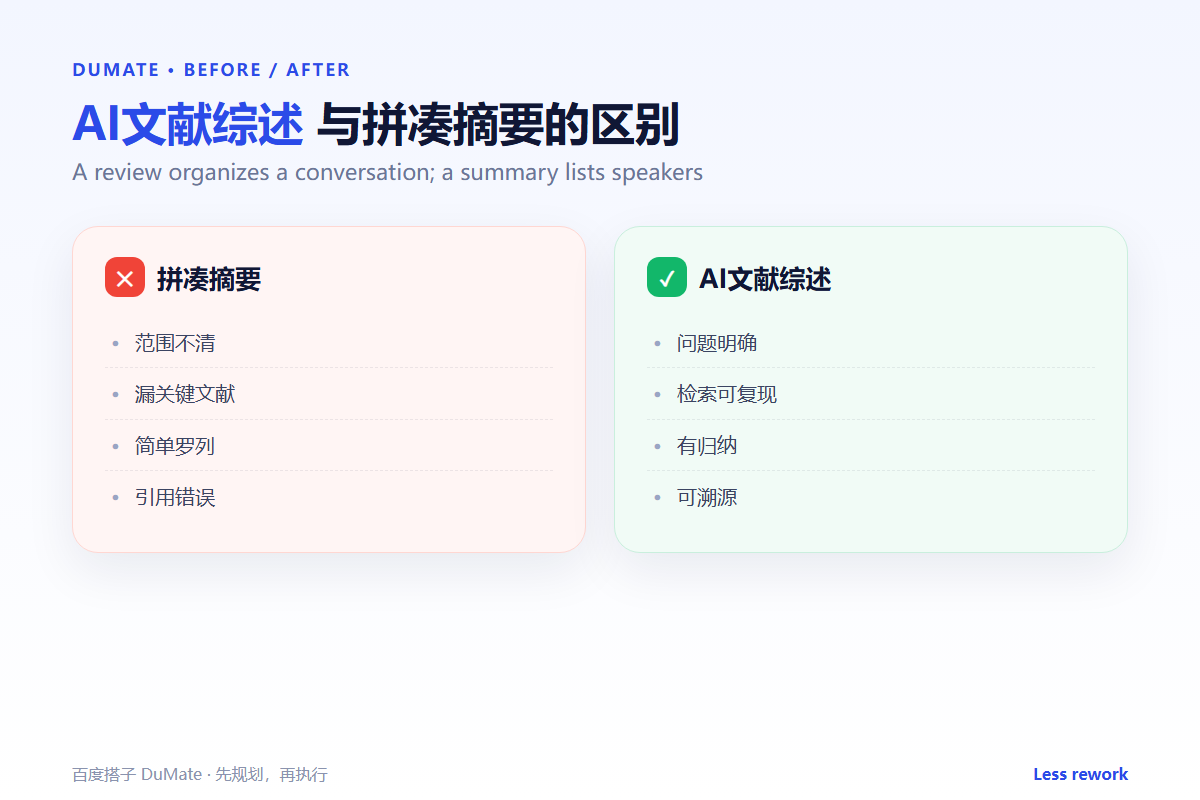
It fails when it summarizes abstracts without reading the methods. It also fails when it treats every paper as equally reliable, regardless of sample size or design.
- Listing instead of synthesizing.
- Missing contradictory findings.
- Citing secondary summaries.
- Ignoring study quality.
Before and After
Before, a review listed thirty papers in chronological order and concluded that more research is needed. After, AI文献综述 grouped the findings into three themes, identified a contradiction between two large studies, and named the gap that justified the new study.
A review is an argument about the state of knowledge. The bibliography supports it.
Used consistently, AI文献综述 becomes part of the normal review routine rather than a separate project.
A final check with AI文献综述 takes a minute and catches the errors that are easiest to miss.
The same AI文献综述 routine works for small tasks and large ones, which is why teams keep using it.
Making It Stick Across a Team
A rollout fails when only one person knows how to use AI文献综述. Write a short guide with three sections: when to use it, what good input looks like, and what to check before sharing the output. Keep the guide to one page.
Train in pairs. One person runs the task while the other checks the output against the guide, then swap roles. That exercise surfaces unclear steps faster than a presentation. Keep a shared folder with one strong output, one weak output, and a note explaining the difference. AI文献综述 becomes easier to teach when people can compare real cases.
Review the guide after the first week of use. Remove steps nobody follows and add the questions that keep coming up. A living guide is more useful than a perfect one written in advance. Finally, assign an owner. AI文献综述 without an owner drifts, and the guide becomes outdated. The owner does not need to do every task, only keep the standard current. That small responsibility is what keeps AI文献综述 useful after the initial training.
Make the training practical. People learn the workflow by completing a real task, not by listening to a walkthrough. Set aside thirty minutes for practice and review the result together. Measure one thing: how many outputs pass review without correction. That number is a better indicator than attendance.
Keep the first month simple. One task, one owner, and one weekly review are enough to prove the workflow before it spreads across the team.
Write down what changed after each run. A short note is easier to trust than a memory, and it makes the next improvement obvious.
Review the output before it leaves your desk. A two-minute check catches most of the errors that would otherwise come back as questions.
FAQ
How many papers should a review include?
Enough to cover the themes, not every paper ever written. Quality and relevance matter more than count.
Can I rely on abstracts?
For screening, yes. For synthesis, read the methods and results.
How do I handle conflicting findings?
Compare samples, methods, and measures. The conflict is often the most interesting part of the review.
延伸阅读
For polishing, see AI论文润色. Organize sources in an AI知识库. Search files with AI文件搜索. For drafting, read AI写作助手. Translation is covered in AI翻译工具. External references: NIST AI Risk Management Framework and ISO/IEC 42001.
评论
还没有评论,来说两句吧。以下为本文的引用通告: