

AI专利检索 is a search problem with a legal consequence. A missed patent can invalidate a product launch, and a missed application can waste a year of research. Keyword search alone is not enough, because the same technology is described with different words in different countries.
This guide covers a five-step search method, the vocabulary expansion that improves recall, and the record that makes a search reproducible.
Key Takeaways
- Break the invention into technical features.
- Expand synonyms in both languages.
- Add classification codes.
- Compare claims, not titles.
- Save the search query and the date.
Why AI专利检索 Needs Classification Codes
Patent language is deliberately broad and inconsistent. A single keyword misses documents that use a different term for the same function. Classification codes group inventions by function, which improves recall when the vocabulary is unknown.
The second reason is claim scope. A patent’s title and abstract are marketing; the claims define the legal boundary. AI专利检索 should surface claims for review, not just a list of titles.
How AI专利检索 Works in Five Steps
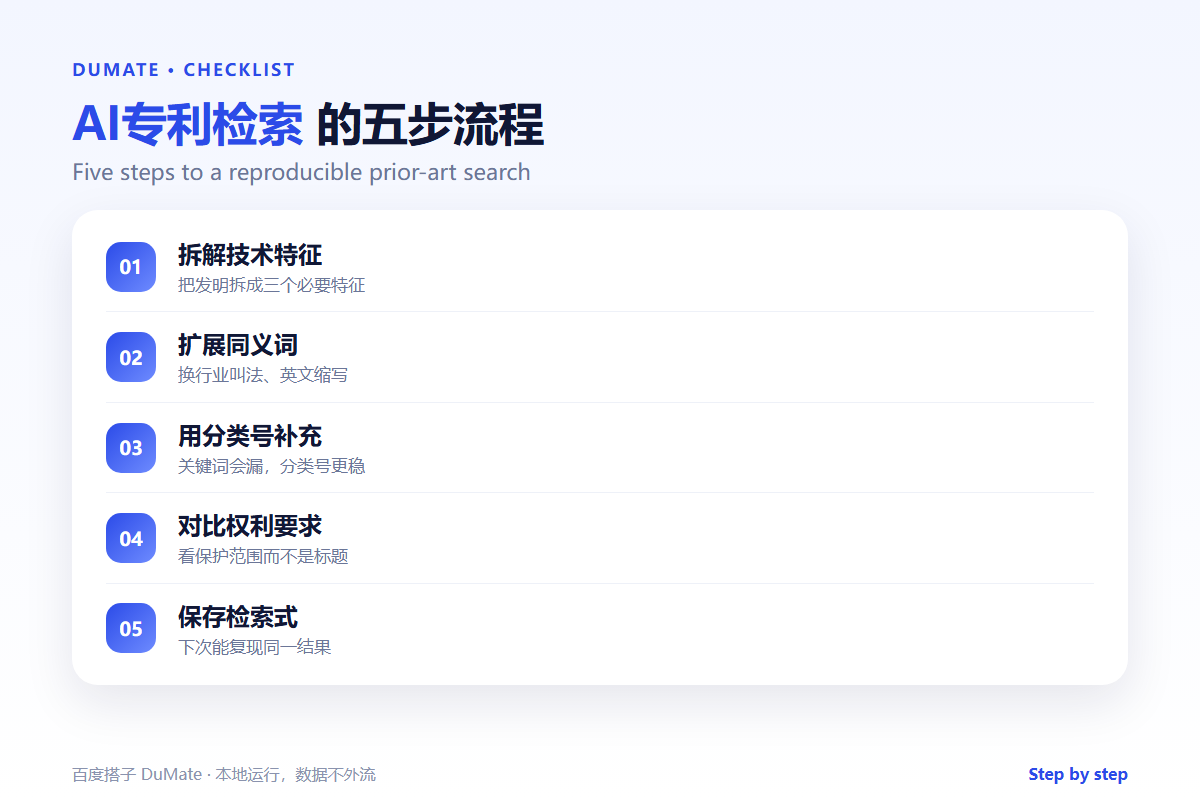
Step 1: Decompose the invention
List the essential technical features and how they interact. Three to five features are usually enough. AI专利检索 should search combinations, not a single phrase.
Step 2: Expand the vocabulary
Add synonyms, abbreviations, and English equivalents. Include older terms that the industry used five years ago. AI专利检索 can propose variants, but a domain expert should confirm them.
Step 3: Add classification codes
Find the relevant CPC or IPC classes and search within them. Combine the code with keywords. AI专利检索 should report which codes were used.
Step 4: Compare claims
Read the independent claims of the closest results. Compare feature by feature. AI专利检索 can produce a comparison table, but the legal judgment is human.
Step 5: Record the search
Save the query, the databases, the date, and the results reviewed. A future search should be able to reproduce the same set. AI专利检索 without a record cannot be defended.
A Search Record Checklist
- The technical features are listed.
- Synonyms and translations are included.
- Classification codes are documented.
- Independent claims were compared.
- The query and date are saved.
Where AI专利检索 Fails
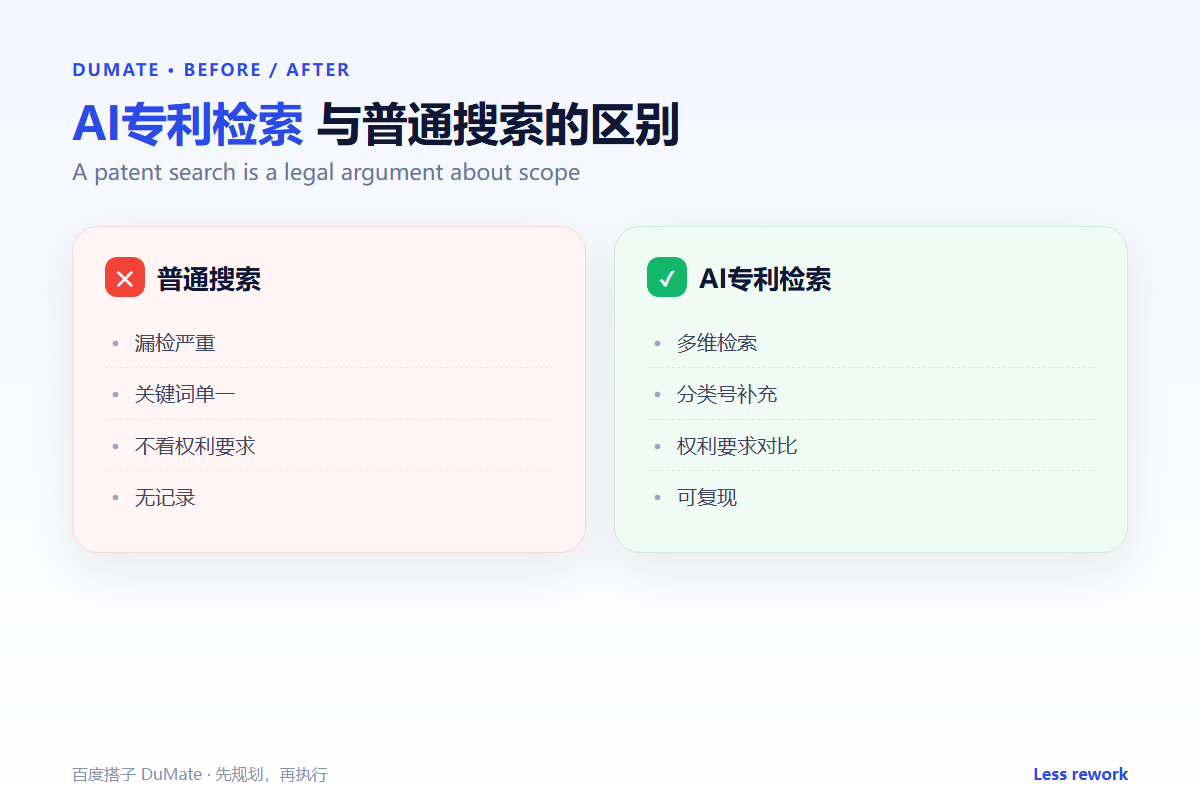
It fails when the search stops at the first page of results. It also fails when the user searches only in one language, which misses the majority of filings in many fields.
- Single-keyword searches.
- Ignoring family members and divisions.
- Reading abstracts instead of claims.
- No record of the search.
Before and After
Before, a team searched one phrase, found nothing, and assumed the field was clear. After, AI专利检索 used three synonyms and two classification codes, found four related families, and the team adjusted the design before filing.
Recall is the goal of search. Precision comes later, in the claims review.
Used consistently, AI专利检索 becomes part of the normal review routine rather than a separate project.
A final check with AI专利检索 takes a minute and catches the errors that are easiest to miss.
A Four-Week Rollout
The first week with AI专利检索 should be a small pilot, not a team-wide launch. Choose one recurring task with a clear output and run it end to end. Keep the sample small enough to check by hand. The point is to see where AI专利检索 saves time and where it creates review work.
During the pilot, keep a short log of inputs, outputs, and corrections. Record the time spent before and after. AI专利检索 feels faster even when it is not, so the log matters. At the end of the week, review the log with one colleague and decide whether to continue, change the input, or stop.
In week two, write a one-page standard for input and output. Include what must be checked and who approves the result. AI专利检索 works better when the standard is visible to everyone. In week three, add permissions and a review step. In week four, compare the results and write a short guide. That guide is what makes AI专利检索 survive after the first month.
Keep the pilot narrow. A broad rollout hides which step failed, and a narrow one shows exactly where the workflow needs help. Expand only after the narrow case is stable.
Keep the first month simple. One task, one owner, and one weekly review are enough to prove the workflow before it spreads across the team.
Write down what changed after each run. A short note is easier to trust than a memory, and it makes the next improvement obvious.
Review the output before it leaves your desk. A two-minute check catches most of the errors that would otherwise come back as questions.
Keep one example of a good result. New team members learn faster from a concrete reference than from a long explanation.
The first version does not need to be perfect. It needs to be complete enough to review, so the team can see the gaps and fix them in the next round.
FAQ
Can AI专利检索 replace a patent attorney?
No. It improves preparation. Freedom-to-operate and validity opinions require professional judgment.
How many databases should we use?
At least two, including one that covers international filings. Coverage differs by country and field.
What is the most common mistake?
Searching only the exact product name. Patents describe function, not brand names.
延伸阅读
For legal boundaries, see AI法律咨询. Keep research in an AI知识库. Search internal files with AI文件搜索. For drafting, read AI写作助手. Tool selection is in AI效率工具. External references: NIST AI Risk Management Framework and ISO/IEC 42001.
评论
还没有评论,来说两句吧。