

A vision system that finds 99 percent of defects in a demonstration can still fail on a Tuesday morning, because the lighting shifted and nobody tested the same part twice. Quality work is not a single impressive result; it is the same part getting the same answer every time. AI质量检测 begins with repeatability, not accuracy.
The steps below cover defect definitions, golden samples, lighting and fixturing, the two error costs, and the drift checks that keep a line honest.
Key Takeaways
- Define each defect with a photo and a measurement.
- AI质量检测 is judged on repeatability before accuracy.
- Lighting and fixture are model inputs, so control them.
- False accepts and false rejects carry different costs.
- Re-test the same sample set every shift.
Why AI质量检测 Needs a Defect Standard
A scratch means one thing to a customer, another to a line operator, and a third to an annotator working from a laptop. A model trained on three definitions learns an average that satisfies nobody. AI质量检测 needs a written standard: size, location, contrast, and the boundary case that is accepted.
Repeatability is the second requirement. If the same part passes in the morning and fails after lunch, the line loses trust in the system and starts overriding it. That override is the real cost, because it turns a controlled process back into a human guess. AI质量检测 should be tested with the same twenty parts, twice a day, before anyone quotes an accuracy figure.
The third requirement is honesty about error costs. A false reject scraps a good part; a false accept ships a bad one. Those costs are not symmetric, and the threshold should reflect the difference. AI质量检测 that reports one accuracy number hides the only trade-off the plant actually cares about.
How AI质量检测 Works in Five Steps
Step 1: Write the defect standard
For each defect type, collect ten examples at the boundary and ten clear ones. Record size, lighting, and viewing angle. Name the person who decides ambiguous cases. A standard with a named arbiter resolves arguments that would otherwise return every week in the review meeting. Review the standard with the supplier, because an agreed boundary keeps a rejected batch from becoming an argument about AI质量检测 and taste.
Step 2: Control the imaging
Fix the camera, the lens, the distance, and the light. Measure the light at the start and middle of each shift. Most model drift in a factory is a lamp aging or a fixture knocked two millimeters out of place. AI质量检测 should log those conditions beside every image.
Step 3: Build a golden sample set
Select two hundred parts that cover every defect type, plus good parts from each supplier. Label them twice, with a gap of at least a day, and keep the disagreements. This set becomes the fixed exam. Nothing ships until AI质量检测 scores the same way on it twice in a row.
Step 4: Set thresholds by cost
Estimate the cost of a false accept and a false reject. Move the threshold until the expected cost is lowest, then check that the resulting reject rate is one the line can absorb. A threshold chosen for a demo number will not survive a production quota. Write the calculation down so a shift change does not quietly reset the trade-off.
Step 5: Watch drift every shift
Run the golden set at the start of each shift and plot the result. Investigate three consecutive shifts in the same direction. Retrain only after the cause is known, because retraining on drifted images teaches the model the drift. AI质量检测 stays useful when the cause is fixed rather than the symptom. A drift that appears only after a weekend usually points to temperature rather than to the camera.
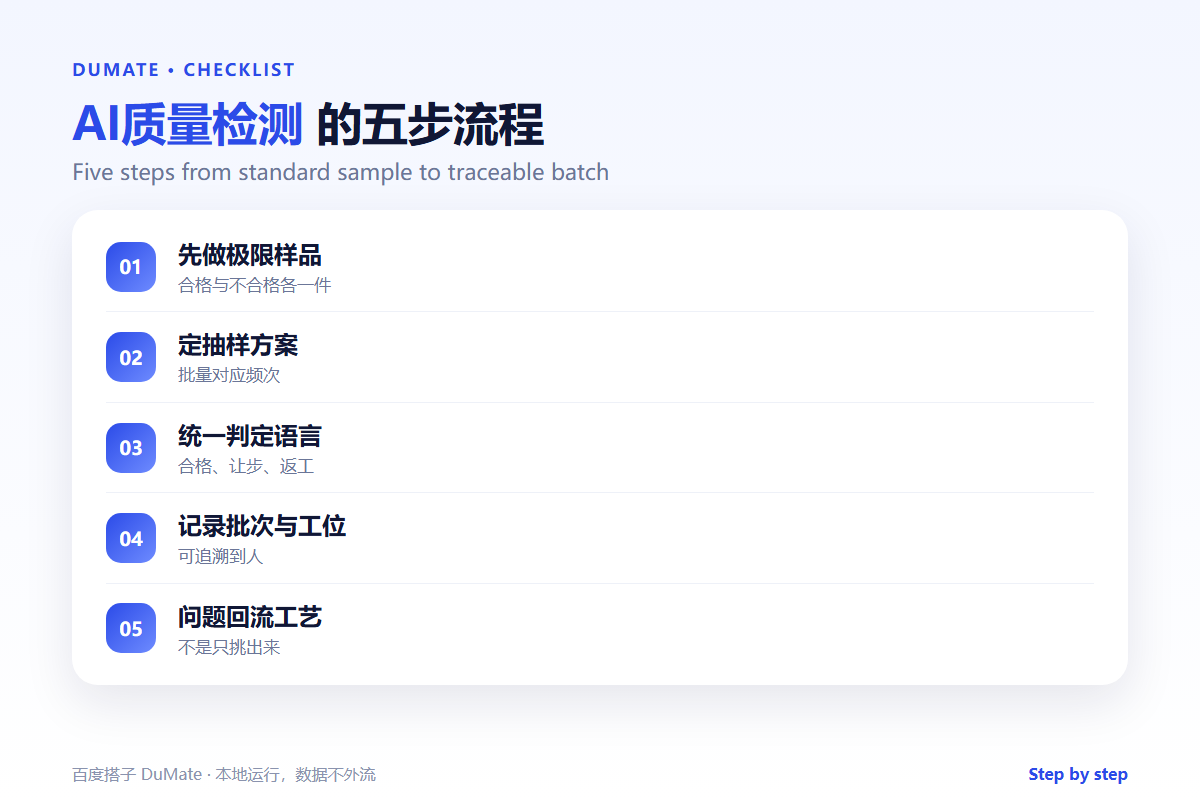
An Inspection Checklist for AI质量检测
- Every defect type has a written boundary.
- Lighting is measured, not assumed.
- The golden set is labeled twice.
- Thresholds reflect the cost of each error.
- Shift results are plotted, not filed.
Where AI质量检测 Fails
It fails when the project is measured once, at acceptance, and never again. AI质量检测 also fails when the quality team is handed a dashboard without the authority to stop the line.
- Training images taken from one supplier only.
- Operators overriding the system without recording why.
- Retraining on data that includes the drift.
- Accuracy quoted without a repeatability test.
Before and After
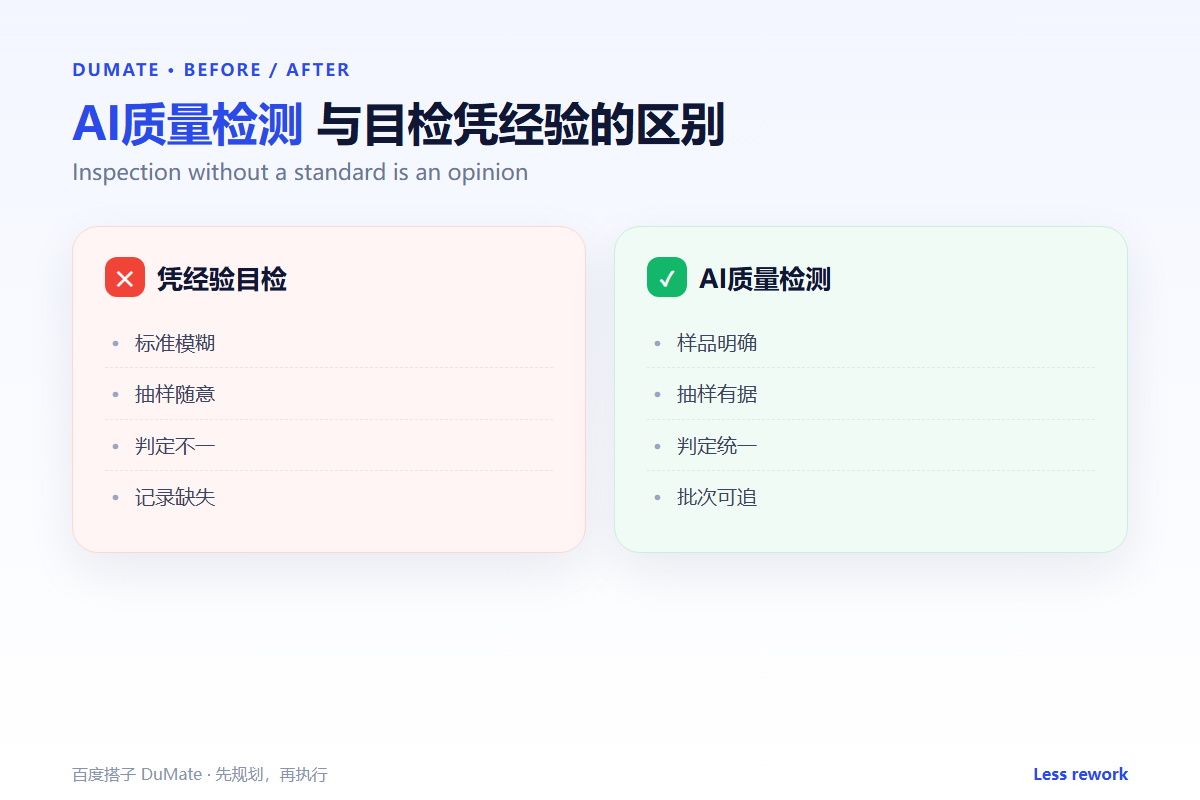
Before, a parts supplier installed a vision system that passed acceptance at 98.6 percent. Six weeks later, rejects rose and operators began waving parts through. The cause was a replacement lamp with a different color temperature, and nobody had recorded the original.
After, AI质量检测 added a light meter, a 200-part golden set, and a shift log. Repeatability settled at 97 percent agreement across two runs, false accepts fell by two thirds, and the line manager could show auditors exactly which images supported the change. The line has run nineteen weeks since without a repeat of that fault.
FAQ
How accurate can AI质量检测 be?
It depends on the defect and the imaging. A narrow, well-lit defect can reach a high agreement; a subjective one cannot. Test repeatability first, because a narrow standard makes the answer testable.
Do we need deep learning?
Not always. A rule or a classical method is easier to maintain when the defect has a clear measurement. Use the simplest method that meets the standard.
How often should the model be retrained?
Only when the cause of a change is understood. Scheduled retraining without a reason tends to hide drift rather than correct it.
延伸阅读
Line quality improves with incident triage for defects that reach a customer and log analysis for the conditions before a stop. Use data labeling to keep boundaries consistent, supplier evaluation to compare incoming material, and test cases to define what a pass looks like. External references: NIST AI Risk Management Framework and ISO/IEC 42001.
评论
还没有评论,来说两句吧。