
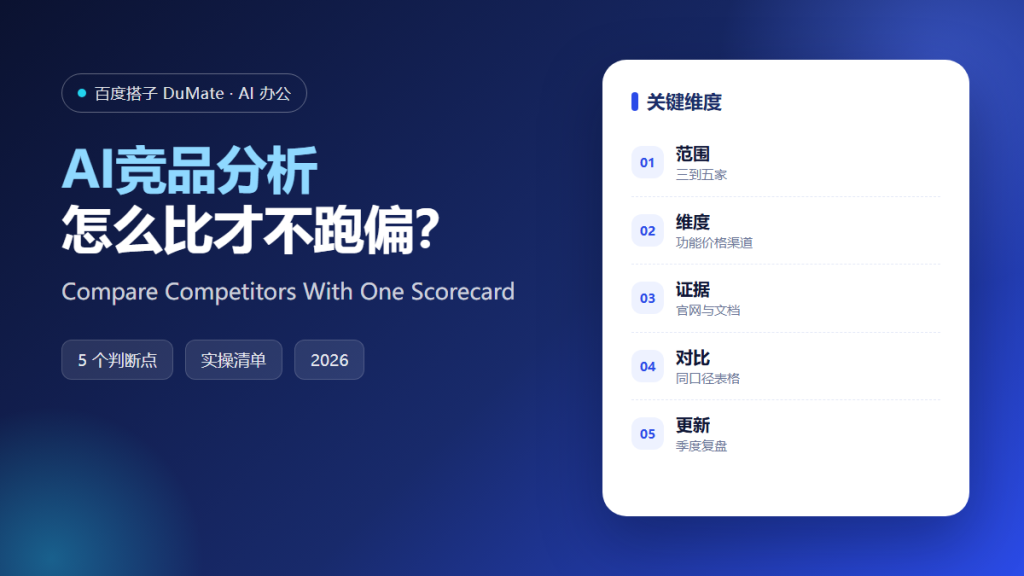
AI竞品分析 is easy to start and hard to trust. Anyone can list five competitors and a handful of features. The hard part is comparing them on the same dimensions, with evidence that survives scrutiny, and keeping the comparison current after the next release. A scorecard fixes all three problems.
This guide describes a five-step method for building a competitor scorecard that a product, sales, or leadership team can actually use.
Key Takeaways
- Limit the set to three to five competitors.
- Use the same dimensions for every vendor.
- Cite a public source for each cell.
- Keep the scorecard to one page.
- Review it every quarter.
Why AI竞品分析 Needs a Fixed Frame
Competitive analysis drifts because the questions drift. One week the team cares about pricing, the next week about integrations, and the week after about security. Each new question produces a new document, and none of them can be compared. A fixed frame turns those questions into columns that stay stable across quarters.
AI竞品分析 helps because it can read public pages, release notes, and pricing tables quickly. It can also normalize messy information into a consistent format. What it cannot do is decide which dimensions matter to your business. That decision stays with you, and it is the most important part of the work.
The third reason for a scorecard is political. A one-page table with sources reduces the room for opinion. When someone says a competitor is cheaper, the table either supports the claim or it does not. That makes the conversation shorter and more useful.
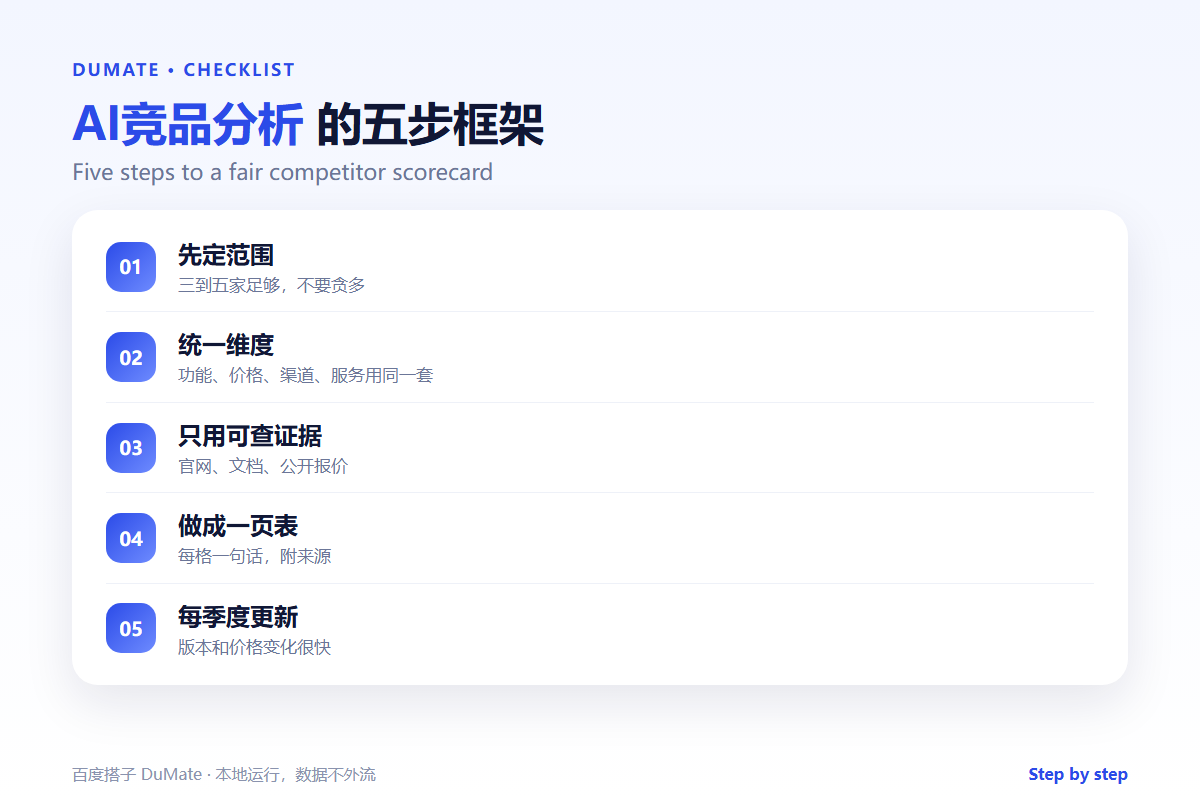
How AI竞品分析 Works in Five Steps
Step 1: Choose three to five competitors
Include the vendor you lose to most often, the vendor you beat most often, and one new entrant. More than five turns the scorecard into a spreadsheet that nobody maintains. Fewer than three hides the pattern.
Step 2: Fix the dimensions
Use six to eight dimensions: core features, pricing model, deployment options, integrations, security posture, support, and target segment. Write a one-line definition for each. Without definitions, every reviewer scores differently.
Step 3: Collect public evidence
Use the official site, documentation, pricing page, release notes, and public security pages. Record the URL and the date next to each score. If a claim has no public source, mark it as unverified instead of guessing.
Step 4: Score and compare
Use a simple scale, such as one to five, and add a short note for each score. Then read the table by column, not by row. Column reading shows where the market is converging; row reading shows where one vendor stands out.
Step 5: Review every quarter
Set a recurring review. Update prices, features, and positioning. Delete stale claims. AI竞品分析 can produce a first draft of the update in minutes, which makes the quarterly habit realistic.
A One-Page Scorecard Layout
- Rows: competitors, capped at five.
- Columns: six to eight fixed dimensions.
- Cells: a score plus a short evidence note.
- Bottom row: what this means for our roadmap.
- Footer: sources and review date.
Where AI竞品分析 Goes Wrong
The most common error is comparing marketing pages instead of products. Marketing pages are written to sound similar, so the comparison flattens. The second error is treating a missing feature as a weakness when it is actually a deliberate positioning choice. The third error is ignoring segment: a tool that is weak for enterprise buyers may be excellent for small teams.
- Different dimensions for different vendors.
- Scores without sources.
- No review date.
- Confusing absence of evidence with evidence of absence.
Before and After
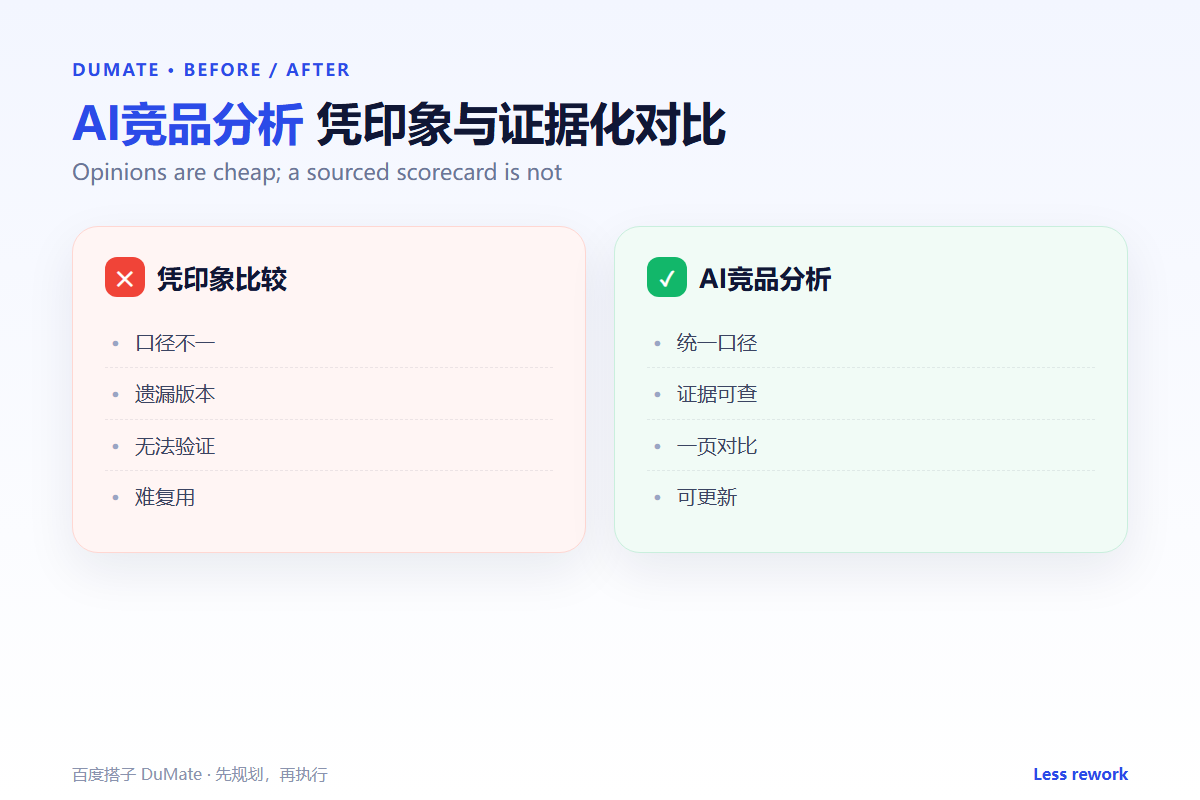
Before, the team had a forty-slide deck that was outdated within a month. Sales used its own anecdotes, and product used a different set of assumptions. After, the team has a one-page table, updated quarterly, with links. Sales arguments start from the same facts, and roadmap debates focus on strategy instead of disputed claims.
The scorecard does not make decisions. It makes decisions cheaper to discuss, which is usually the same thing.
Start your first AI竞品分析 with the deals you lost last quarter. Those losses contain the dimensions that matter, and the evidence is usually easy to find. Once the AI竞品分析 covers the lost deals, extend it to the deals you won. The contrast is often more informative than either list alone.
A scorecard also needs a maintenance owner. Without one, the AI竞品分析 becomes another artifact that was impressive in March and wrong by June. Give one person thirty minutes a month to update prices, release notes, and broken links. That small habit keeps the AI竞品分析 credible.
When you present the scorecard, show the sources and the review date on the same page. Decision makers trust an AI竞品分析 more when they can see its limits. If a cell is unverified, say so. An honest gap is stronger than a confident guess, and the next AI竞品分析 will be judged by how well it handled both.
Finally, connect the AI竞品分析 to your own roadmap. A scorecard that does not change a decision is entertainment. A scorecard that changes one priority per quarter is doing its job, and a quarterly AI竞品分析 review keeps that habit alive.
FAQ
How often should the scorecard change?
The dimensions should stay stable for a year. The scores can change every quarter.
Should we include internal data?
Yes, in a separate column that is not shared externally. Keep public evidence and win-loss notes clearly separated.
What if a competitor has no public pricing?
Mark it as contact sales and note the date. Do not invent a number.
延伸阅读
For the underlying analysis, see AI数据分析工具. To turn the table into a short brief, read AI报告生成. Keep past scorecards in an AI知识库 so trends are visible. For source collection, see AI文件搜索. Tool selection is covered in AI效率工具. External references: NIST AI Risk Management Framework and ISO/IEC 42001.
评论
还没有评论,来说两句吧。以下为本文的引用通告: