

AI市场调研 has a data problem and a decision problem. The data problem is that information is abundant and mostly irrelevant. The decision problem is that reports arrive after the decision has already been made. A useful AI市场调研 process fixes both by starting with the decision and working backward.
This guide covers the five steps we use for small and mid-sized research projects, the sample checks that keep conclusions honest, and the output format that gets read.
Key Takeaways
- Write the decision question before collecting data.
- Describe the sample, including its biases.
- Use one interview guide for every participant.
- Group findings into three to five themes.
- End with a one-page recommendation.
Why AI市场调研 Should Start With a Decision
Research without a decision becomes a hobby. If nobody can say what would change as a result of the study, the study will produce interesting facts and no action. AI市场调研 is fast enough to encourage endless exploration, so the scope has to be protected by a written question.
A good question has three parts: the decision, the options, and the evidence that would separate them. For example: should we launch a team plan this quarter, and would usage data plus ten customer interviews be enough to choose between yes, no, and wait? That question tells you what to collect and when to stop.
AI市场调研 also helps with synthesis. Interviews produce hours of transcript, and most teams underuse it because reading is slow. A structured pass through the transcripts can surface themes in minutes, leaving the team free to judge what the themes mean.
How AI市场调研 Works in Five Steps
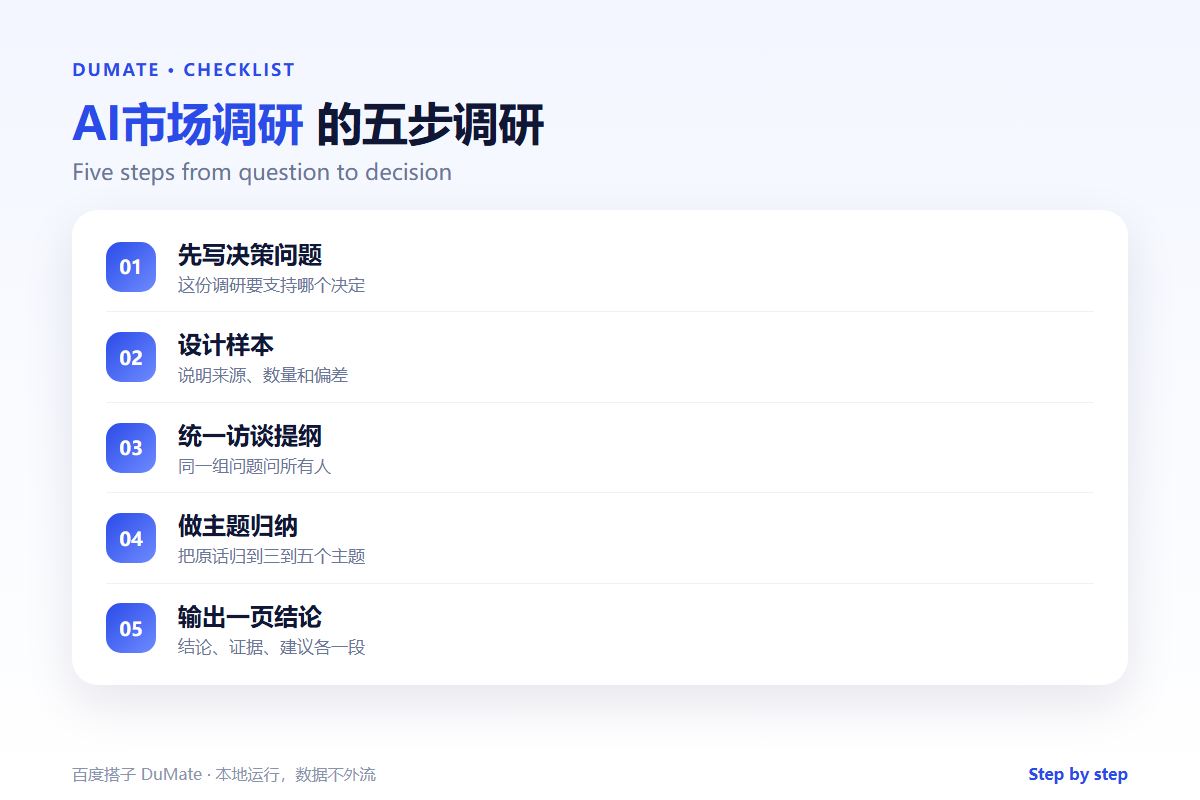
Step 1: Write the decision question
Put it at the top of the project document. If a new data request does not help answer the question, it goes to a parking lot. This one rule prevents most scope creep.
Step 2: Design the sample and name the bias
Decide who you will talk to, how many, and how you will find them. Write down who is missing. A sample of ten happy customers is not a market; it is a testimonial collection. AI市场调研 can help draft the recruitment message, but the sampling choice is yours.
Step 3: Use one interview guide
Ask the same core questions in the same order. Allow follow-ups, but keep the spine consistent so answers can be compared. Record the session and transcribe it. The guide is the backbone of a reliable AI市场调研 project.
Step 4: Code the transcripts into themes
Read for repeated problems, not for quotable lines. Group the evidence into three to five themes, and count how many participants mentioned each. AI市场调研 can draft the themes; you should check the counts against the transcripts.
Step 5: Write a one-page recommendation
Use three sections: what we learned, what it means for the decision, and what we recommend. Keep the appendix for quotes and method notes. A one-page AI市场调研 output is more likely to be read than a forty-page deck.
The One-Page Output Template
- Decision question and deadline.
- Method, sample size, and known bias.
- Three to five themes with counts.
- What would change our mind.
- Recommendation and next step.
Where AI市场调研 Goes Wrong
The first failure is asking leading questions. The second is treating frequency as importance: a theme mentioned by many people may still be minor if it is easy to work around. The third is ignoring the people who did not respond, because their absence is often the most important finding.
- Sample skew hidden in an appendix.
- Themes with no supporting quotes.
- Recommendations that do not follow from the evidence.
- No record of what would change the conclusion.
Before and After
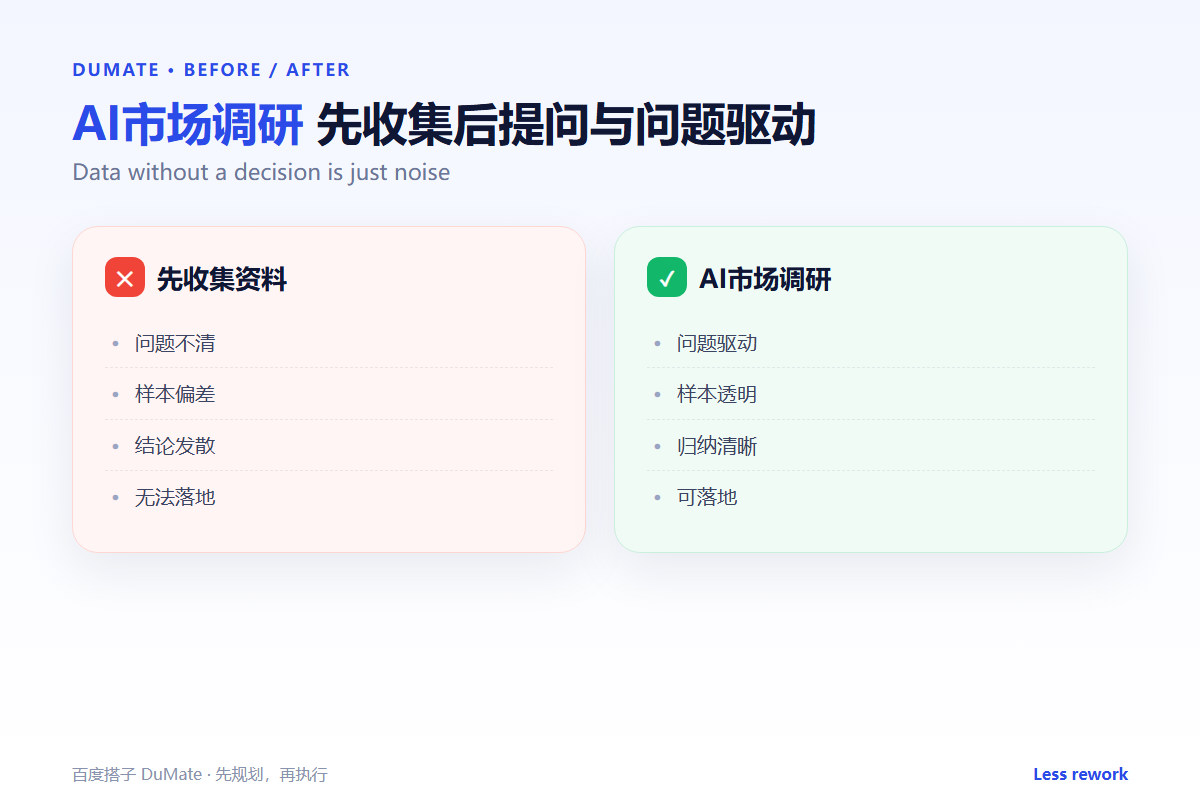
Before, a team runs twenty interviews, writes a long summary, and debates the meaning for a month. After, the same team writes the decision question first, codes the transcripts into five themes, and presents one page in the second week. The discussion focuses on the decision, not on the formatting.
A small AI市场调研 project done in two weeks beats a large one that never ships. The point is not to know everything. The point is to reduce uncertainty enough to act.
A useful AI市场调研 habit is to write the decision question on a whiteboard and leave it there for the duration of the project. Every meeting starts by reading it aloud. If the findings do not change the answer, the AI市场调研 is not finished; it has simply produced more context.
Keep the raw transcripts. Summaries are useful, but the original wording is what convinces a skeptical stakeholder. When a debate starts, quote the participant directly and let the AI市场调研 evidence settle it.
Finally, schedule a follow-up ninety days later. The best AI市场调研 projects check whether the decision worked, not just whether it was made. That follow-up is also the cheapest way to improve the next study.
FAQ
How many interviews are enough?
For a narrow question, eight to twelve often reveal the pattern. For a broad market, combine interviews with desk research and usage data.
Can AI市场调研 replace interviews?
No. It can summarize and organize them. It cannot ask the follow-up question that reveals the real problem.
What if the findings contradict our plan?
That is a successful study. Report it early, with the evidence, while there is still time to change the plan.
延伸阅读
To compare what you learn with public competitor material, see AI竞品分析. For the numbers behind the themes, read AI数据分析工具. To turn findings into a brief, see AI报告生成. Summarize source pages with AI网页总结. Keep the archive in an AI知识库. External references: NIST AI Risk Management Framework and ISO/IEC 42001.
评论
还没有评论,来说两句吧。