
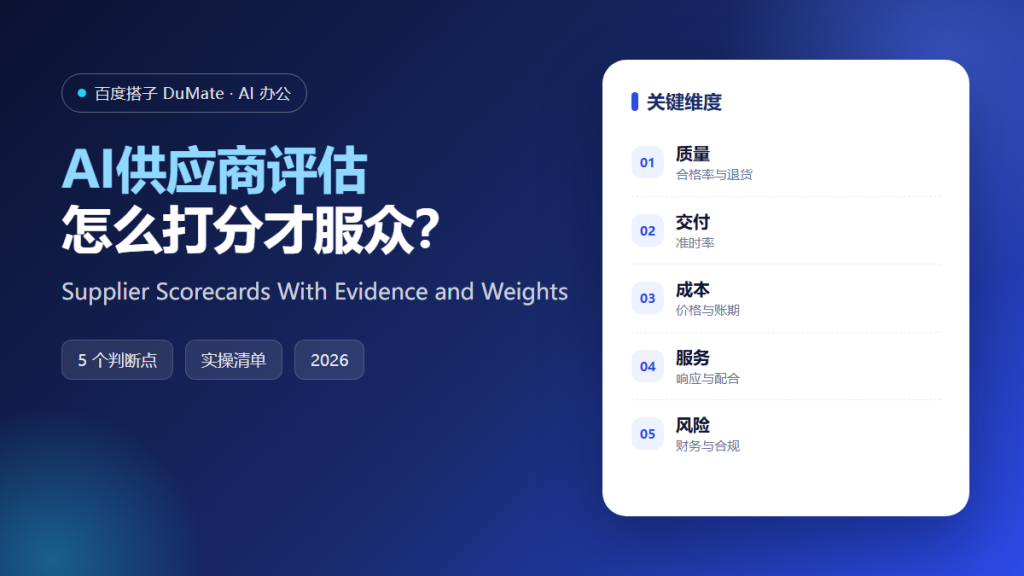
AI供应商评估 is often reduced to a yearly dinner and a vague impression. A scorecard changes that. It makes the criteria explicit, ties each score to evidence, and gives both sides a basis for improvement.
This guide covers a five-step evaluation process, the weights that work for most categories, and the review meeting that turns a score into an action.
Key Takeaways
- Publish the weights before scoring.
- Use at least three months of data.
- Attach evidence to every score.
- Review the result with the supplier.
- Update the score every quarter.
Why AI供应商评估 Needs Published Weights
Suppliers cannot improve against criteria they cannot see. When the weights are hidden, the score feels arbitrary and the conversation becomes defensive. AI供应商评估 can calculate the total, but the credibility comes from transparency.
The second reason is internal alignment. Procurement, quality, and finance often value different things. A published weighting forces the team to agree before the results arrive.
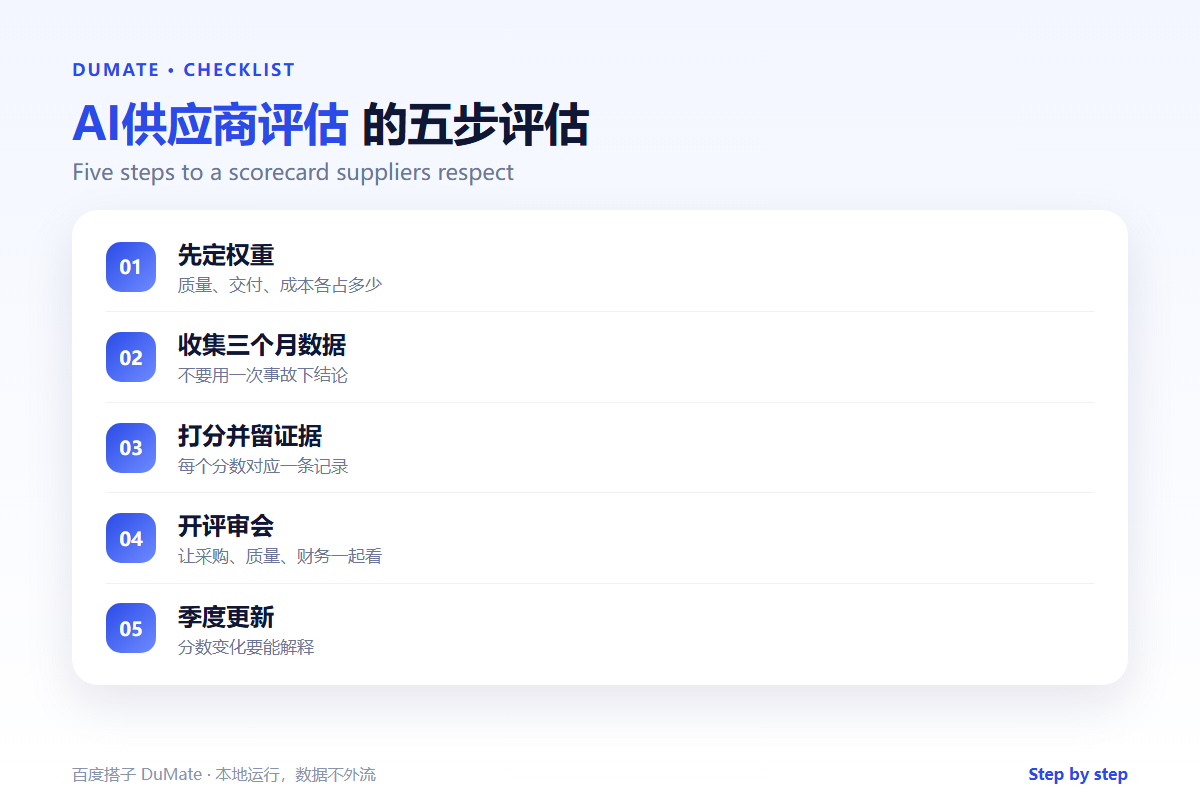
How AI供应商评估 Works in Five Steps
Step 1: Set the weights
For most categories, quality and delivery together should carry at least half the weight. Cost matters, but cheap and late is expensive. AI供应商评估 can help test different weightings for sensitivity.
Step 2: Collect data
Use inspection records, on-time delivery, invoice accuracy, and service tickets from the last three months. AI供应商评估 should be fed structured data, not impressions from one meeting.
Step 3: Score with evidence
Give each dimension a score and one line of evidence. If evidence is missing, mark the dimension as unrated instead of guessing. AI供应商评估 can flag missing data automatically.
Step 4: Hold a review meeting
Share the scorecard with the supplier before the meeting. Discuss the two lowest dimensions and agree on an action with a date. AI供应商评估 can draft the minutes and the action list.
Step 5: Update quarterly
Re-score every quarter using the same method. Trends matter more than a single result. AI供应商评估 should keep the history so improvement is visible.
A Scorecard Template
- Quality: defect rate and returns.
- Delivery: on-time rate and lead time.
- Cost: price competitiveness and payment terms.
- Service: response time and issue closure.
- Risk: financial health and compliance.
Where AI供应商评估 Fails
It fails when the data is inconsistent across suppliers, because the comparison becomes meaningless. It also fails when a single incident dominates the score, which encourages hiding problems instead of fixing them.
- Weights changed after the results.
- Scores without evidence.
- No conversation with the supplier.
- Annual review only.
Before and After
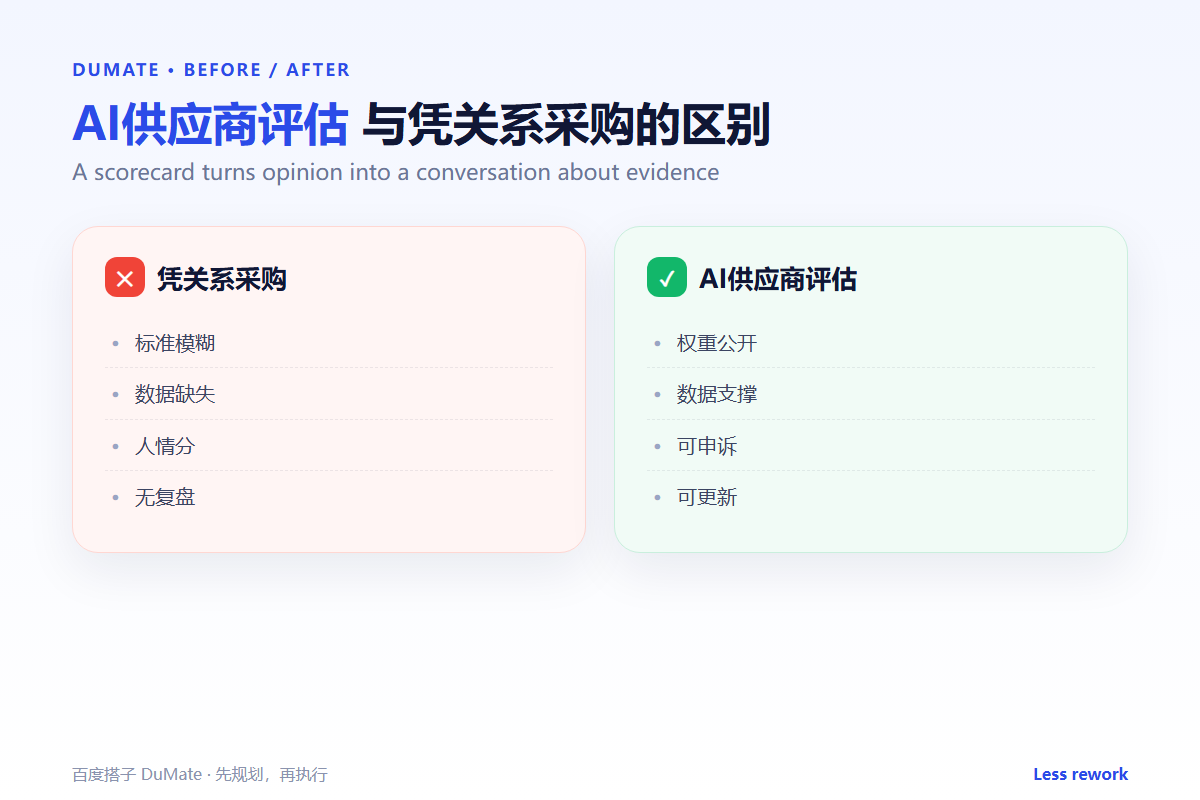
Before, supplier reviews were a list of complaints followed by a promise to do better. After, AI供应商评估 produced a scorecard with evidence, and the meeting focused on two measurable improvements with dates.
A scorecard is not a punishment. It is a shared language for improvement.
Used consistently, AI供应商评估 becomes part of the normal review routine rather than a separate project.
A final check with AI供应商评估 takes a minute and catches the errors that are easiest to miss.
The same AI供应商评估 routine works for small tasks and large ones, which is why teams keep using it.
A Four-Week Rollout
The first week with AI供应商评估 should be a small pilot, not a team-wide launch. Choose one recurring task with a clear output and run it end to end. Keep the sample small enough to check by hand. The point is to see where AI供应商评估 saves time and where it creates review work.
During the pilot, keep a short log of inputs, outputs, and corrections. Record the time spent before and after. AI供应商评估 feels faster even when it is not, so the log matters. At the end of the week, review the log with one colleague and decide whether to continue, change the input, or stop.
In week two, write a one-page standard for input and output. Include what must be checked and who approves the result. AI供应商评估 works better when the standard is visible to everyone. In week three, add permissions and a review step. In week four, compare the results and write a short guide. That guide is what makes AI供应商评估 survive after the first month.
Keep the pilot narrow. A broad rollout hides which step failed, and a narrow one shows exactly where the workflow needs help. Expand only after the narrow case is stable.
Keep the first month simple. One task, one owner, and one weekly review are enough to prove the workflow before it spreads across the team.
Write down what changed after each run. A short note is easier to trust than a memory, and it makes the next improvement obvious.
Review the output before it leaves your desk. A two-minute check catches most of the errors that would otherwise come back as questions.
Keep one example of a good result. New team members learn faster from a concrete reference than from a long explanation.
The first version does not need to be perfect. It needs to be complete enough to review, so the team can see the gaps and fix them in the next round.
FAQ
How many dimensions should we use?
Five to seven. More dimensions make the score hard to explain and easy to manipulate.
What if a supplier refuses to share data?
Score only what you can verify and mark the rest as unrated. Missing data is itself a risk signal.
How often should weights change?
Rarely. Change them at the start of a period, not after scoring.
延伸阅读
Compare quotes with AI采购比价. Access and approval rules are in AI权限管理. For analysis, read AI数据分析工具. Reporting is covered in AI报告生成. Tool selection is in AI效率工具. External references: NIST AI Risk Management Framework and ISO/IEC 42001.
评论
还没有评论,来说两句吧。以下为本文的引用通告: