
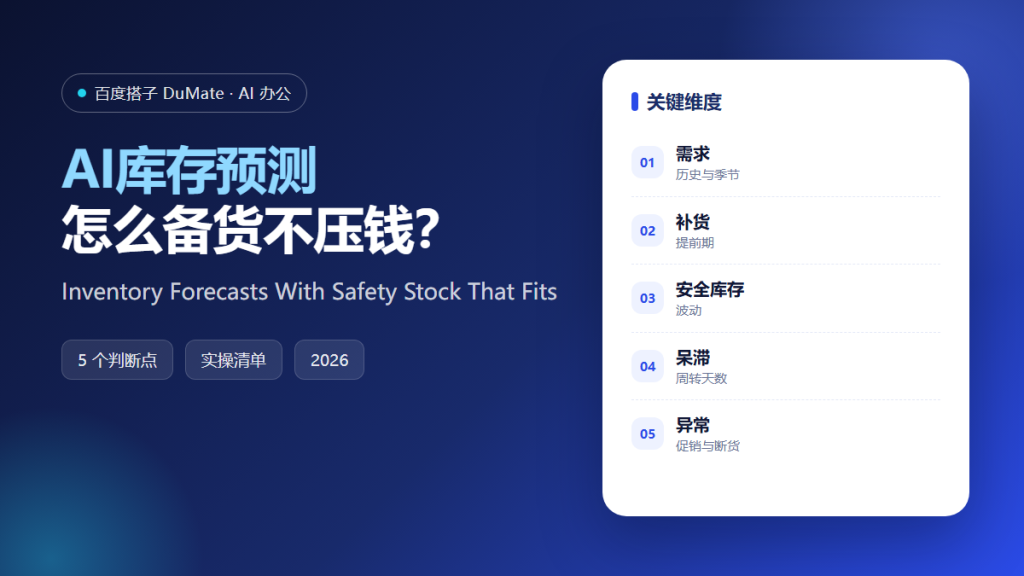
AI库存预测 is a balancing act. Too little stock loses sales, and too much stock ties up cash and creates markdowns. The forecast is never perfect, so the goal is not accuracy for its own sake. The goal is a replenishment rule that performs well when the forecast is wrong.
This guide covers a five-step forecasting process, the data cleaning that matters most, and the monthly review that keeps the model honest.
Key Takeaways
- Clean the sales history before modeling.
- Mark promotions, stockouts, and returns.
- Set safety stock from volatility and lead time.
- Use a reorder point, not a feeling.
- Review forecast error every month.
Why AI库存预测 Needs Clean History
Sales history is not demand history. A stockout looks like low demand, and a promotion looks like a permanent increase. Training a model on that data produces forecasts that repeat past mistakes. AI库存预测 can only be as good as the cleaned input.
The second reason is lead time. A forecast without supply constraints produces orders that arrive too late. The model should output demand, and the rule should translate demand into orders using lead time and variability.
How AI库存预测 Works in Five Steps
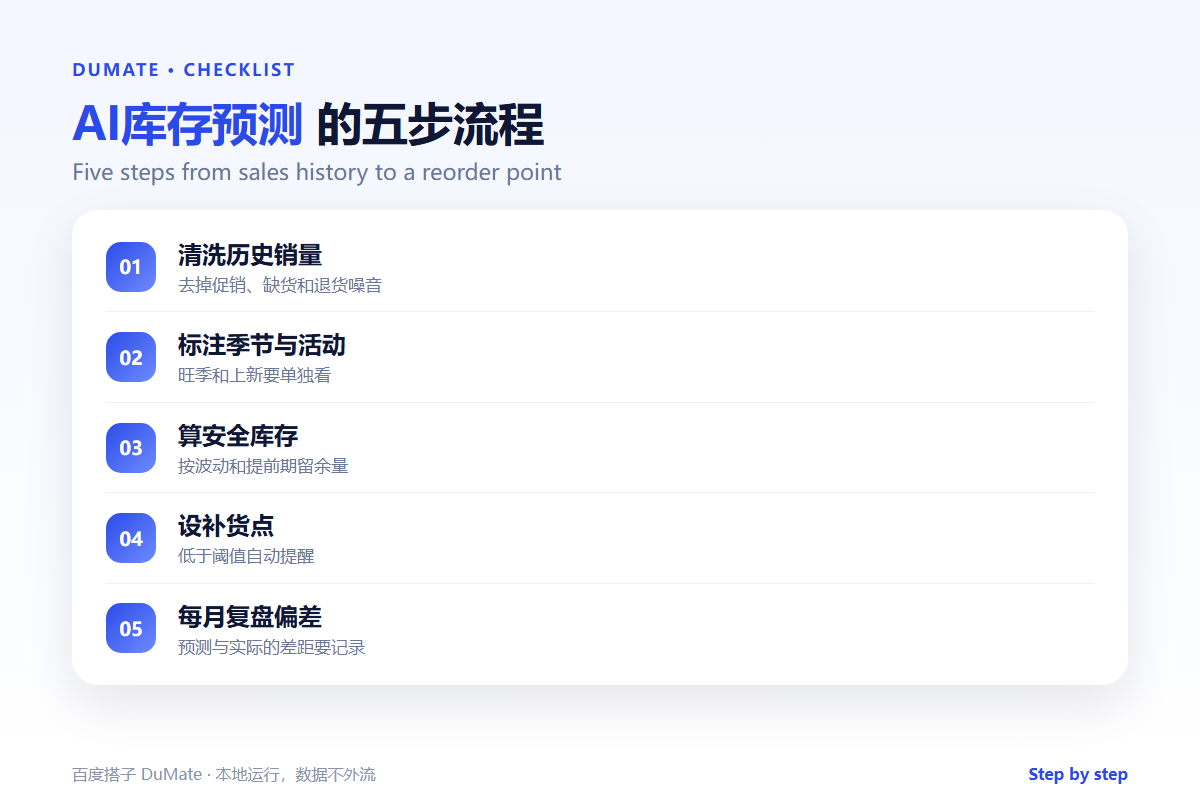
Step 1: Clean the history
Mark stockout days, promotions, returns, and one-off bulk orders. Correct or exclude them. AI库存预测 should be given the corrected series, not the raw export.
Step 2: Separate baseline and seasonality
Estimate a baseline and add seasonal factors for each product family. Do not force seasonality where the data does not support it. AI库存预测 can test several seasonal patterns and show the error for each.
Step 3: Set safety stock
Base it on demand variability and lead-time variability. Higher uncertainty needs more stock, but the relationship is not linear. AI库存预测 can calculate the buffer for a target service level.
Step 4: Define the reorder point
Reorder when stock plus on-order falls below the point. Include minimum order quantities and supplier schedules. AI库存预测 should output a rule, not only a chart.
Step 5: Review the error
Compare forecast with actual every month and record the cause of large misses. Adjust the model or the rule, not both at once. AI库存预测 improves through disciplined review.
A Replenishment Checklist
- Stockouts are marked in the history.
- Promotions are modeled separately.
- Safety stock reflects variability.
- Lead time includes supplier delays.
- Forecast error is reviewed monthly.
Where AI库存预测 Fails
It fails when the product catalog changes quickly, because new items have no history. It also fails when the sales team’s pipeline is ignored, which is especially costly for large accounts.
- New products forecast from a category average.
- Promotions treated as organic demand.
- Lead time assumed to be stable.
- No feedback loop from actuals.
Before and After
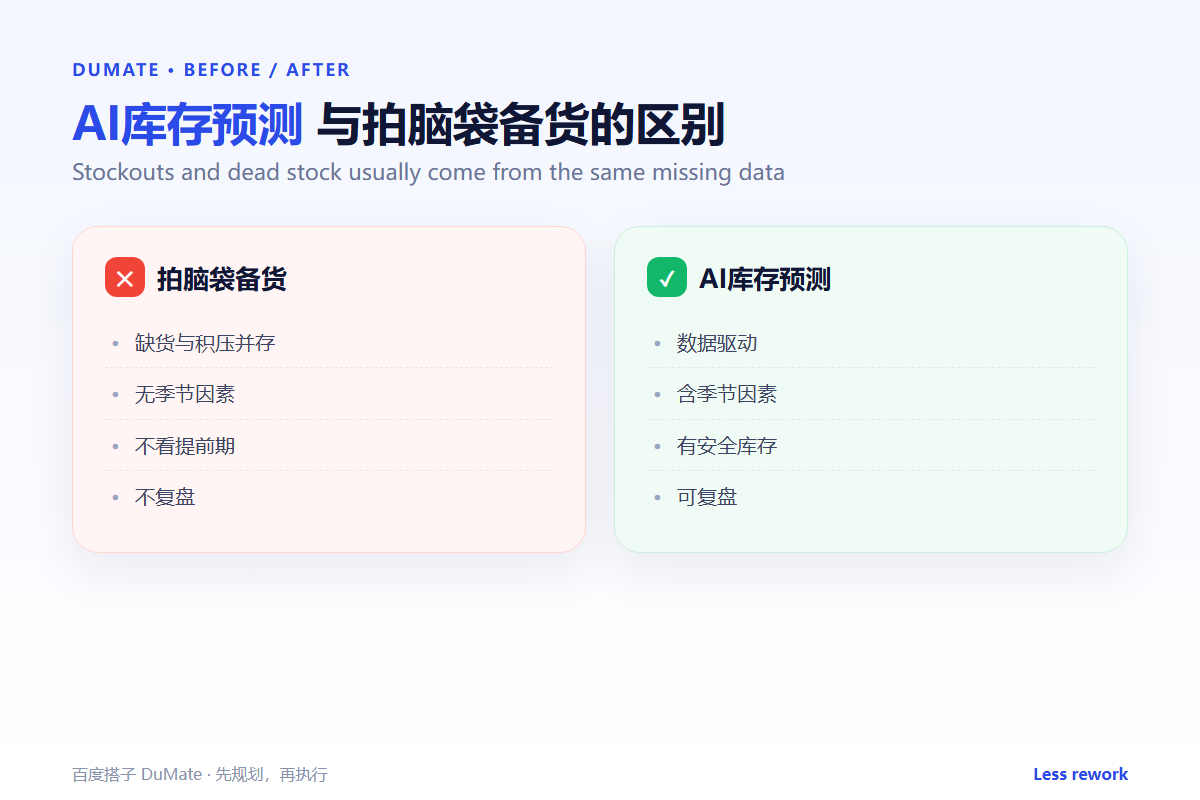
Before, replenishment depended on a weekly meeting and a few strong opinions, and the warehouse carried both stockouts and slow-moving items. After, AI库存预测 produced a baseline, a safety stock, and a reorder point, and the meeting reviewed exceptions instead of every item.
The forecast did not become perfect. The decisions became consistent.
Used consistently, AI库存预测 becomes part of the normal review routine rather than a separate project.
A final check with AI库存预测 takes a minute and catches the errors that are easiest to miss.
The same AI库存预测 routine works for small tasks and large ones, which is why teams keep using it.
Making It Stick Across a Team
A rollout fails when only one person knows how to use AI库存预测. Write a short guide with three sections: when to use it, what good input looks like, and what to check before sharing the output. Keep the guide to one page.
Train in pairs. One person runs the task while the other checks the output against the guide, then swap roles. That exercise surfaces unclear steps faster than a presentation. Keep a shared folder with one strong output, one weak output, and a note explaining the difference. AI库存预测 becomes easier to teach when people can compare real cases.
Review the guide after the first week of use. Remove steps nobody follows and add the questions that keep coming up. A living guide is more useful than a perfect one written in advance. Finally, assign an owner. AI库存预测 without an owner drifts, and the guide becomes outdated. The owner does not need to do every task, only keep the standard current. That small responsibility is what keeps AI库存预测 useful after the initial training.
Make the training practical. People learn the workflow by completing a real task, not by listening to a walkthrough. Set aside thirty minutes for practice and review the result together. Measure one thing: how many outputs pass review without correction. That number is a better indicator than attendance.
Keep the first month simple. One task, one owner, and one weekly review are enough to prove the workflow before it spreads across the team.
Write down what changed after each run. A short note is easier to trust than a memory, and it makes the next improvement obvious.
FAQ
How accurate should a forecast be?
Accuracy depends on the category. What matters is whether the error is stable enough to set safety stock.
What about new products?
Use a comparable product and a short review cycle. Do not pretend the history exists.
How often should safety stock change?
Quarterly, or after a sustained change in variability or lead time.
延伸阅读
Prepare data with AI数据清洗 and AI表格处理. For analysis, read AI数据分析工具. Reporting is covered in AI报告生成. Batch work is covered in AI批量处理. External references: NIST AI Risk Management Framework and ISO/IEC 42001.
评论
还没有评论,来说两句吧。以下为本文的引用通告: