
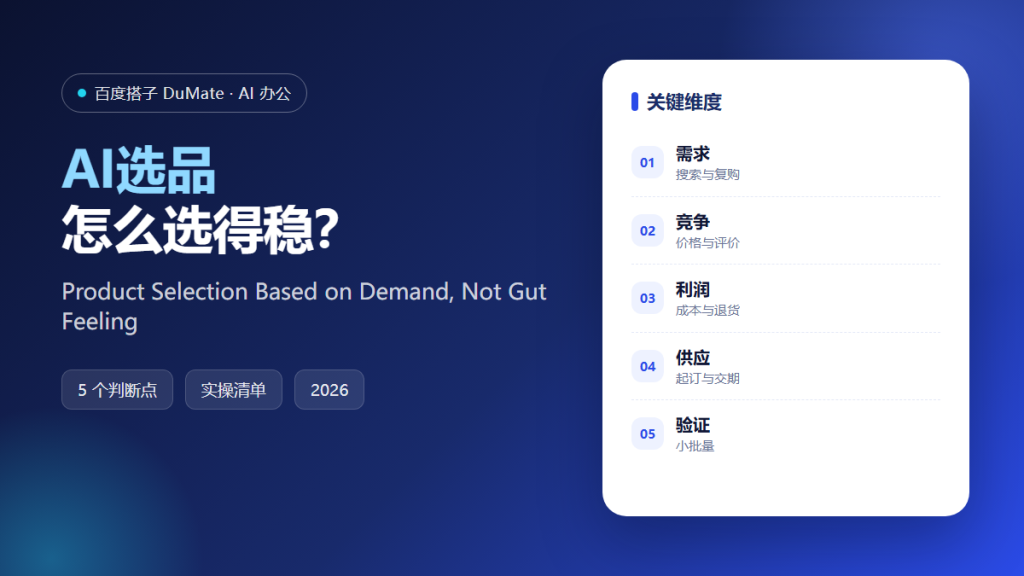
AI选品 should begin with evidence of demand, not with a supplier’s recommendation or a hunch formed at a trade show. The cost of a wrong pick is not the sample order; it is the shelf space, the advertising budget, and the months spent pretending the product is working. A shortlist built on evidence is easier to defend and easier to abandon.
This guide covers demand signals, landed margin, and the five-step routine that decides what to scale and what to drop before the next buying season. It assumes the buyer, not the supplier, sets the agenda.
Key Takeaways
- Look for demand that already exists.
- Calculate margin after fees and returns.
- Check the supplier’s defect history.
- Test the listing before the bulk order.
- Write a drop rule before launch.
Why AI选品 Needs Demand Evidence
A supplier will always describe a product as popular, and the description is not evidence. What counts is a pattern of searches, questions, and purchases that existed before the product arrived. AI选品 that reads those signals starts from a market rather than a warehouse, and the first order can be sized to what the market has already shown. AI选品 that begins with a supplier’s pitch is really just buying, with extra steps.
Margin is the second filter, and it is usually calculated too early. The landed cost includes freight, duties, storage, platform fees, payment fees, and the returns that a new category always produces. AI选品 should model the whole chain at a realistic return rate, because a product that looks profitable at the unit level can lose money on every sale once the extras arrive.
Supply reliability decides whether demand can be served twice. A supplier who ships late in the first month will ship late in the peak month, and the reviews will carry the cost. AI选品 should check defect rates, lead times, and the supplier’s capacity before the listing goes live, not after the first complaint.
How AI选品 Works in Five Steps
Step 1: Read existing demand
Collect search phrases, marketplace questions, and support tickets that mention the problem the product solves. Look for repeated questions with no good answer for sale. A phrase that appears every week without a matching product is a stronger signal than a trend chart with a sharp spike.
Step 2: Model the landed margin
Build the cost from the supplier’s unit price to the customer’s doorstep, including freight, tax, fees, and returns. Then test the model at a lower price than you hope to charge. If the product only works at the optimistic price, it does not work.
Step 3: Check supply and defects
Ask for the defect rate, the replacement policy, and the production capacity for a peak month. Order a sample from the same batch that will ship in volume, and inspect it against the specification. A sample assembled for a buyer is not always a sample from the line. Ask what happens when a batch fails inspection, and who pays for the freight in that case.
Step 4: Let AI选品 test the listing
Before the bulk order, publish a small listing with real photos, a clear specification, and a preorder option. AI选品 can compare the click and conversion pattern with the category baseline, which is more informative than a survey. A weak listing response is cheaper to learn from than a full pallet.
Step 5: Scale or drop
Set the threshold in advance: the conversion rate that justifies a second order and the loss that ends the project. If the listing misses the threshold, stop, sell the remaining stock at cost, and write the reason in the shortlist file. A drop is a result, not a failure of effort.
‘ alt=’AI选品 checklist: demand signal, landed margin and test listing’ />
A Selection Checklist
- Demand existed before the product was sourced.
- The margin survives a realistic return rate.
- The supplier shares defect and lead-time data.
- A small listing was tested before the bulk order.
- The drop rule is written and dated.
Where AI选品 Fails
AI选品 fails when a supplier’s story replaces a demand check. A catalog full of new items feels like progress, and the warehouse fills with products nobody asked for. AI选品 without a threshold becomes a collection of experiments that never conclude.
- Buying because a competitor listed it.
- Counting impressions instead of sales.
- Ignoring returns in the margin model.
- Scaling after one good week.
Before and After
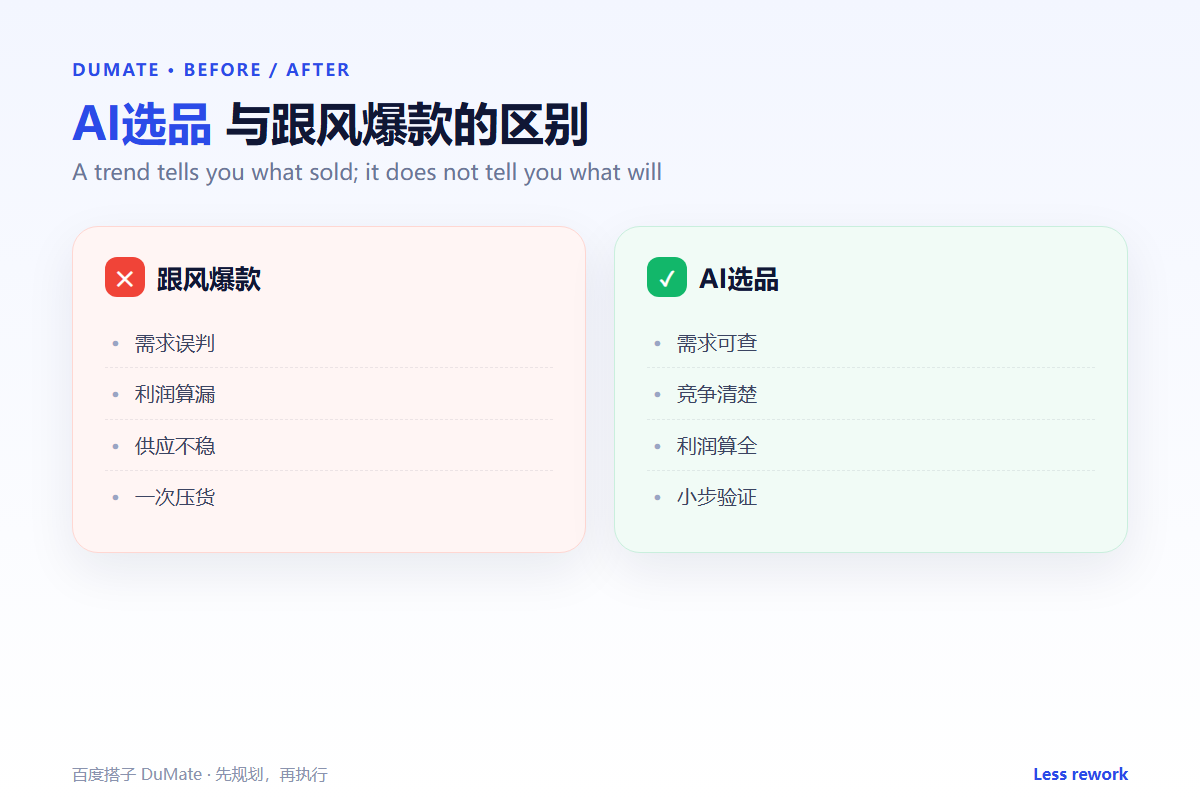
Before, a team ordered two thousand units of a gadget because a supplier promised exclusivity and the photos looked good. The listing received traffic and almost no orders, and the inventory sat for a year. After, AI选品 was used to read search phrases for the same problem, model the margin, and test a small listing first.
The test sold sixty units in three weeks at a modest margin. The team ordered a second batch, and the supplier’s defect rate stayed inside the range they had checked before the first order.
FAQ
How much demand is enough?
Enough to cover the first order within a defined window at a realistic price. A small, repeating signal beats a large, one-off spike.
Should we always start with a preorder?
Not always, but a test listing or a small batch serves the same purpose. AI选品 needs a response from buyers, not an opinion from the team.
What if the supplier is the only one?
Then the supply risk becomes part of the price. Keep a backup source in mind, and do not build a season on a single line.
延伸阅读
For stock planning after the pick, see inventory forecast, and for demand sizes, sales forecast. Supplier quality is covered in supplier evaluation, and cost comparison in procurement comparison. For the listing itself, read product copy. External references: NIST AI Risk Management Framework and ISO/IEC 42001.
评论
还没有评论,来说两句吧。