
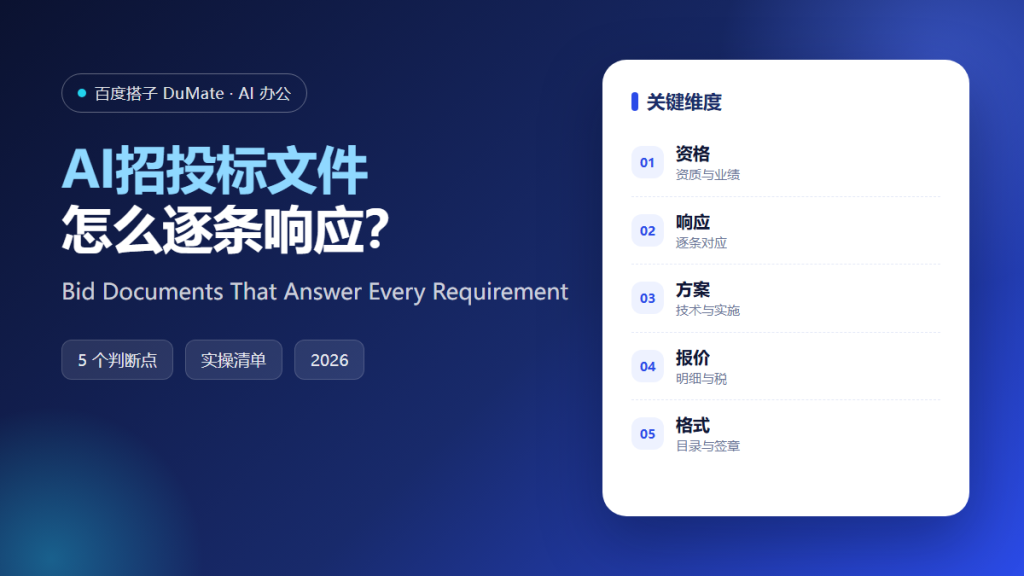
AI招投标文件 is scored on compliance before it is scored on quality. A strong solution that misses a required form can be rejected. The first task is therefore a complete map of the requirements, not a beautiful narrative.
This guide covers a five-step process for assembling a bid, the response matrix that prevents omissions, and the final checks that protect against disqualification.
Key Takeaways
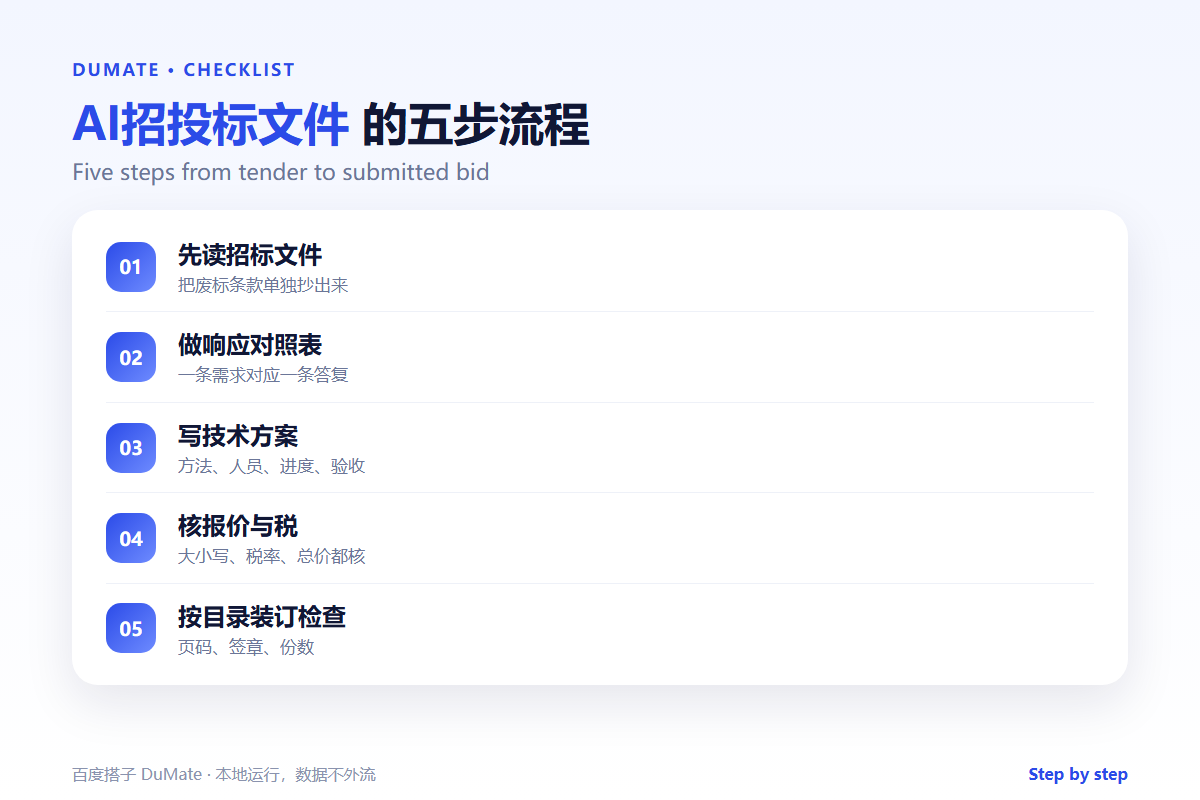
- Read the tender and extract the disqualification clauses.
- Build a requirement-by-requirement matrix.
- Write the technical plan around delivery.
- Check pricing, tax, and totals.
- Follow the required format and signatures.
Why AI招投标文件 Needs a Response Matrix
Tenders contain dozens of requirements spread across sections. Without a matrix, the team answers what it finds interesting and misses what the evaluator scores. AI招投标文件 can extract the requirements and build the matrix, which is the highest-value use of the tool.
The second reason is review. A matrix lets a second person check completeness without reading the entire bid. That shortens the final review and reduces avoidable errors.
How AI招投标文件 Works in Five Steps
Step 1: Extract the requirements
List every mandatory item, including forms, certificates, and format rules. Mark the disqualification clauses separately. AI招投标文件 should quote the clause number for traceability.
Step 2: Build the matrix
Create columns for requirement, response, evidence, and owner. Every row must be answered. AI招投标文件 can draft the first version; the bid manager confirms it.
Step 3: Write the technical plan
Cover method, team, schedule, quality control, and acceptance. Tie each section to a scored criterion. AI招投标文件 can produce a structured draft from the matrix.
Step 4: Check the commercial offer
Verify unit prices, quantities, tax, totals, and the written amount. Check that the offer matches the scope in the technical plan. AI招投标文件 should not calculate prices without a finance review.
Step 5: Format and sign
Follow the required order, page limits, and signature locations. Produce the requested number of copies. AI招投标文件 can generate a checklist, but a person must inspect the final document.
A Bid Submission Checklist
- Every requirement has a response.
- Disqualification clauses are satisfied.
- Pricing matches the technical scope.
- Forms and certificates are current.
- Signatures and copies are complete.
Where AI招投标文件 Fails
It fails when the team writes a generic company introduction instead of answering the criteria. It also fails when the technical plan promises capacity that operations has not confirmed.
- Boilerplate that ignores the tender.
- Certificates that expire before submission.
- Prices that do not match the scope.
- Missing signatures or copies.
Before and After
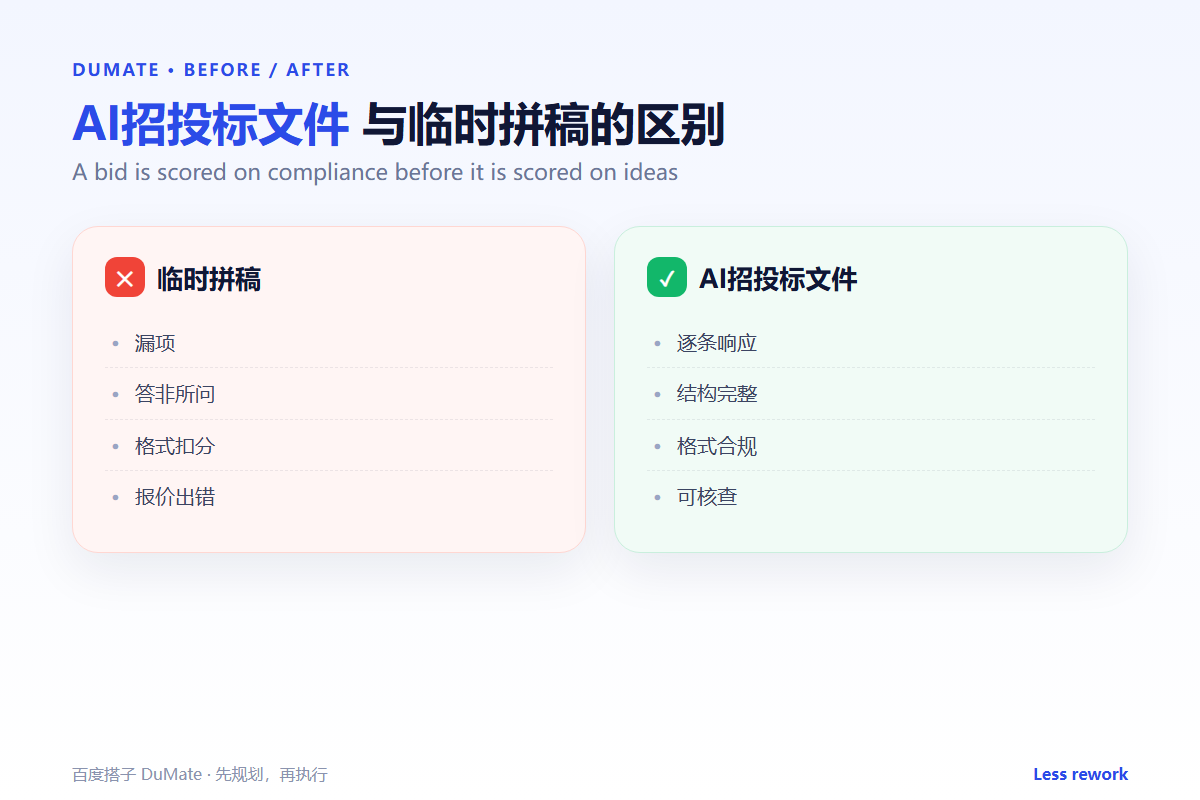
Before, the team assembled a bid from an old template and lost points for a missing form. After, AI招投标文件 produced a requirement matrix, the team answered every row, and the final review took an afternoon instead of a night.
A bid is won by completeness first and brilliance second.
Used consistently, AI招投标文件 becomes part of the normal review routine rather than a separate project.
A final check with AI招投标文件 takes a minute and catches the errors that are easiest to miss.
The same AI招投标文件 routine works for small tasks and large ones, which is why teams keep using it.
Making It Stick Across a Team
A rollout fails when only one person knows how to use AI招投标文件. Write a short guide with three sections: when to use it, what good input looks like, and what to check before sharing the output. Keep the guide to one page.
Train in pairs. One person runs the task while the other checks the output against the guide, then swap roles. That exercise surfaces unclear steps faster than a presentation. Keep a shared folder with one strong output, one weak output, and a note explaining the difference. AI招投标文件 becomes easier to teach when people can compare real cases.
Review the guide after the first week of use. Remove steps nobody follows and add the questions that keep coming up. A living guide is more useful than a perfect one written in advance. Finally, assign an owner. AI招投标文件 without an owner drifts, and the guide becomes outdated. The owner does not need to do every task, only keep the standard current. That small responsibility is what keeps AI招投标文件 useful after the initial training.
Make the training practical. People learn the workflow by completing a real task, not by listening to a walkthrough. Set aside thirty minutes for practice and review the result together. Measure one thing: how many outputs pass review without correction. That number is a better indicator than attendance.
Keep the first month simple. One task, one owner, and one weekly review are enough to prove the workflow before it spreads across the team.
Write down what changed after each run. A short note is easier to trust than a memory, and it makes the next improvement obvious.
Review the output before it leaves your desk. A two-minute check catches most of the errors that would otherwise come back as questions.
FAQ
Can AI write the whole bid?
It can draft sections. The solution, the commitments, and the pricing must come from the people who will deliver them.
How early should we start?
As soon as the tender is published. The matrix alone often takes a day.
What should be checked last?
Signatures, copies, and the written amount. These are the errors that disqualify a good bid.
延伸阅读
For the review stage, see AI标书检查. Prepare tables with AI表格处理. Access rules are in AI权限管理. Document assembly is covered in AI文档处理. Reporting is covered in AI报告生成. External references: NIST AI Risk Management Framework and ISO/IEC 42001.
评论
还没有评论,来说两句吧。以下为本文的引用通告: