
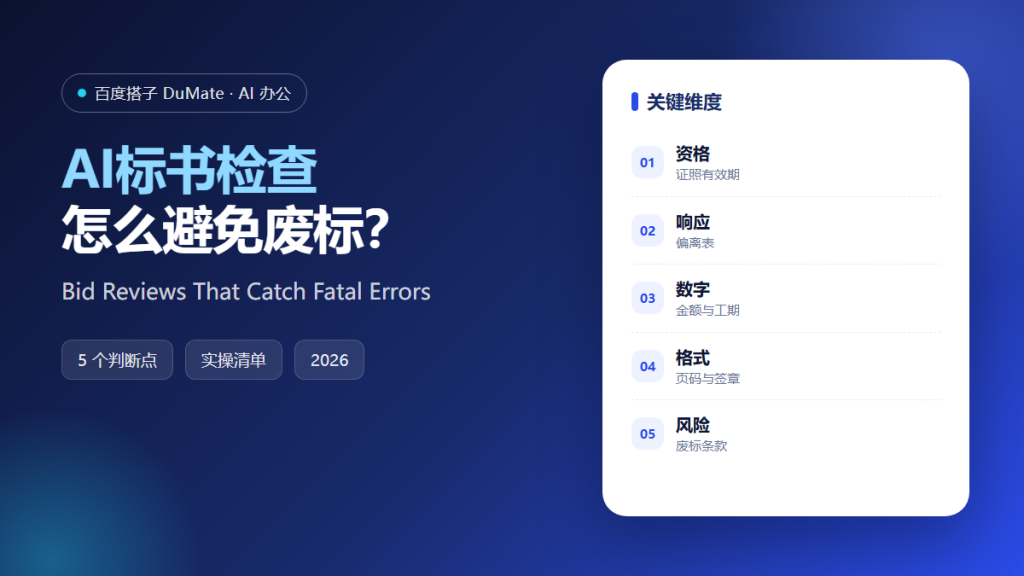
AI标书检查 is a risk-reduction step, not a proofreading step. Most bid failures are not caused by bad writing. They are caused by a missing certificate, a mismatched number, or a signature on the wrong page.
This guide covers a five-step review process, the errors that appear most often, and the division of labor that makes a second review useful.
Key Takeaways
- Start with the disqualification clauses.
- Check every requirement against the response matrix.
- Cross-check all numbers.
- Inspect signatures, seals, and page numbers.
- Use two reviewers with different checklists.
Why AI标书检查 Needs a Separate Review
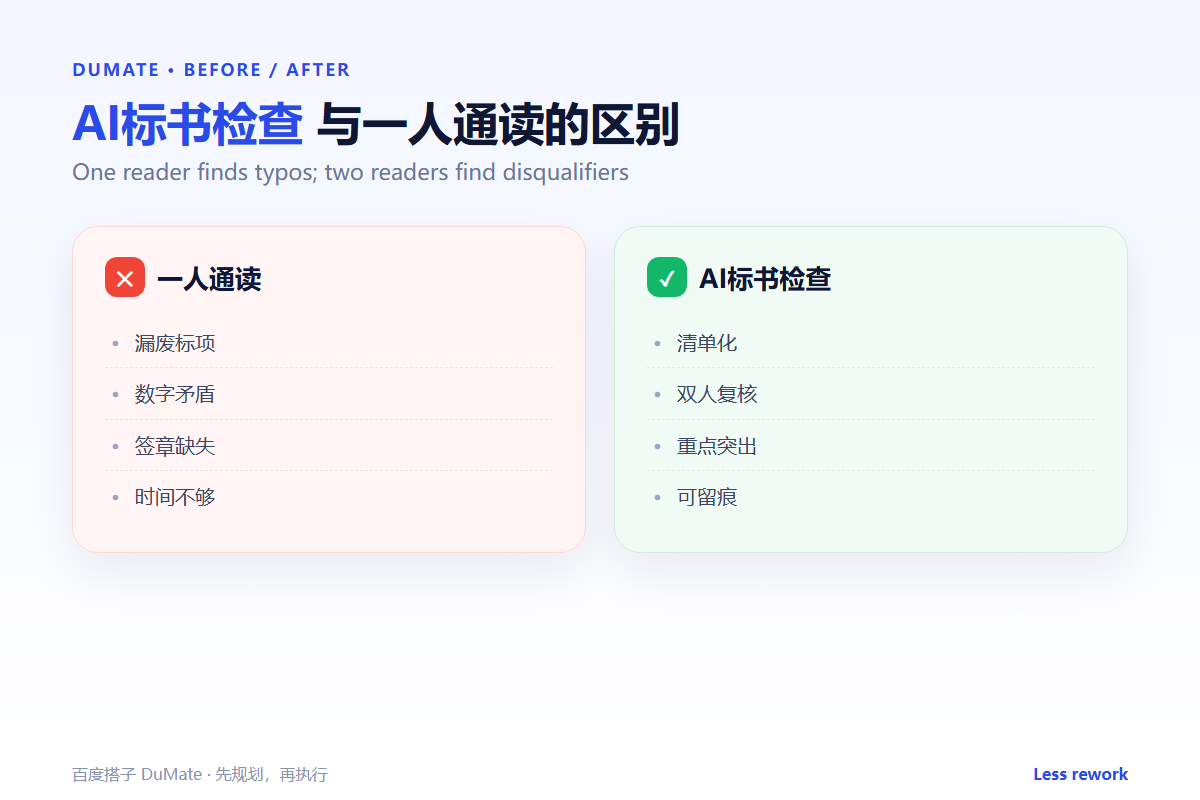
The person who wrote the bid reads what they intended, not what is on the page. A separate reviewer sees the document as an evaluator would. AI标书检查 can generate the checklist and compare versions, but a fresh pair of eyes is still the best detector.
The second reason is time pressure. Bids are usually finished late, and fatigue causes exactly the errors that disqualify. A structured checklist keeps the review from depending on memory.
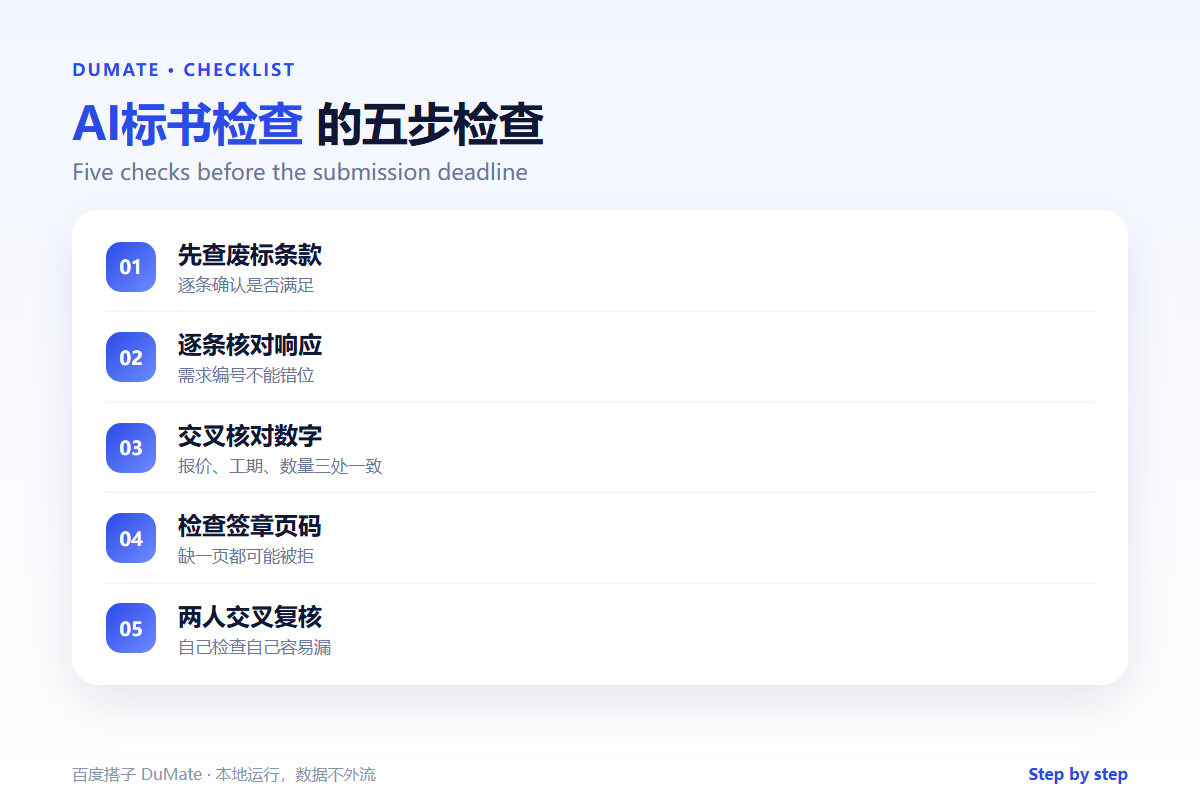
How AI标书检查 Works in Five Steps
Step 1: Review the disqualification clauses
Read them first and confirm each one. If a clause is ambiguous, ask the buyer before the deadline. AI标书检查 should list these clauses separately from the general requirements.
Step 2: Check requirement coverage
Compare the response matrix with the final document. Look for requirements that were answered in a draft but dropped in the final version. AI标书检查 can highlight missing sections.
Step 3: Cross-check numbers
Compare the price table, the written amount, the schedule, and the quantities. Ask two people to read the numbers independently. AI标书检查 can flag inconsistencies but cannot confirm the correct value.
Step 4: Inspect the form
Check signatures, seals, page numbers, table of contents, and the number of copies. These are mechanical errors with severe consequences. AI标书检查 should produce a printable checklist.
Step 5: Run a second review
Give the document to someone who did not write it. Ask them to review against the tender, not against the draft. AI标书检查 can support both reviewers with different checklists.
A Review Checklist
- Disqualification clauses are satisfied.
- Every requirement has a response.
- Numbers agree across sections.
- Signatures and seals are in place.
- The copy count matches the tender.
Where AI标书检查 Fails
It fails when the reviewer only runs a spelling check. It also fails when the same person reviews the document twice, because the second pass repeats the first blind spots.
- Checking style before compliance.
- Trusting a previous version.
- Ignoring the appendices.
- Reviewing after the deadline buffer is gone.
Before and After
Before, a team submitted a technically strong bid with an expired certificate and lost the opportunity. After, AI标书检查 put the certificate date on the first page of the checklist, and the renewal happened a week before submission.
The review is not glamorous. It is the difference between being evaluated and being excluded.
Used consistently, AI标书检查 becomes part of the normal review routine rather than a separate project.
A final check with AI标书检查 takes a minute and catches the errors that are easiest to miss.
Measuring Whether It Works
Measure AI标书检查 with three numbers: time spent, rework required, and output accepted without changes. Track them for four weeks before drawing a conclusion. Set a baseline from the manual process, because without a baseline any result looks like progress.
Time alone is misleading. A task that finishes faster but needs a full rewrite is not an improvement. Pair time with rework, and pair both with the quality of the final output. AI标书检查 should be compared with how the work was done before, not with an ideal.
Review the numbers monthly with the people doing the work. They know why a week was slow or why rework increased. AI标书检查 improves when the review includes the operators, not only the managers. Keep the dashboard small: three numbers and one note are enough.
Also record the exceptions. A week with an unusual campaign or a system outage is not a fair test. Note the context next to the numbers so a later reader does not compare incomparable weeks. When the numbers are stable, expand the scope; when they move the wrong way, fix the input before adding more use cases. The goal is not to prove that AI标书检查 works, but to know when it works and when it does not.
Keep the first month simple. One task, one owner, and one weekly review are enough to prove the workflow before it spreads across the team.
Write down what changed after each run. A short note is easier to trust than a memory, and it makes the next improvement obvious.
Review the output before it leaves your desk. A two-minute check catches most of the errors that would otherwise come back as questions.
Keep one example of a good result. New team members learn faster from a concrete reference than from a long explanation.
FAQ
How long should a review take?
At least half a day for a complex bid, with two reviewers. The last hour should be reserved for form checks.
What is the most common disqualifier?
Missing or expired documents. Numbers and signatures come next.
Can AI标书检查 replace the buyer’s clarification?
No. If a requirement is ambiguous, ask the buyer in writing before the deadline.
延伸阅读
For assembly, see AI招投标文件. Access rules are in AI权限管理. Document handling is covered in AI文档处理. Planning is covered in AI任务规划. Tool selection is in AI效率工具. External references: NIST AI Risk Management Framework and ISO/IEC 42001.
评论
还没有评论,来说两句吧。以下为本文的引用通告: