
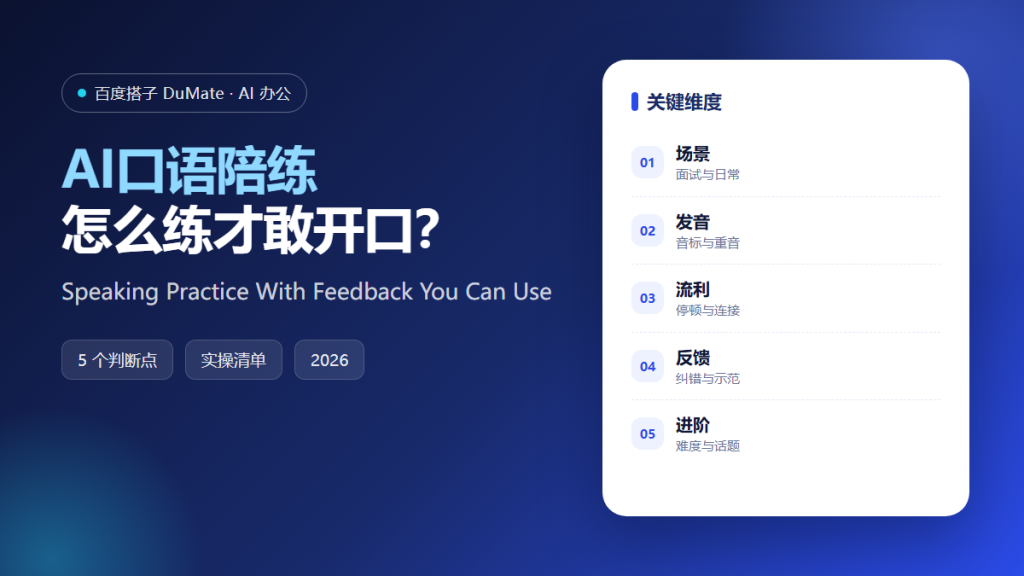
AI口语陪练 solves the biggest barrier to speaking: the fear of wasting another person’s time. A patient practice partner is available at any hour, repeats the same scenario, and never sighs. But practice only works when it is structured.
This guide covers a five-step speaking routine, the feedback that actually changes speech, and the progression that keeps practice challenging without becoming discouraging.
Key Takeaways
- Choose one real scenario per session.
- Learn a small set of high-frequency phrases.
- Record and listen to yourself.
- Fix three errors at a time.
- Increase difficulty gradually.
Why AI口语陪练 Needs a Scenario
Free conversation drifts toward the vocabulary you already know. A scenario creates a target: introduce yourself, explain a delay, negotiate a deadline. AI口语陪练 can play the other role and keep the conversation on task.
The second reason is repetition. Fluency comes from saying the same useful phrases in different contexts, not from learning new words every day.
How AI口语陪练 Works in Five Steps
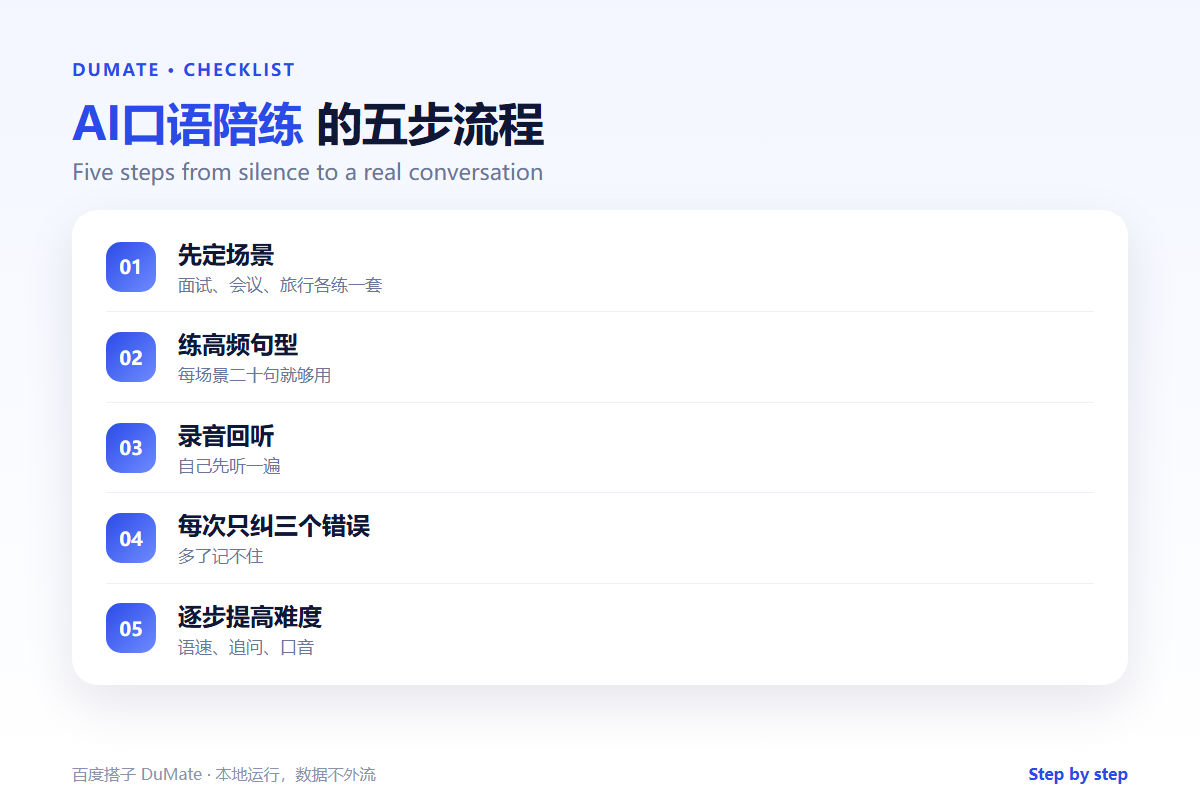
Step 1: Pick the scenario
Choose a situation you will actually face this month. AI口语陪练 should be told the role, the goal, and the level of formality.
Step 2: Prepare a few phrases
Learn five to ten expressions that fit the scenario. Practice them until they are automatic. AI口语陪练 can model pronunciation and provide variations.
Step 3: Speak and record
Run the conversation and record it. Do not stop to correct yourself mid-sentence. AI口语陪练 should keep the flow and note errors for later.
Step 4: Review three errors
Listen to the recording and choose three issues: one pronunciation, one grammar, one word choice. Fixing everything at once is overwhelming. AI口语陪练 can explain the three corrections with examples.
Step 5: Repeat and raise the difficulty
Run the same scenario again with the corrections. Then increase speed, add a follow-up question, or change the accent. AI口语陪练 should adapt to the learner’s level.
A Practice Checklist
- The scenario is realistic.
- Key phrases are practiced.
- The session is recorded.
- Only three errors are targeted.
- The next session is slightly harder.
Where AI口语陪练 Fails
It fails when the learner reads instead of speaking. It also fails when feedback is a long list, which nobody can apply in real time.
- Scripted answers.
- No recording.
- Too much correction.
- No progression.
Before and After
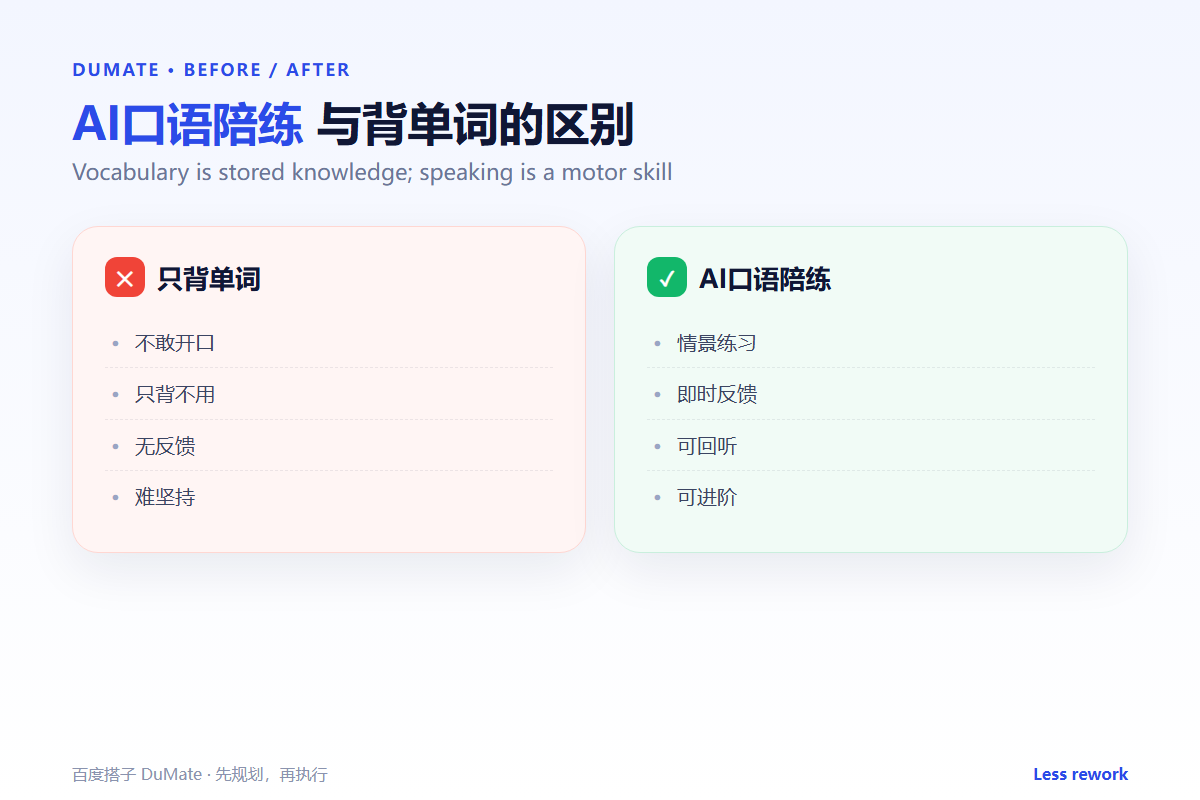
Before, a learner studied vocabulary for months and froze in the first meeting. After, AI口语陪练 rehearsed the meeting scenario three times, and the learner delivered the introduction without reading from notes.
Speaking is a physical skill. It improves through repetition, not accumulation.
Used consistently, AI口语陪练 becomes part of the normal review routine rather than a separate project.
A final check with AI口语陪练 takes a minute and catches the errors that are easiest to miss.
The same AI口语陪练 routine works for small tasks and large ones, which is why teams keep using it.
Measuring Whether It Works
Pick three numbers
Measure AI口语陪练 with three numbers: time spent, rework required, and output accepted without changes. Track them for four weeks before drawing a conclusion. Set a baseline from the manual process, because without a baseline any result looks like progress.
Pair time with rework
Time alone is misleading. A task that finishes faster but needs a full rewrite is not an improvement. Pair time with rework, and pair both with the quality of the final output. AI口语陪练 should be compared with how the work was done before, not with an ideal.
Review with the operators
Review the numbers monthly with the people doing the work. They know why a week was slow or why rework increased. AI口语陪练 improves when the review includes the operators, not only the managers. Keep the dashboard small: three numbers and one note are enough.
Record the exceptions
Also record the exceptions. A week with an unusual campaign or a system outage is not a fair test. Note the context next to the numbers so a later reader does not compare incomparable weeks.
Expand only when stable
When the numbers are stable, expand the scope; when they move the wrong way, fix the input before adding more use cases. The goal is not to prove that AI口语陪练 works, but to know when it works and when it does not.
Keep the first month simple
Keep the first month simple. One task, one owner, and one weekly review are enough to prove the workflow before it spreads across the team.
Write down what changed
Write down what changed after each run. A short note is easier to trust than a memory, and it makes the next improvement obvious.
Review the output before it leaves
Review the output before it leaves your desk. A two-minute check catches most of the errors that would otherwise come back as questions.
Keep one good example
Keep one example of a good result. New team members learn faster from a concrete reference than from a long explanation.
Ship a complete first version
The first version does not need to be perfect. It needs to be complete enough to review, so the team can see the gaps and fix them in the next round.
Keep notes next to the work
Write the review notes in the same place as the work. Notes stored somewhere else are rarely read when the next decision arrives.
FAQ
How long should a session be?
Fifteen to twenty minutes of focused speaking is enough. Fatigue reduces quality.
Should I use a script?
Use it to prepare, then put it away. The goal is to speak without reading.
How do I know I am improving?
Record the same scenario every two weeks and compare. Fewer pauses and clearer structure are the signals.
延伸阅读
For study planning, see AI学习计划. For error review, read AI错题整理. Transcription is covered in AI语音转文字. Translation is in AI翻译工具. For drafting, read AI写作助手. External references: W3C Web Accessibility Initiative and NIST AI Risk Management Framework.
评论
还没有评论,来说两句吧。以下为本文的引用通告: