
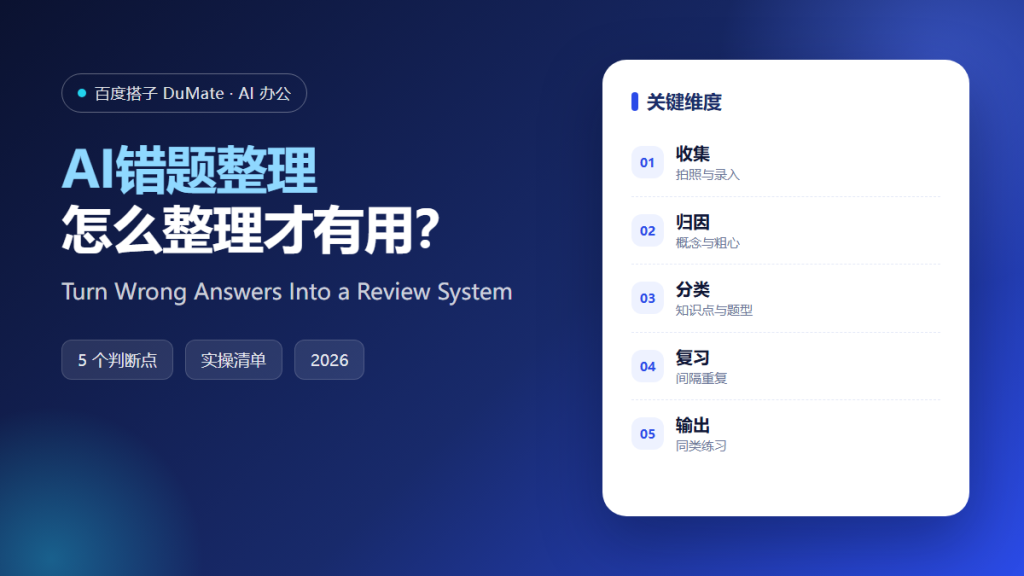
AI错题整理 is not about making a neat notebook. It is about finding the gap behind the mistake and testing whether the gap is closed. A page of copied answers feels productive and changes nothing.
This guide covers a five-step method for turning wrong answers into a review system, the classification that makes patterns visible, and the review schedule that keeps the work from fading.
Key Takeaways
- Keep the original question and answer.
- Classify the cause before rewriting.
- Group by knowledge point.
- Review on a spaced schedule.
- Generate similar questions to confirm mastery.
Why AI错题整理 Needs Error Classification
Not every mistake is a knowledge gap. Some are careless reading, some are calculation slips, and some are genuine misconceptions. The remedy differs. AI错题整理 should tag the cause, because a review plan for misconceptions is useless for careless errors.
The second reason is grouping. Ten mistakes in the same topic are one problem, not ten. Grouping reduces the workload and makes the pattern visible.
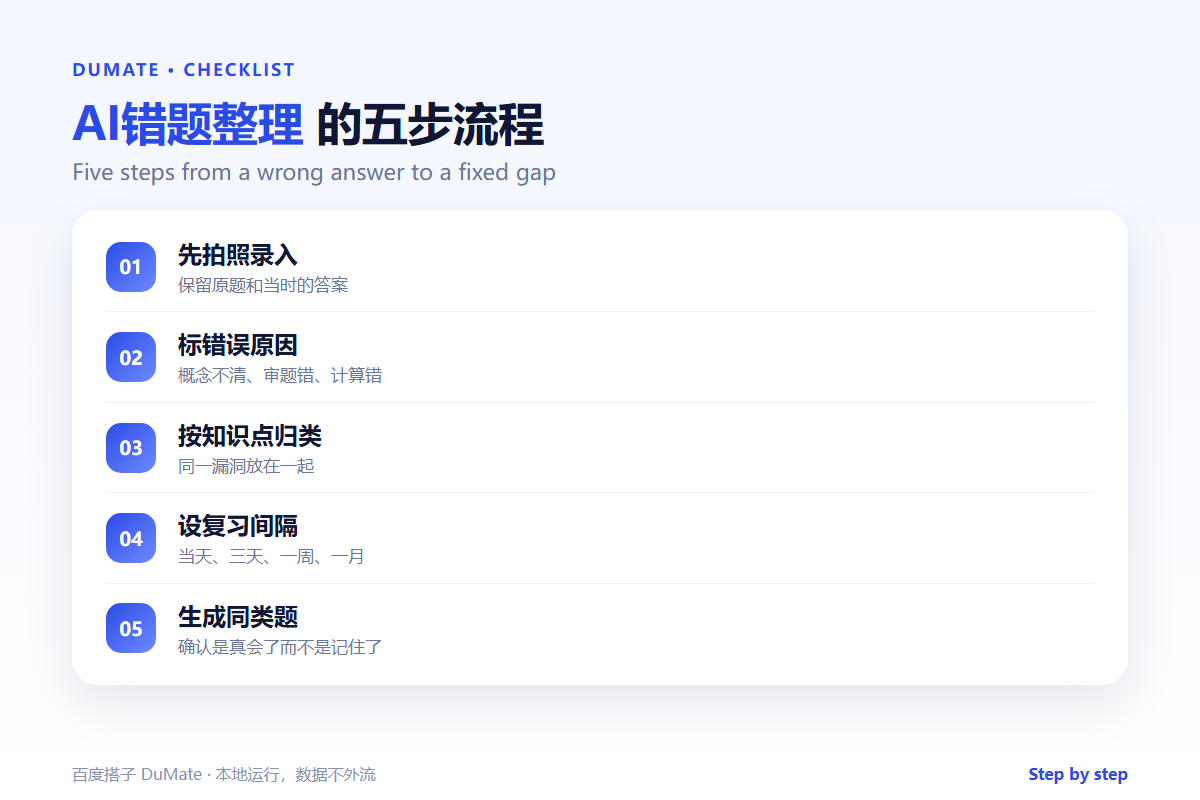
How AI错题整理 Works in Five Steps
Step 1: Capture the original
Photograph or copy the question and the answer exactly as written. Do not correct it yet. AI错题整理 should preserve what the learner actually did.
Step 2: Classify the cause
Choose one: concept, method, reading, or calculation. Add a short note. AI错题整理 can suggest a category, but the learner should confirm.
Step 3: Group by knowledge point
Tag each item with a topic and a question type. Sort the list by tag. AI错题整理 can build the index and count the frequency.
Step 4: Schedule review
Review after one day, three days, one week, and one month. Mark each review as correct or incorrect. AI错题整理 can generate the schedule and reminders.
Step 5: Practice similar questions
Generate two or three variations of each wrong question. Solve them without looking at the answer. AI错题整理 confirms whether the learner recognized the pattern or memorized the solution.
A Review Checklist
- The original answer is preserved.
- Each error has a cause.
- Items are grouped by topic.
- Review dates are scheduled.
- Similar questions are practiced.
Where AI错题整理 Fails
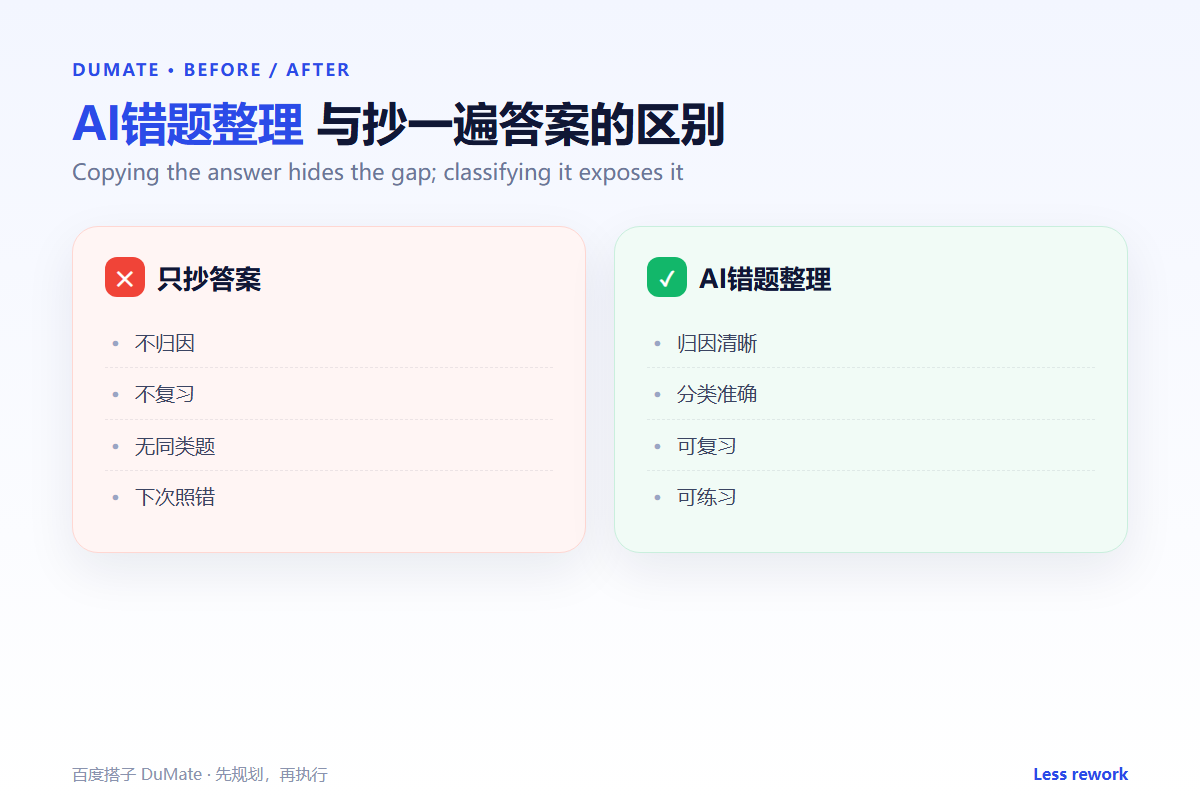
It fails when the learner copies the correct answer without understanding the error. It also fails when the collection grows faster than the review, which turns the notebook into an archive.
- No cause classification.
- Too many items, no review.
- Memorizing answers.
- No similar-question practice.
Before and After
Before, a student copied every wrong answer into a notebook and never opened it again. After, AI错题整理 grouped the errors into four topics, scheduled reviews, and generated similar questions. The next test showed improvement in three of the four.
The value is not the record. It is the repeated retrieval.
Used consistently, AI错题整理 becomes part of the normal review routine rather than a separate project.
A final check with AI错题整理 takes a minute and catches the errors that are easiest to miss.
The same AI错题整理 routine works for small tasks and large ones, which is why teams keep using it.
Making It Stick Across a Team
A rollout fails when only one person knows how to use AI错题整理. Write a short guide with three sections: when to use it, what good input looks like, and what to check before sharing the output. Keep the guide to one page.
Train in pairs. One person runs the task while the other checks the output against the guide, then swap roles. That exercise surfaces unclear steps faster than a presentation. Keep a shared folder with one strong output, one weak output, and a note explaining the difference. AI错题整理 becomes easier to teach when people can compare real cases.
Review the guide after the first week of use. Remove steps nobody follows and add the questions that keep coming up. A living guide is more useful than a perfect one written in advance. Finally, assign an owner. AI错题整理 without an owner drifts, and the guide becomes outdated. The owner does not need to do every task, only keep the standard current. That small responsibility is what keeps AI错题整理 useful after the initial training.
Make the training practical. People learn the workflow by completing a real task, not by listening to a walkthrough. Set aside thirty minutes for practice and review the result together. Measure one thing: how many outputs pass review without correction. That number is a better indicator than attendance.
Keep the first month simple. One task, one owner, and one weekly review are enough to prove the workflow before it spreads across the team.
Write down what changed after each run. A short note is easier to trust than a memory, and it makes the next improvement obvious.
Review the output before it leaves your desk. A two-minute check catches most of the errors that would otherwise come back as questions.
Keep one example of a good result. New team members learn faster from a concrete reference than from a long explanation.
FAQ
How many mistakes should I review at once?
Ten to fifteen. More becomes a reading task rather than a retrieval task.
Should I write the correct answer?
Yes, but only after classifying the cause. The explanation matters more than the answer.
How long should I keep an item?
Until two consecutive reviews are correct and a similar question is solved independently.
延伸阅读
For planning, see AI学习计划. For drafting explanations, read AI写作助手. Organize material in an AI知识库. For tasks, see AI待办事项. Tool selection is in AI效率工具. External references: NIST AI Risk Management Framework and ISO/IEC 42001.
评论
还没有评论,来说两句吧。