
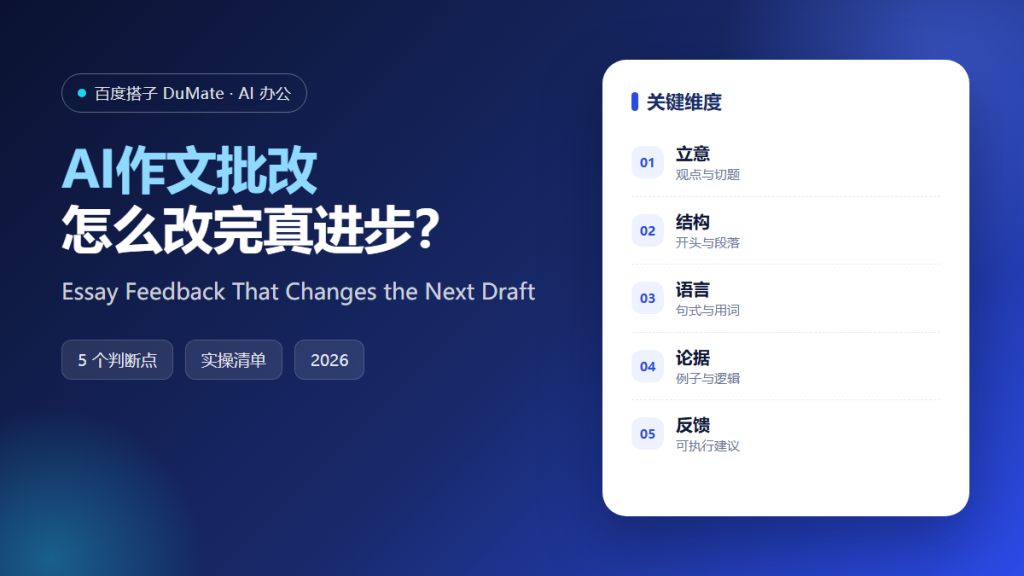
AI作文批改 can produce a score in seconds, and a score is the least useful part. A student who receives 78 out of 100 learns almost nothing. A student who receives two specific revisions and a model sentence learns something they can use in the next draft.
This guide covers a five-step feedback process, the order in which problems should be addressed, and the follow-up that turns correction into improvement.
Key Takeaways
- Check relevance before language.
- Mark structural problems with examples.
- Rewrite two or three sentences as models.
- Give no more than two action items.
- Compare the next draft with the feedback.
Why AI作文批改 Needs an Order
Correcting grammar in an off-topic essay wastes effort. The first question is whether the essay answers the prompt. The second is whether the structure supports the answer. Language comes last, because it is the easiest to fix once the ideas are in place.
The second reason is attention. Students can act on two or three changes. A page of red marks produces discouragement, not learning.
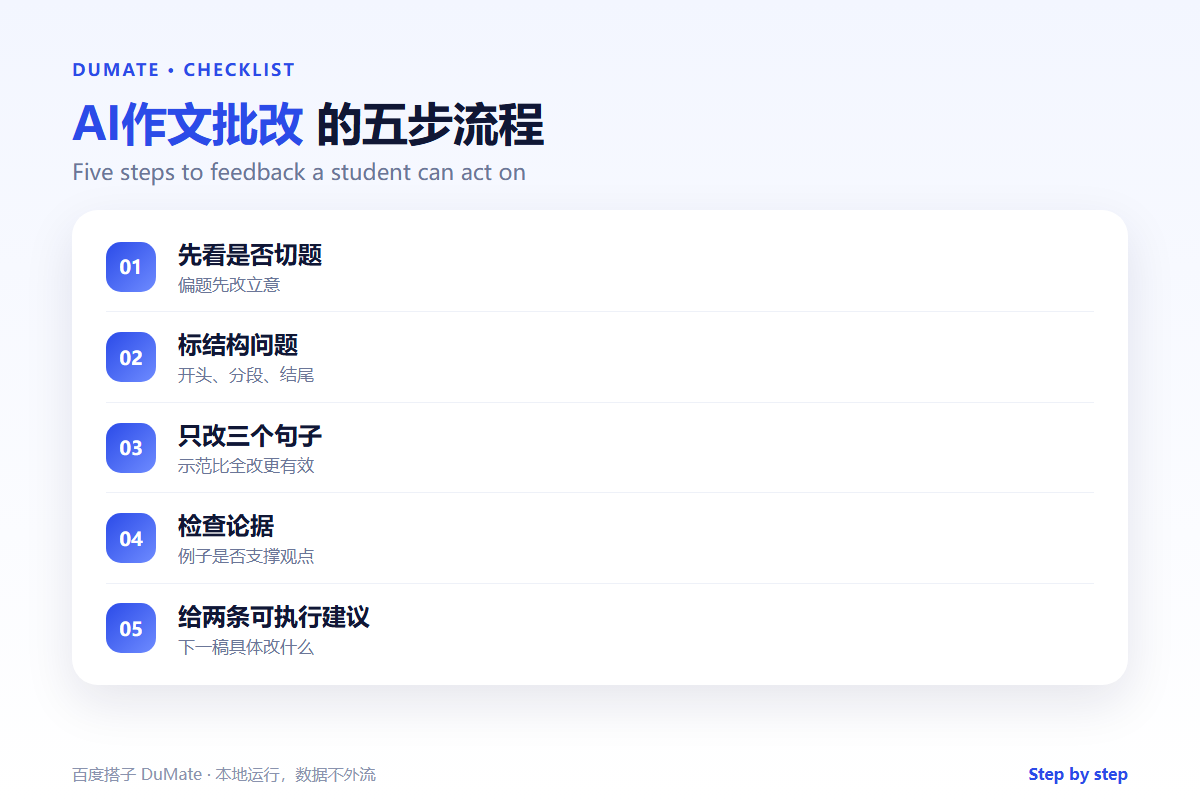
How AI作文批改 Works in Five Steps
Step 1: Check relevance
Compare the essay with the prompt. Identify the thesis and whether it answers the question. AI作文批改 should quote the prompt and the thesis side by side.
Step 2: Review the structure
Look at the opening, the paragraph order, and the conclusion. Mark where the argument jumps or repeats. AI作文批改 can outline the essay to make the structure visible.
Step 3: Check evidence
Ask whether each claim has an example, a reason, or a source. Flag unsupported claims. AI作文批改 should distinguish between a missing example and a weak one.
Step 4: Model two or three sentences
Rewrite a few sentences to show a stronger pattern. Do not rewrite the whole essay. AI作文批改 should explain why the model works.
Step 5: Assign two actions
Give the student two specific tasks for the next draft, such as adding a counterargument or splitting a long paragraph. AI作文批改 should track whether the actions were completed.
A Feedback Checklist
- The essay answers the prompt.
- The structure is visible.
- Claims have evidence.
- Model sentences are provided.
- No more than two actions are assigned.
Where AI作文批改 Fails
It fails when it rewrites the essay in its own voice, which removes the student’s ownership. It also fails when it scores style before relevance, which rewards polished emptiness.
- Full rewrites instead of models.
- Scores without explanation.
- Too many corrections.
- No follow-up on the next draft.
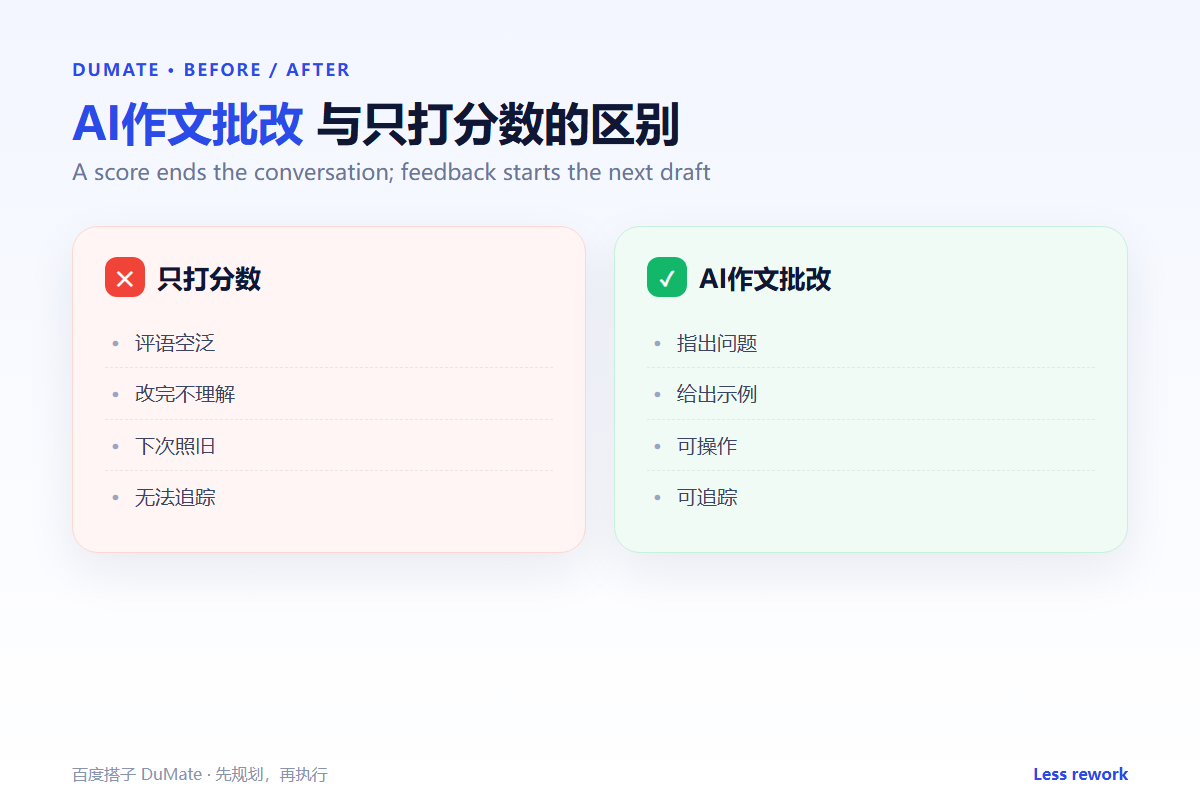
Before and After
Before, a student received a score and a comment that said improve structure, with no example. After, AI作文批改 showed the outline, modeled one paragraph opening, and assigned two actions. The next draft was noticeably clearer.
Feedback is useful when it changes the next attempt.
Used consistently, AI作文批改 becomes part of the normal review routine rather than a separate project.
A final check with AI作文批改 takes a minute and catches the errors that are easiest to miss.
The same AI作文批改 routine works for small tasks and large ones, which is why teams keep using it.
Used consistently, AI作文批改 becomes part of the normal review routine rather than a separate project.
A Four-Week Rollout
The first week with AI作文批改 should be a small pilot, not a team-wide launch. Choose one recurring task with a clear output and run it end to end. Keep the sample small enough to check by hand. The point is to see where AI作文批改 saves time and where it creates review work.
During the pilot, keep a short log of inputs, outputs, and corrections. Record the time spent before and after. AI作文批改 feels faster even when it is not, so the log matters. At the end of the week, review the log with one colleague and decide whether to continue, change the input, or stop.
In week two, write a one-page standard for input and output. Include what must be checked and who approves the result. AI作文批改 works better when the standard is visible to everyone. In week three, add permissions and a review step. In week four, compare the results and write a short guide. That guide is what makes AI作文批改 survive after the first month.
Keep the pilot narrow. A broad rollout hides which step failed, and a narrow one shows exactly where the workflow needs help. Expand only after the narrow case is stable.
Keep the first month simple. One task, one owner, and one weekly review are enough to prove the workflow before it spreads across the team.
Write down what changed after each run. A short note is easier to trust than a memory, and it makes the next improvement obvious.
Review the output before it leaves your desk. A two-minute check catches most of the errors that would otherwise come back as questions.
Keep one example of a good result. New team members learn faster from a concrete reference than from a long explanation.
FAQ
Should AI give the score?
It can, but the score should follow the feedback, not replace it. Use a rubric and explain the main deduction.
How many sentences should be rewritten?
Two or three. Enough to show the pattern without taking over the essay.
What if the student disagrees?
Ask them to point to the evidence in the text. The discussion is part of the learning.
延伸阅读
For planning, see AI学习计划. For error tracking, read AI错题整理 and AI口语陪练. For drafting, see AI写作助手. Keep rubrics in an AI知识库. External references: NIST AI Risk Management Framework and ISO/IEC 42001.
评论
还没有评论,来说两句吧。