
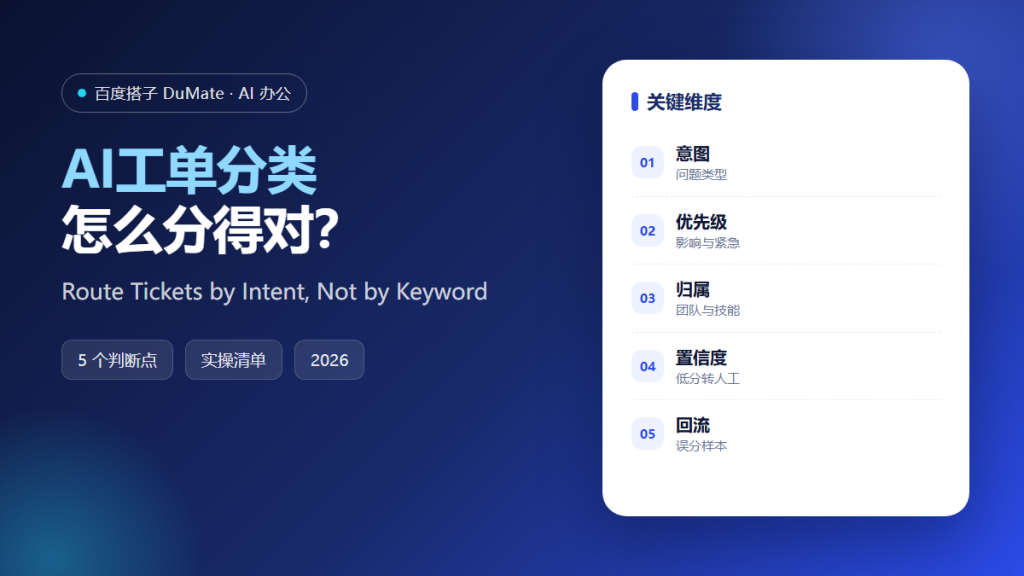
AI工单分类 is a routing decision made under time pressure, and most teams get it wrong in the same way: they match words. A message that mentions cancel may concern a subscription, a delivery, or a meeting room, and each of those belongs to a different team. Routing by keyword is fast to build and expensive to live with.
This guide describes how AI工单分类 should be designed, the fields that make routing testable, and the review loop that stops misroutes from becoming a permanent tax on support.
Key Takeaways
- AI工单分类 should store intent and urgency as two separate fields.
- Keep one taxonomy with a named owner and a version.
- Route on the first message plus account context.
- Send low-confidence tickets to a review queue, not a random team.
- Audit misroutes weekly using real examples.
Why AI工单分类 Needs a Taxonomy, Not a Word List
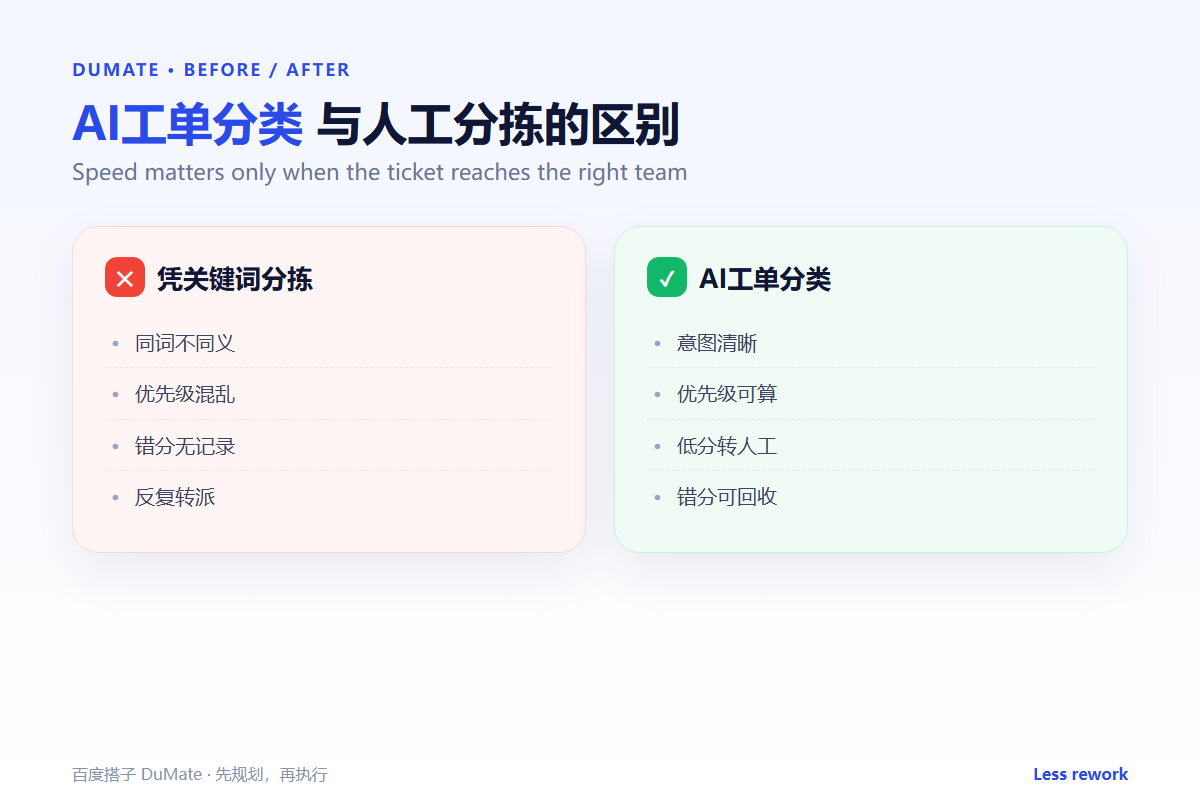
Words overlap. Refund appears in billing disputes, return requests, and travel cancellations. Change appears in address updates, plan upgrades, and rescheduling. A keyword list grows one exception at a time until nobody can explain why a ticket landed where it did, while AI工单分类 simply reproduces those rules at greater speed. A word list also hides its own failures, because a ticket that matches nothing lands quietly in a default queue where nobody measures it.
Intent and urgency are different questions. Intent says what the request is about; urgency says when someone must act. A locked account is urgent and simple, while a feature request is neither. A taxonomy that mixes the two forces every reviewer to untangle them again, and AI工单分类 cannot repair a field design that was never separated in the first place.
The third reason is measurement. Without labels, a backlog is just a number. AI工单分类 gives that number a shape. A manager can see that password tickets doubled after a release, or that one region receives most delivery complaints, and can assign the fix to the team that owns the cause.
How AI工单分类 Works in Five Steps
Step 1: Sample and label real tickets
Take six hundred closed tickets across channels and have two people label them independently. Compare the results. Where they disagree, the category is badly defined, and no model will resolve that ambiguity. Rewrite the definition before training anything, and keep the disputed examples beside it. Those examples are worth more than a style guide, because they show where the judgment actually sits.
Step 2: Draft a short taxonomy
Begin with eight to twelve intents and four urgency levels. Give each intent a one-sentence definition and two examples. AI工单分类 improves when the examples sit close to the boundary, because those are the cases that decide whether routing is useful.
Step 3: Attach account context
A short message from a customer on an enterprise plan means something different from the same words sent by a trial user. Pass plan tier, contract status, region, and recent contact history into the routing step. Context usually explains more misroutes than the text itself, especially when a complaint is really about an earlier promise.
Step 4: Set a confidence floor
When the model is unsure, the ticket should go to a small review queue staffed by an experienced agent. This costs a few minutes and prevents the silent failure where a legal notice is filed as a general question. Review decisions become new training examples.
Step 5: Close the loop weekly
Sample reassigned and escalated tickets every week. For each one, record whether the cause was wording, missing context, or a missing category. Change one thing at a time, then measure again. AI工单分类 without this loop drifts as products and policies change.
‘ alt=’AI工单分类 checklist: intent labels, urgency levels and review queue’ />
A Routing Checklist for AI工单分类
- Every intent has a definition and two examples.
- Urgency is stored apart from intent.
- Account context travels with the ticket.
- Low-confidence cases reach a named reviewer.
- Reassignment reasons are recorded, not just counted.
Where AI工单分类 Fails
It fails when the taxonomy mirrors the org chart instead of the customer request. AI工单分类 also inherits every unresolved argument about who owns a queue, and those arguments show up later as reassignments that nobody can explain.
- Categories added for political reasons, never removed.
- Multilingual tickets labeled from machine translation alone.
- Screenshots and attachments ignored during classification.
- No owner, so nobody notices when accuracy falls.
Before and After
Before, a software company routed by keywords and reassigned roughly a third of its tickets. Agents learned to check three queues each morning, and customers received two holding replies before reaching anyone useful. Nobody could say how many tickets were misrouted, only that the number felt high.
After, AI工单分类 delivered tickets with an intent, an urgency, and a confidence score. Reassignments fell sharply, and the weekly review surfaced a billing page that generated confused messages. Fixing that page removed more tickets than any routing tweak had managed.
FAQ
How accurate should routing be before launch?
Accurate enough that the review queue stays small. AI工单分类 should be measured on a held-out sample, and the uncertain cases treated as a designed path rather than a failure.
Can we reuse one taxonomy across regions?
Only if the products and policies match. Otherwise share the intent names and allow local urgency rules, so reports remain comparable. Share the definitions as well as the names.
Do we still need human triage?
Yes, for edge cases and for the review queue. The goal is fewer routine decisions, not the removal of judgment.
延伸阅读
Routing decisions improve with sentiment monitoring for tone signals and customer profile data for account context. Use log analysis to see where tickets stall, data labeling to keep categories consistent, and legal consultation for escalations that carry legal risk. External references: NIST AI Risk Management Framework and ISO/IEC 42001.
评论
还没有评论,来说两句吧。