

AI用户调研 produces confident answers, and confidence is the risk. A leading question returns a polite agreement, a hypothetical question returns a guess, and a question about the future returns a wish. None of them tells you what a customer will do on an ordinary Tuesday.
This guide covers question design, the five-step routine that keeps a study honest, and the moments when a short conversation beats a long survey.
Key Takeaways
- Start from the decision, not the topic.
- Ask about the last time, not the next time.
- Remove praise from the script.
- Pilot on five people before the launch.
- Report contradictions instead of averages.
Why AI用户调研 Needs Question Design
People answer the question they hear, not the one you meant. Ask whether a feature would be useful and most respondents say yes, because yes is cheap and disagreement requires an argument. AI用户调研 that relies on that wording collects agreement and mistakes it for demand. The fix is not a cleverer tool; it is a question that gives the respondent something specific to recall.
A better question asks for a recent event and the steps inside it. What did you do the last time this happened, where did you stop, and what did you use instead? AI用户调研 gains detail from those answers because memory of a specific episode is more reliable than a forecast about a hypothetical one. Specific episodes also expose the workaround, which is usually where the real product opportunity sits.
Design also protects the sample. A script with balanced options and no implied answer lets quiet respondents disagree, and the quiet ones are often the majority. AI用户调研 should make disagreement easy to express, or the findings will describe the most agreeable people in the room.
How AI用户调研 Works in Five Steps
Step 1: Name the decision
Write the decision the study must inform: which onboarding step to rebuild, which price to test, which segment to serve first. A study without a decision grows questions, and a study with one can stop asking when the answer is clear. Keep the decision visible during analysis, because a study that drifts toward interesting findings loses the thread.
Step 2: Ask about the last time
Replace every question about the future with a question about a specific past event. Ask for the date, the tool, the people involved, and the point where the task became difficult. Concrete details are harder to invent and easier to compare across respondents. AI用户调研 should ask what happened just before the task and what happened after it, since the edges often carry the cause.
Step 3: Remove the pitch
Delete any sentence that explains the product before the question. Once a respondent knows what you hope to hear, the answer bends toward it. Keep the introduction short and neutral, and save the explanation for the end of the session. If a demo is part of the session, put it after the questions, not before them.
Step 4: Let AI用户调研 cluster the notes
After the interviews, use it to group quotes by the task people were trying to finish, not by the feature they mentioned. AI用户调研 is quick at sorting and poor at deciding what matters, so keep the transcript beside every cluster and check the label against the original words. Save the raw notes as well, because a cluster is an argument and every argument needs evidence.
Step 5: Surface the contradiction
Find the respondents whose behavior contradicts the majority and write down why. The exception often explains the average, and it is usually where a new segment or a broken assumption appears. Report the contradiction next to the headline number rather than in an appendix. Name the exception in the summary so the reader can weigh it against the average.
‘ alt=’AI用户调研 checklist: decision, behavior question and pilot’ />
An Interview Checklist
- The decision is written before the script.
- Questions describe past behavior.
- No question implies the desired answer.
- The pilot produced at least one revised question.
- Quotes are stored with their source.
Where AI用户调研 Fails
AI用户调研 fails when a survey is used to settle a question that only behavior can answer. People cannot reliably report why they churned, and a neat chart can hide that uncertainty for months. A confident chart built on the wrong question is worse than no chart.
- Asking customers to predict their own behavior.
- Sampling only the happiest users.
- Reporting averages without the spread.
- Treating a small sample as a verdict.
Before and After
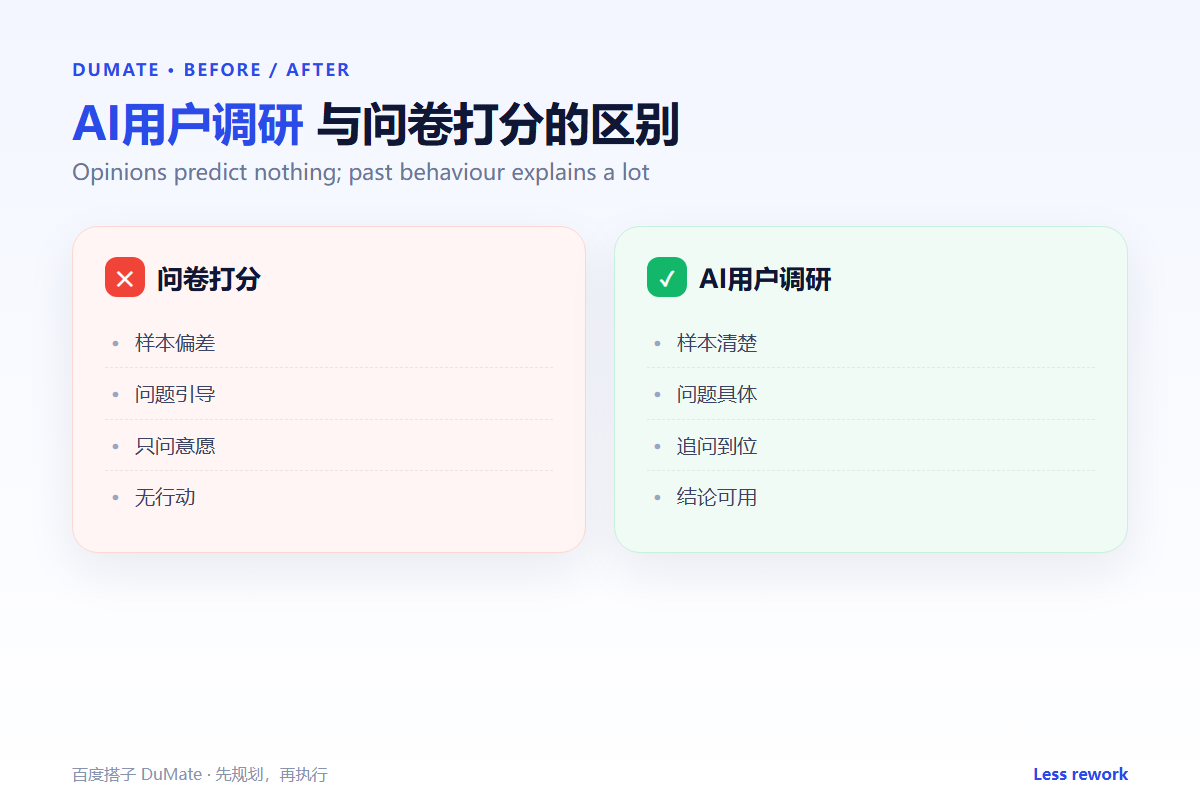
Before, a team ran a survey that asked whether users would pay for a reporting feature. Most said yes, the feature shipped, and almost nobody used it. After, AI用户调研 was used to interview twelve customers about the last report they had built by hand, and the transcripts showed the real obstacle was export, not reporting.
The second project was smaller and duller. It removed three steps from an existing workflow, and the usage held because the study had described a task rather than a preference.
FAQ
How many interviews are enough?
Five to eight per segment often reveal the pattern. Stop when new sessions repeat the same tasks and the same stops. Beyond that, the answers repeat and the marginal session adds little.
Are surveys useless?
No. They measure distribution well and cause poorly. Use them to count what interviews have already explained, because AI用户调研 can count what a conversation has already made clear.
Should we record sessions?
With consent and a clear retention period. AI用户调研 works from transcripts, and a transcript is personal data that needs a policy.
延伸阅读
To write questions that hold up, see question bank. Buyer history is covered in customer profile, and audience grouping in user segmentation. For language at scale, read sentiment monitoring, and for retention signals, churn warning. External references: NIST AI Risk Management Framework and ISO/IEC 42001.
评论
还没有评论,来说两句吧。