

AI用户分群 fails in a predictable way: too many groups, no clear rules, and no action attached to any of them. A team ends up with twelve segments, three campaigns, and no idea which one worked. Fewer, clearer groups outperform elaborate taxonomies.
This guide covers a five-step segmentation method, the rules that make a segment explainable, and the small test that prevents a full rollout from becoming an expensive guess.
Key Takeaways
- Start from one operating goal.
- Use three to five dimensions.
- Keep the number of segments small.
- Write a rule that explains each segment.
- Validate with a small share of traffic.
Why AI用户分群 Needs an Operating Goal
Segments are built for a decision. Reactivation, repeat purchase, and upsell require different cuts of the same data. Without a goal, AI用户分群 produces a general-purpose taxonomy that is interesting and unusable.
The second reason is reachability. A segment that cannot be targeted with a channel is not a segment. The team should be able to say how each group will be contacted before the segmentation is finalized.
How AI用户分群 Works in Five Steps
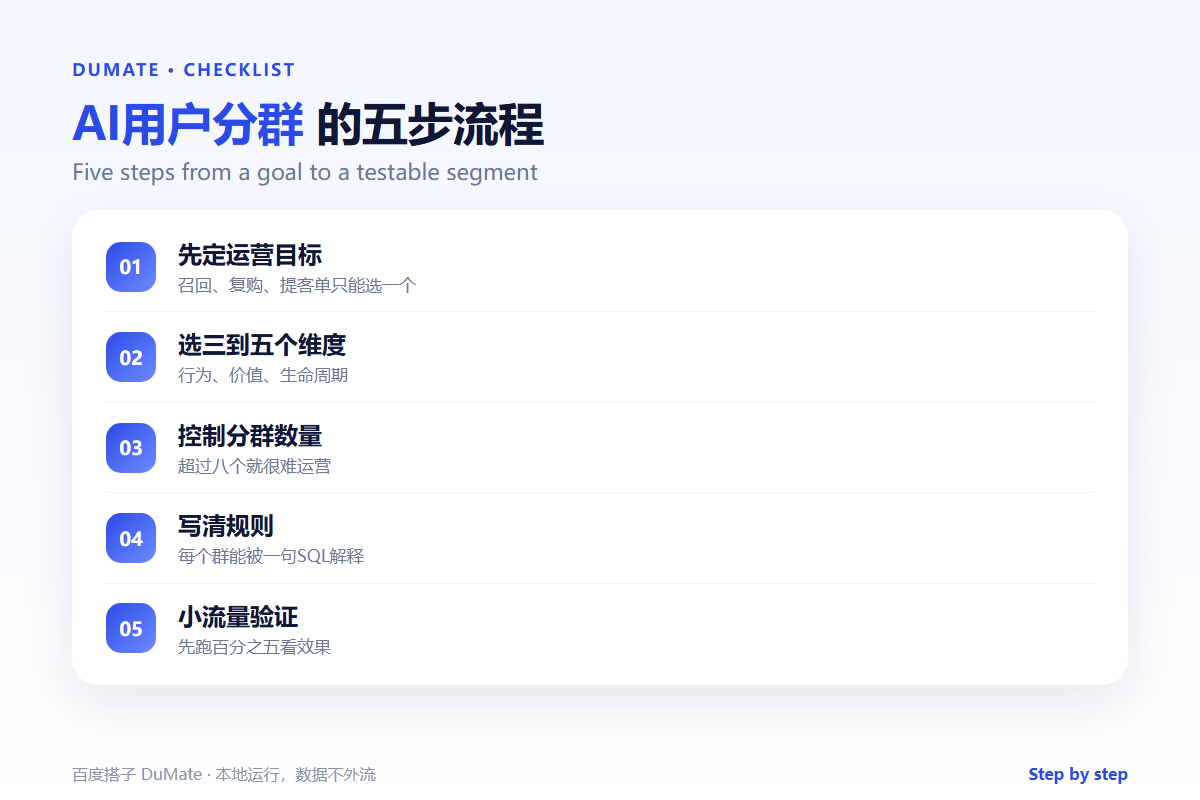
Step 1: Name the operating goal
Choose one: bring back dormant users, increase repeat rate, or raise average order value. AI用户分群 should be constrained to this goal.
Step 2: Pick the dimensions
Use recency, frequency, value, and one behavior signal. Avoid demographic dimensions unless they change the action. AI用户分群 can compare the predictive power of each dimension.
Step 3: Limit the number of groups
Aim for four to six groups. Each group should be large enough to measure and different enough to justify a separate message. AI用户分群 can merge groups that behave the same.
Step 4: Write the rules
Express each segment as a sentence a marketer can read and a analyst can implement. Example: bought twice in ninety days and opened at least one email. AI用户分群 should output both the sentence and the logic.
Step 5: Test on a small share
Run the campaign on five to ten percent of the audience. Compare conversion with a control group. AI用户分群 that is not tested is a hypothesis, not a result.
A Segmentation Checklist
- One goal is written down.
- No more than six segments.
- Each rule uses available fields.
- Each segment has a channel.
- A control group exists for the test.
Where AI用户分群 Fails
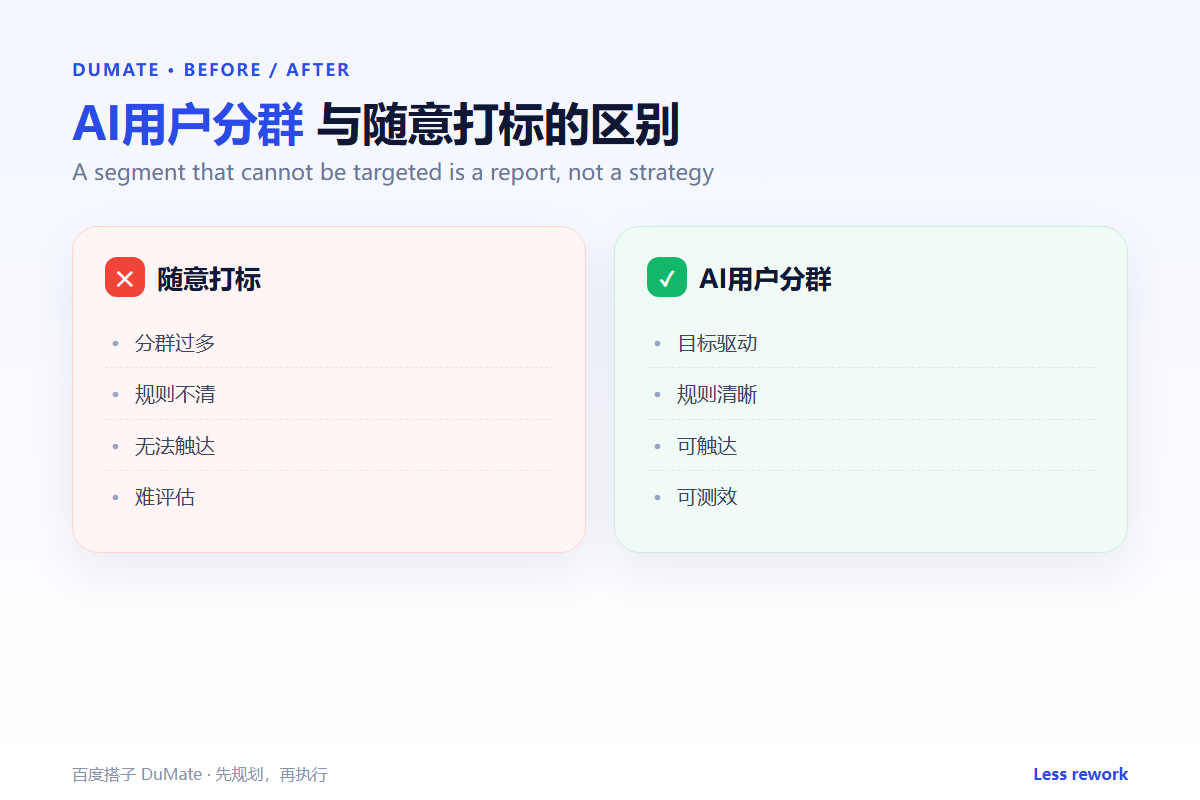
It fails when segments are defined after seeing the campaign results, which guarantees a good story and no learning. It also fails when the same user appears in several segments, which makes measurement impossible.
- Segments with no action.
- Overlapping membership.
- Rules that change every month.
- No control group.
Before and After
Before, the team had a dashboard with fifteen segments and no idea which one to prioritize. After, AI用户分群 produced five segments tied to one goal, and a two-week test showed that two of them responded to a different message.
Segmentation is a decision tool. If it does not change the decision, it is just a chart.
Used consistently, AI用户分群 becomes part of the normal review routine rather than a separate project.
A final check with AI用户分群 takes a minute and catches the errors that are easiest to miss.
The same AI用户分群 routine works for small tasks and large ones, which is why teams keep using it.
Making It Stick Across a Team
A rollout fails when only one person knows how to use AI用户分群. Write a short guide with three sections: when to use it, what good input looks like, and what to check before sharing the output. Keep the guide to one page.
Train in pairs. One person runs the task while the other checks the output against the guide, then swap roles. That exercise surfaces unclear steps faster than a presentation. Keep a shared folder with one strong output, one weak output, and a note explaining the difference. AI用户分群 becomes easier to teach when people can compare real cases.
Review the guide after the first week of use. Remove steps nobody follows and add the questions that keep coming up. A living guide is more useful than a perfect one written in advance. Finally, assign an owner. AI用户分群 without an owner drifts, and the guide becomes outdated. The owner does not need to do every task, only keep the standard current. That small responsibility is what keeps AI用户分群 useful after the initial training.
Make the training practical. People learn the workflow by completing a real task, not by listening to a walkthrough. Set aside thirty minutes for practice and review the result together. Measure one thing: how many outputs pass review without correction. That number is a better indicator than attendance.
Keep the first month simple. One task, one owner, and one weekly review are enough to prove the workflow before it spreads across the team.
Write down what changed after each run. A short note is easier to trust than a memory, and it makes the next improvement obvious.
FAQ
How many segments are too many?
If the team cannot name the action for each segment, there are already too many.
Can segments overlap?
They can, but each user should receive only one message. Decide the priority order in advance.
How long should the test run?
Long enough to reach a stable conversion rate. Two weeks is a common minimum.
延伸阅读
Build profiles with AI客户画像. For retention, see AI流失预警. Analyze results in AI数据分析工具. Clean data with AI数据清洗. Tool selection is in AI效率工具. External references: NIST AI Risk Management Framework and ISO/IEC 42001.
评论
还没有评论,来说两句吧。以下为本文的引用通告: