

Why AI任务规划 Matters More Than Speed
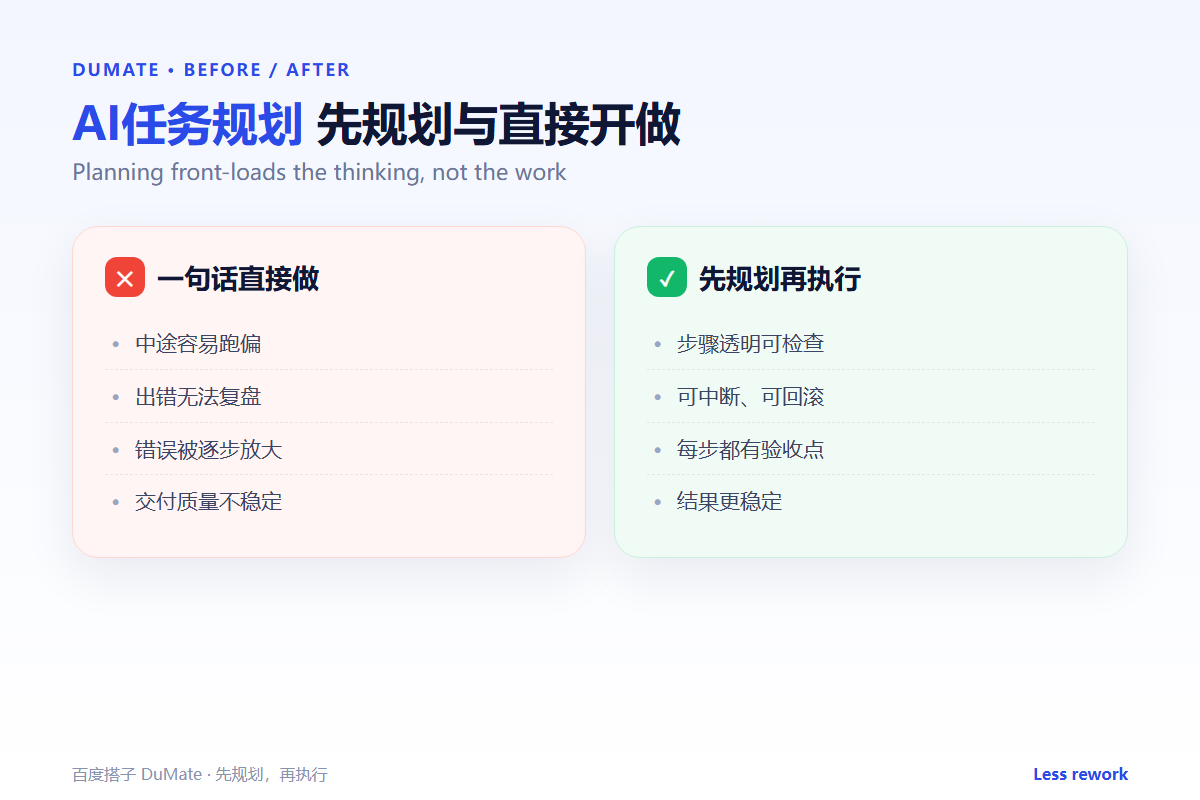
AI任务规划 is the difference between a fast answer and a finished job. A model can draft a paragraph in seconds, but a multi-step task needs a plan: what to do first, what depends on what, and how to know each step is correct. Without that structure, errors compound quietly and the final result looks plausible but fails review.
- Write the finish line as a testable sentence.
- Split the work into steps with inputs and outputs.
- Mark dependencies before execution starts.
- Pause before destructive or external actions.
- Check the result against the original goal.
- Keep a log for the next run.
The Five-Step AI任务规划 Method
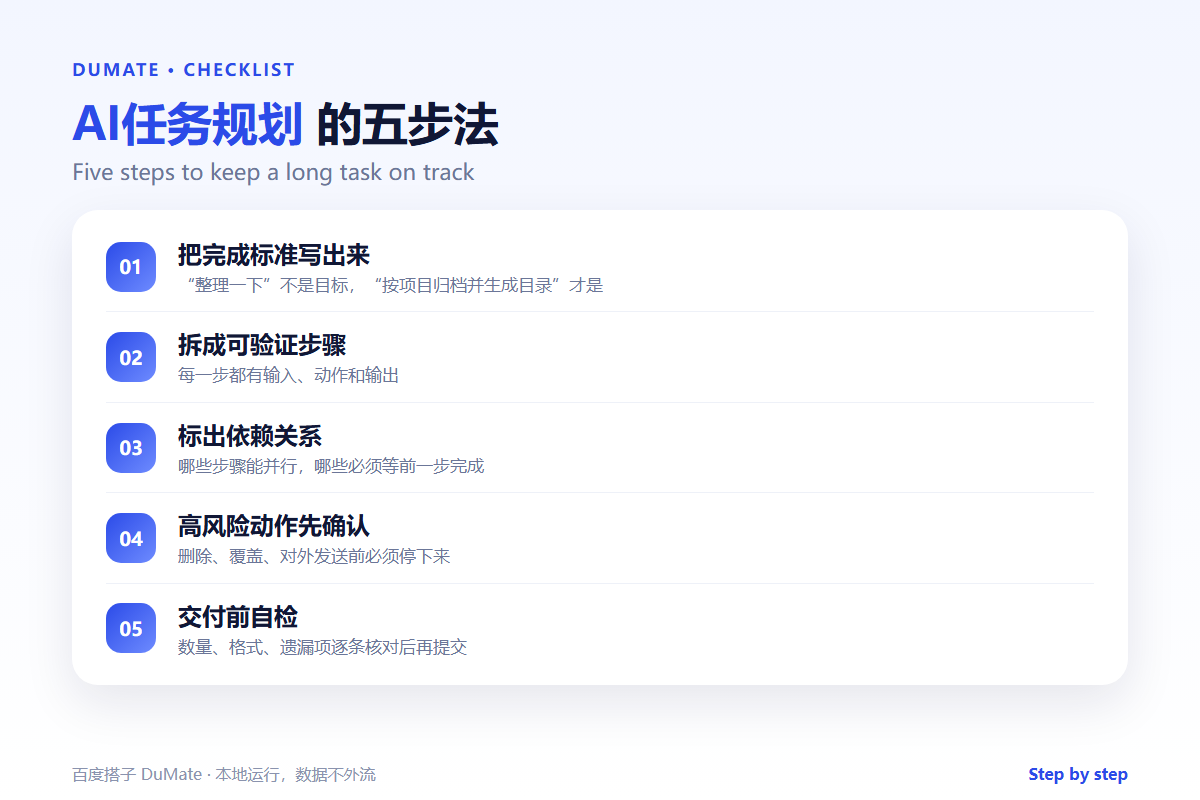
Start with the end state, not the tool. If the goal is “prepare the monthly report”, define the file, the period, the audience, and the deadline. Then ask for a plan. The plan should be short enough to review and specific enough to verify. A plan with vague verbs such as “handle” or “optimize” is not a plan.
- Define the finish line and the constraints.
- Break the goal into verifiable steps.
- List dependencies and required inputs.
- Add confirmation gates for risky actions.
- Verify the output before delivery.
Good steps have evidence
Each step should produce something you can inspect: a cleaned table, a list of missing fields, a draft, or a signed-off summary. Evidence makes AI任务规划 auditable. It also makes it easier to resume after an interruption, because the last good state is visible.
Dependencies and Interruptions
Long tasks rarely fail at the end; they fail at a handoff. A report generated before the data is cleaned, an email sent before the approval, a file overwritten before the backup. Mapping dependencies prevents these mistakes and shows where a human check is required.
| Step | Depends on | Check before moving on |
|---|---|---|
| Collect files | Folder access | File count and dates |
| Clean data | Collected files | Missing values and duplicates |
| Build report | Clean data | Totals match the source |
| Send report | Approval | Recipient list and attachment |
Interruptions are normal. A good AI任务规划 can pause, state what is done, and continue from the last verified step. This is more useful than a perfect plan that cannot recover. The AI自动化流程 guide shows how repeatable tasks benefit from the same structure.
Confirmation Gates and Rollback
Any step that deletes, overwrites, sends, or pays needs a gate. The gate should show the exact change, not a summary. “Delete 14 duplicate files” is a summary; a list of names is a decision. For external actions, add a recipient check and a preview. For internal changes, keep a version or a copy.
Rollback is part of planning, not an emergency feature. If the plan cannot be reversed, the risk is higher and the confirmation should be stronger. This principle applies to cross-app operations as much as to local file edits.
Who approves the risky step?
Name the approver in advance. An AI任务规划 that stops without telling anyone who should decide is only half a plan. For team work, the approver should be the person who owns the outcome, not the person who owns the tool.
Common Planning Mistakes
The first mistake is planning at the wrong level. Ten tiny steps hide the real dependency; three giant steps hide the real work. Aim for five to nine steps, each with a clear output. The second mistake is skipping verification because the agent sounds confident. Confidence is not evidence.
- Starting without a written finish line.
- Mixing research, decisions, and execution in one step.
- Ignoring file permissions until the task fails.
- Sending output without a final check.
- Never reviewing why a run failed.
FAQ
Can AI任务规划 handle creative work?
It can structure the process, but taste and judgment remain human. Use it for drafts and options, not for the final call.
How detailed should the plan be?
Detailed enough that each step has an output you can check. If you cannot tell whether a step is done, it is too vague.
What if an AI任务规划 changes midway?
Stop, update the goal and dependencies, then regenerate the plan. The AI智能体 guide explains why a written goal is the anchor.
References
Related reading: AI智能体 和聊天机器人差在哪.
延伸阅读: 《AI技能 怎么用?Turn Prompts Into Reusable Skills》、《AI操作录制 怎么用?Record Once, Replay Safely》。
延伸阅读: 《AI日程管理 怎么排才不打架?Protect Focus Time》、《AI待办事项 怎么变成清单?Turn Promises Into Tasks》。
评论
还没有评论,来说两句吧。