

AI数字人 is a production format, not a strategy. It lets a team publish consistent video at a scale that would be impossible with a single presenter. The risks are equally practical: lip sync, brand fit, copyright, and disclosure.
This guide covers a five-step production process, the checks that keep a digital presenter credible, and the compliance decisions that should be made before the first video goes live.
Key Takeaways
- Choose the format before the avatar.
- Write a spoken script, not an article.
- Check lip sync on long sentences and numbers.
- Use licensed or owned backgrounds and voices.
- Disclose that the presenter is synthetic.
Why AI数字人 Needs a Clear Purpose
Internal training, product updates, and advertising have different standards. A digital presenter works well for repetitive updates and poorly for emotional stories. AI数字人 should be chosen because the format fits, not because it is novel.
The second reason is trust. Audiences accept a synthetic presenter when the content is useful and the disclosure is clear. They react badly when they feel deceived.
How AI数字人 Works in Five Steps
Step 1: Define the format
Decide the length, the setting, and the level of production. A weekly update needs a simple background and a predictable structure. AI数字人 should be configured to match that format.
Step 2: Write the spoken script
Use short sentences, concrete verbs, and spoken numbers. Avoid clauses that require a visual. AI数字人 handles conversational scripts better than written reports.
Step 3: Choose the avatar and background
Match the brand and the audience. Check that the avatar and voice are licensed for commercial use. AI数字人 should not use a real person’s likeness without written permission.
Step 4: Check sync and detail
Watch the full video. Check lip movement on long words, numbers, and names. Look for unnatural blinking and frozen hands. AI数字人 quality varies by scene, so review every segment.
Step 5: Add disclosure and publish
State clearly that the presenter is synthetic. Include the disclosure in the video or the description. AI数字人 should be labeled in a way the audience can understand.

A Production Checklist
- The format matches the content.
- The script is written for speech.
- The avatar and voice are licensed.
- Lip sync is checked on hard words.
- Disclosure is visible.
Where AI数字人 Fails
It fails on emotional content, where subtle expression matters. It also fails when the script is too long, because the repetition of expression becomes noticeable.
- Uncanny facial movement.
- Mismatched voice and appearance.
- Unlicensed likeness or music.
- No disclosure.
Before and After
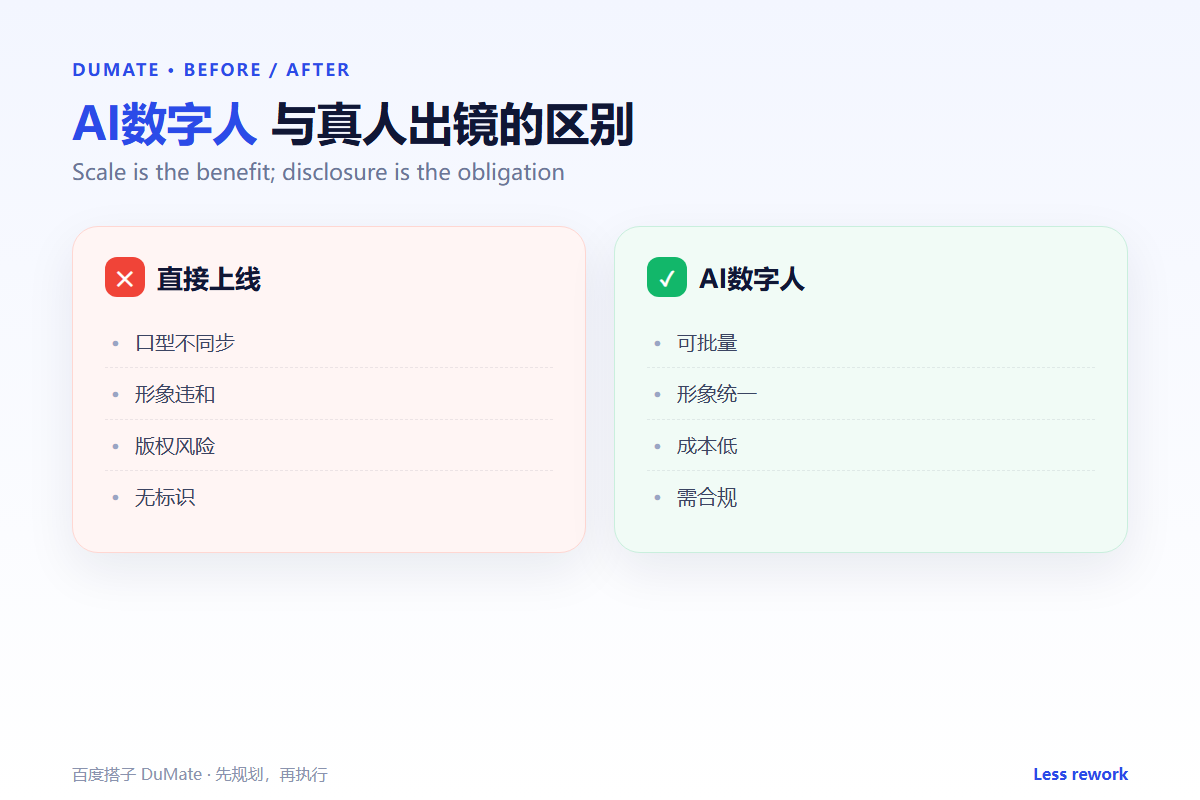
Before, a team produced one video a month because filming required a presenter, a studio, and a schedule. After, AI数字人 produced a weekly update with a fixed format, and the team spent its time on the content instead of the logistics.
Scale is the benefit. Disclosure and taste are the conditions.
Used consistently, AI数字人 becomes part of the normal review routine rather than a separate project.
A final check with AI数字人 takes a minute and catches the errors that are easiest to miss.
The same AI数字人 routine works for small tasks and large ones, which is why teams keep using it.
Making It Stick Across a Team
A rollout fails when only one person knows how to use AI数字人. Write a short guide with three sections: when to use it, what good input looks like, and what to check before sharing the output. Keep the guide to one page.
Train in pairs. One person runs the task while the other checks the output against the guide, then swap roles. That exercise surfaces unclear steps faster than a presentation. Keep a shared folder with one strong output, one weak output, and a note explaining the difference. AI数字人 becomes easier to teach when people can compare real cases.
Review the guide after the first week of use. Remove steps nobody follows and add the questions that keep coming up. A living guide is more useful than a perfect one written in advance. Finally, assign an owner. AI数字人 without an owner drifts, and the guide becomes outdated. The owner does not need to do every task, only keep the standard current. That small responsibility is what keeps AI数字人 useful after the initial training.
Make the training practical. People learn the workflow by completing a real task, not by listening to a walkthrough. Set aside thirty minutes for practice and review the result together. Measure one thing: how many outputs pass review without correction. That number is a better indicator than attendance.
Keep the first month simple. One task, one owner, and one weekly review are enough to prove the workflow before it spreads across the team.
Write down what changed after each run. A short note is easier to trust than a memory, and it makes the next improvement obvious.
Review the output before it leaves your desk. A two-minute check catches most of the errors that would otherwise come back as questions.
FAQ
Can a digital presenter replace a spokesperson?
For routine updates, often yes. For trust-building and crisis communication, a real person is still stronger.
Do I need to disclose?
Yes. Clear disclosure is both ethical and, in many places, legally required.
How long should the video be?
As short as the message allows. Two to three minutes works for most updates.
延伸阅读
For voice production, see AI配音工具. Scriptwriting is covered in AI短视频脚本. Presentation design is in AI生成PPT. For drafting, read AI写作助手. Translation is covered in AI翻译工具. External references: NIST AI Risk Management Framework and ISO/IEC 42001.
评论
还没有评论,来说两句吧。以下为本文的引用通告: