
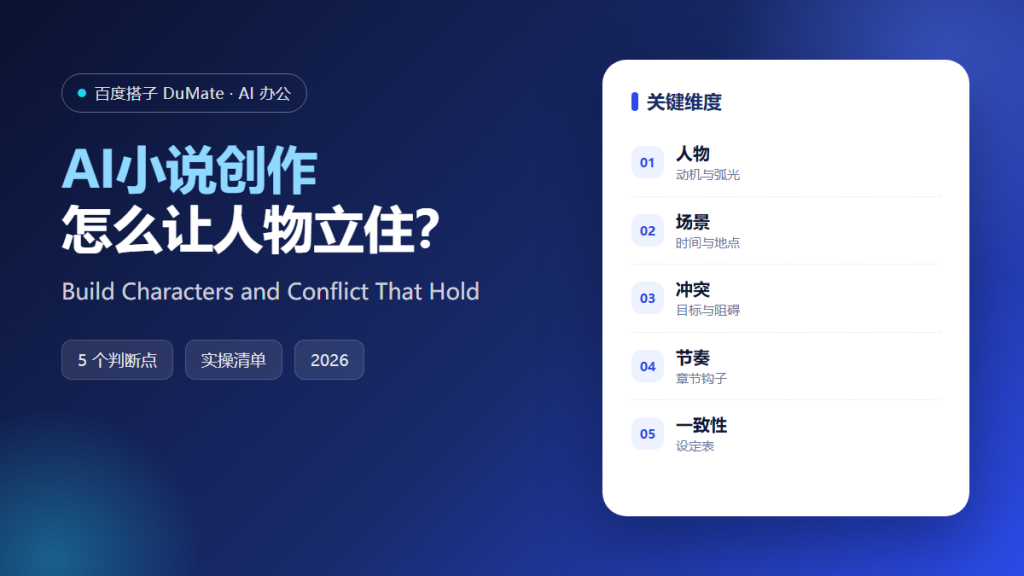
AI小说创作 can produce pages quickly, and that is the danger. Fast prose makes it easy to lose track of who wants what, which chapter revealed which secret, and why a character suddenly behaves differently. The craft is not in generating sentences. It is in maintaining a world that stays coherent for three hundred pages.
This guide covers a five-step method for drafting fiction with an assistant, the consistency tools that prevent drift, and the moments where the writer must take over.
Key Takeaways
- Build character cards before chapter one.
- State the core conflict in one sentence.
- Plan chapter beats, not just scenes.
- Keep a setting sheet for names, dates, and rules.
- Read the whole draft for consistency.
Why AI小说创作 Needs a Setting Sheet
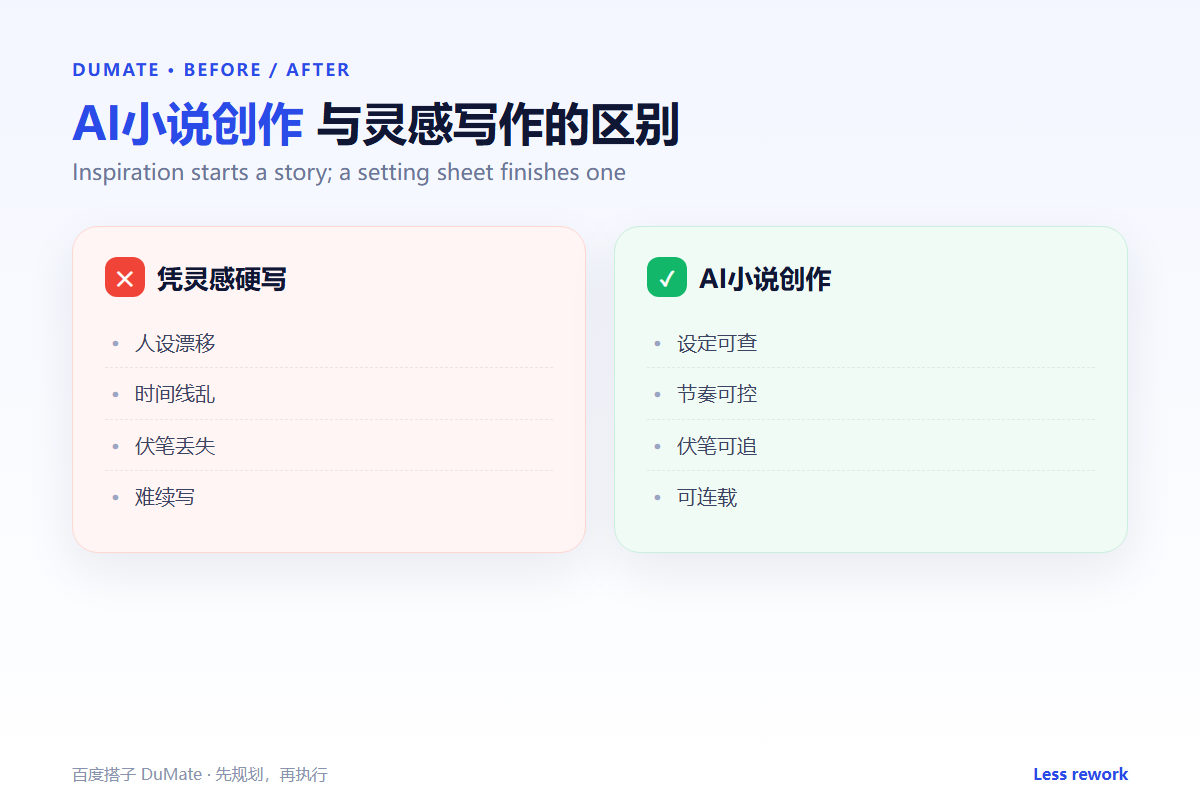
Long fiction fails on details. Eye color changes, a dead character reappears, a journey takes two days in chapter three and two hours in chapter twelve. Readers forgive a lot, but they do not forgive a world that contradicts itself. AI小说创作 will happily generate a new detail that conflicts with an earlier one unless the facts are written down.
A setting sheet is the cheapest fix. It records names, relationships, physical details, timeline, and the rules of the world. When the assistant is given the sheet, the output improves immediately, because it no longer has to invent continuity.
The second reason is voice. A novel needs a consistent narrator, even when the plot moves between tones. AI小说创作 tends to drift toward generic prose. Character cards and sample passages anchor the voice.
How AI小说创作 Works in Five Steps
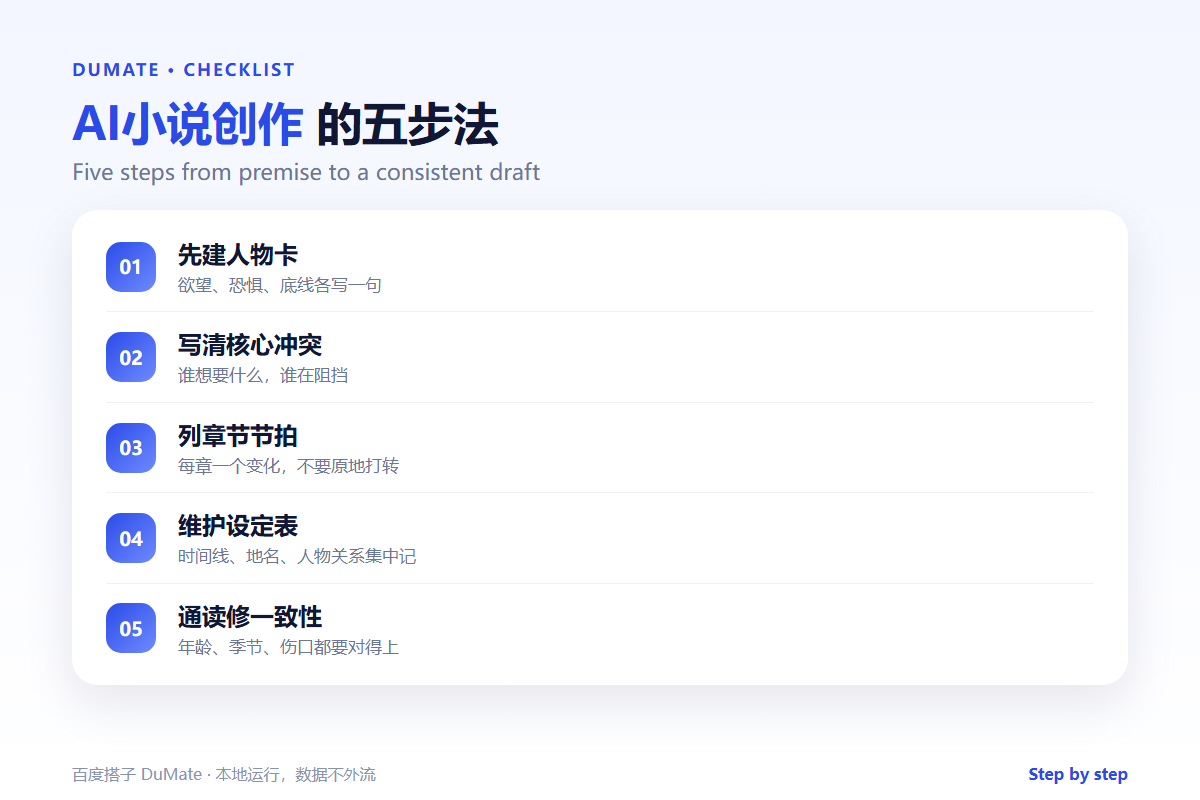
Step 1: Build character cards
For each main character, write desire, fear, and a line they would never cross. Add one physical detail and one speech habit. AI小说创作 can expand these cards, but the writer should choose the contradictions that make a character interesting.
Step 2: State the core conflict
Write one sentence: who wants what, and who or what blocks it. Every scene should either advance or complicate that sentence. If a chapter does neither, cut it or merge it.
Step 3: Plan chapter beats
List what changes in each chapter: a discovery, a decision, a loss, a reversal. Beats prevent the middle of the book from becoming a series of conversations. AI小说创作 can suggest beats, but the writer chooses the order.
Step 4: Draft with constraints
Give the assistant the character cards, the setting sheet, and the current beat. Ask for one scene at a time. Short generations are easier to control and easier to reject. AI小说创作 is a drafting partner, not a co-author with veto power.
Step 5: Read for continuity
After the draft, read the whole manuscript with the setting sheet open. Check dates, distances, injuries, and knowledge. A character cannot know a secret before it is revealed, even if the assistant forgets.
A Continuity Checklist
- Names and spellings are consistent.
- Timeline and travel times add up.
- Injuries and weather persist across scenes.
- Each character knows only what they witnessed.
- Foreshadowing is paid off or removed.
Where AI小说创作 Fails
It fails at long-range tension. A model can write a tense scene but may resolve it too quickly, because resolution is easier than escalation. It also fails at subtext, turning a loaded silence into an explicit explanation. Finally, it fails when the writer accepts the first draft of a chapter and moves on without checking continuity.
- Conflicts resolved too neatly.
- Dialogue that explains instead of revealing.
- New rules invented to solve a plot problem.
- Characters who forget what they know.
Before and After
Before, a writer generated twenty chapters and discovered in revision that two timelines contradicted each other and a side character had three different jobs. After, the same writer kept a setting sheet, drafted one scene at a time, and finished with a manuscript that needed line edits rather than reconstruction.
The speed of AI小说创作 is real. The value comes from the constraints around it.
Used consistently, AI小说创作 becomes part of the normal review routine rather than a separate project.
A final check with AI小说创作 takes a minute and catches the errors that are easiest to miss.
The same AI小说创作 routine works for small tasks and large ones, which is why teams keep using it.
Measuring Whether It Works
Measure AI小说创作 with three numbers: time spent, rework required, and output accepted without changes. Track them for four weeks before drawing a conclusion. Set a baseline from the manual process, because without a baseline any result looks like progress.
Time alone is misleading. A task that finishes faster but needs a full rewrite is not an improvement. Pair time with rework, and pair both with the quality of the final output. AI小说创作 should be compared with how the work was done before, not with an ideal.
Review the numbers monthly with the people doing the work. They know why a week was slow or why rework increased. AI小说创作 improves when the review includes the operators, not only the managers. Keep the dashboard small: three numbers and one note are enough.
Also record the exceptions. A week with an unusual campaign or a system outage is not a fair test. Note the context next to the numbers so a later reader does not compare incomparable weeks. When the numbers are stable, expand the scope; when they move the wrong way, fix the input before adding more use cases. The goal is not to prove that AI小说创作 works, but to know when it works and when it does not.
FAQ
Can AI小说创作 write a whole novel?
It can generate a draft. Structure, taste, and the decision about what the book is really about remain the writer’s work.
How do I keep the voice consistent?
Include two or three sample passages in every prompt and ask the assistant to match them. Update the samples as the book develops.
What should I never delegate?
The core conflict and the ending. If those are vague, the middle will wander no matter how good the sentences are.
延伸阅读
For prose drafting, see AI写作助手. Keep story notes in an AI知识库. For adaptation into video, read AI短视频脚本. Presentation decks are covered in AI生成PPT. Tool selection is covered in AI效率工具. External references: NIST AI Risk Management Framework and ISO/IEC 42001.
评论
还没有评论,来说两句吧。