
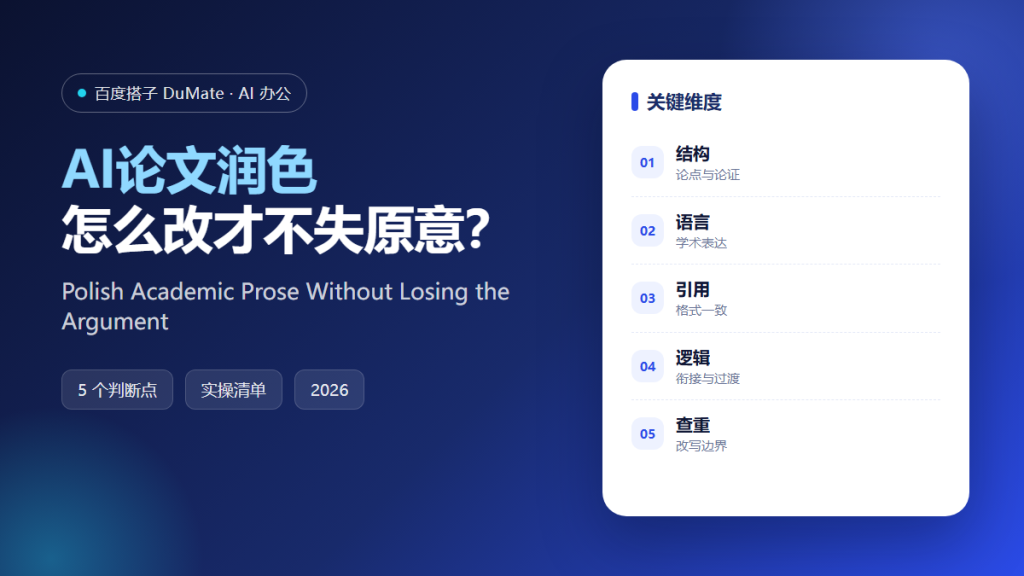
AI论文润色 is a narrow task with a clear boundary. The goal is to make an existing argument easier to follow, not to replace it with a smoother one. A paper that reads well but says something different from what the author intended is a failure, even if every sentence is grammatical.
This guide covers a five-step editing process, the checks that protect citations, and the cases where a writer should stop and rewrite instead of polishing.
Key Takeaways
- Read the whole argument before editing a sentence.
- Mark gaps in evidence before improving style.
- Use one term for one concept.
- Verify every citation against the source.
- Keep the author’s voice and claims intact.
Why AI论文润色 Needs a Boundary
Academic writing carries accountability. A reviewer assumes that the author chose the claims, the method, and the citations. AI论文润色 can easily cross that line by strengthening a conclusion or softening a limitation. The result may read better and misrepresent the work.
The second reason is precision. Academic language is dense because it needs to distinguish between similar ideas. A general-purpose rewrite often replaces a precise term with a friendlier one, which changes the meaning. AI论文润色 should be asked to preserve terminology, not simplify it away.
The third reason is citations. A polished sentence can drift away from the source it cites. Every claim that depends on a reference should be checked against the original, especially when the wording changes.
How AI论文润色 Works in Five Steps
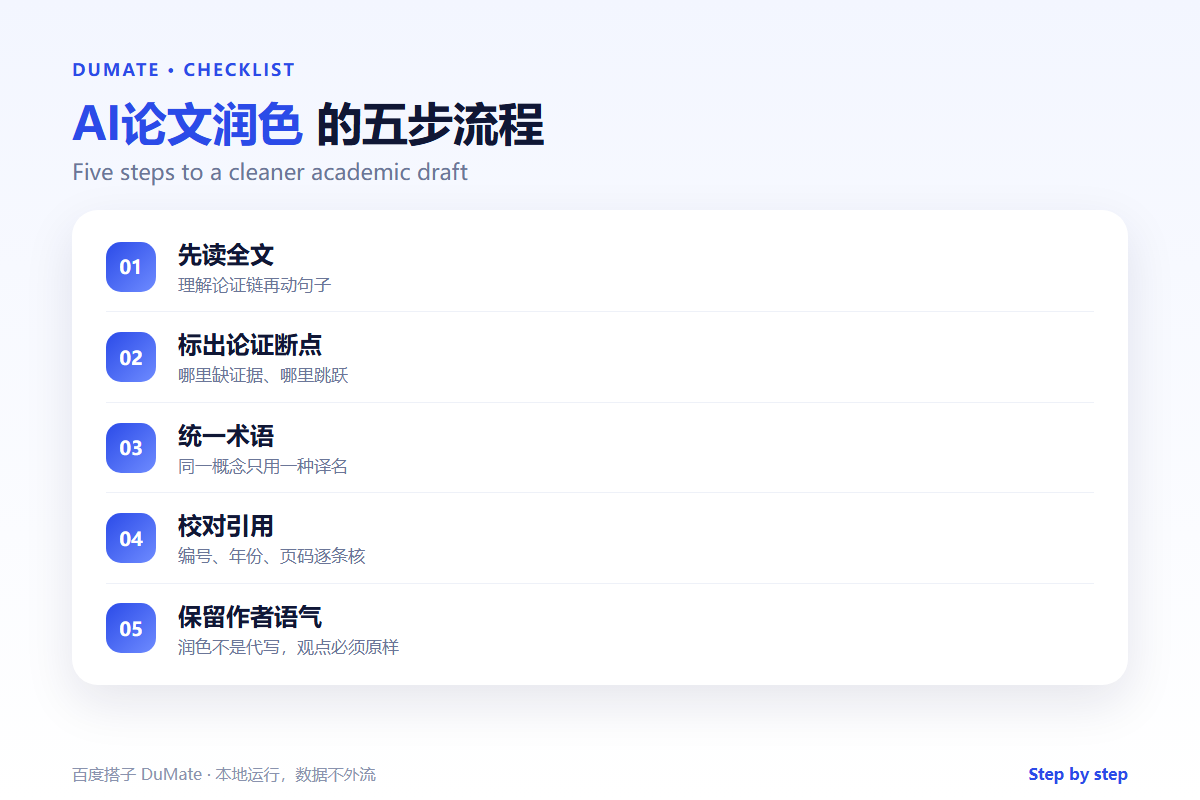
Step 1: Read the whole paper first
Understand the research question, the method, and the conclusion before changing anything. AI论文润色 works best when the editor can see the whole argument, not a single paragraph pasted into a chat.
Step 2: Mark gaps in the argument
List places where the evidence does not support the claim, or where a transition is missing. Fix these before style. AI论文润色 cannot supply missing evidence, and a polished gap is still a gap.
Step 3: Unify terminology
Choose one term per concept and apply it throughout. Check abbreviations, variable names, and translated terms. AI论文润色 should be instructed to keep the glossary fixed.
Step 4: Edit sentence by sentence
Prefer small changes: remove redundancy, split long sentences, clarify pronouns. Avoid rewriting whole paragraphs unless the logic is broken. This keeps the author’s voice and makes the changes reviewable.
Step 5: Verify citations and limitations
Check that each citation still supports the sentence it follows. Confirm that limitations and caveats survived the edit. AI论文润色 should never remove a hedge that the author put there for a reason.
A Review Checklist for AI论文润色
- The research question is unchanged.
- Every claim still has the same strength.
- Terminology is consistent.
- Citations match the original sources.
- The author has read the final version.
Where AI论文润色 Fails
It fails when the prompt asks for a complete rewrite, because the model will optimize for fluency over accuracy. It also fails on technical sections where a small word change alters the method. Finally, it fails when the output is accepted without a full read, which is how citations drift.
- Hedges removed without permission.
- Technical terms replaced by synonyms.
- Citations attached to the wrong claim.
- Paragraphs rewritten beyond recognition.
Before and After
Before, a draft repeated the same idea in three paragraphs and buried the method in the middle. After, AI论文润色 tightened the sentences, moved one transition, and left the claims untouched. The reviewer read it in half the time and raised the same two methodological questions, which is exactly what should happen.
The measure of success is not how different the text looks. It is whether the reader understands the same argument with less effort.
Used consistently, AI论文润色 becomes part of the normal review routine rather than a separate project.
Making It Stick Across a Team
A rollout fails when only one person knows how to use AI论文润色. Write a short guide with three sections: when to use it, what good input looks like, and what to check before sharing the output. Keep the guide to one page.
Train in pairs. One person runs the task while the other checks the output against the guide, then swap roles. That exercise surfaces unclear steps faster than a presentation. Keep a shared folder with one strong output, one weak output, and a note explaining the difference. AI论文润色 becomes easier to teach when people can compare real cases.
Review the guide after the first week of use. Remove steps nobody follows and add the questions that keep coming up. A living guide is more useful than a perfect one written in advance. Finally, assign an owner. AI论文润色 without an owner drifts, and the guide becomes outdated. The owner does not need to do every task, only keep the standard current. That small responsibility is what keeps AI论文润色 useful after the initial training.
Make the training practical. People learn the workflow by completing a real task, not by listening to a walkthrough. Set aside thirty minutes for practice and review the result together. Measure one thing: how many outputs pass review without correction. That number is a better indicator than attendance.
FAQ
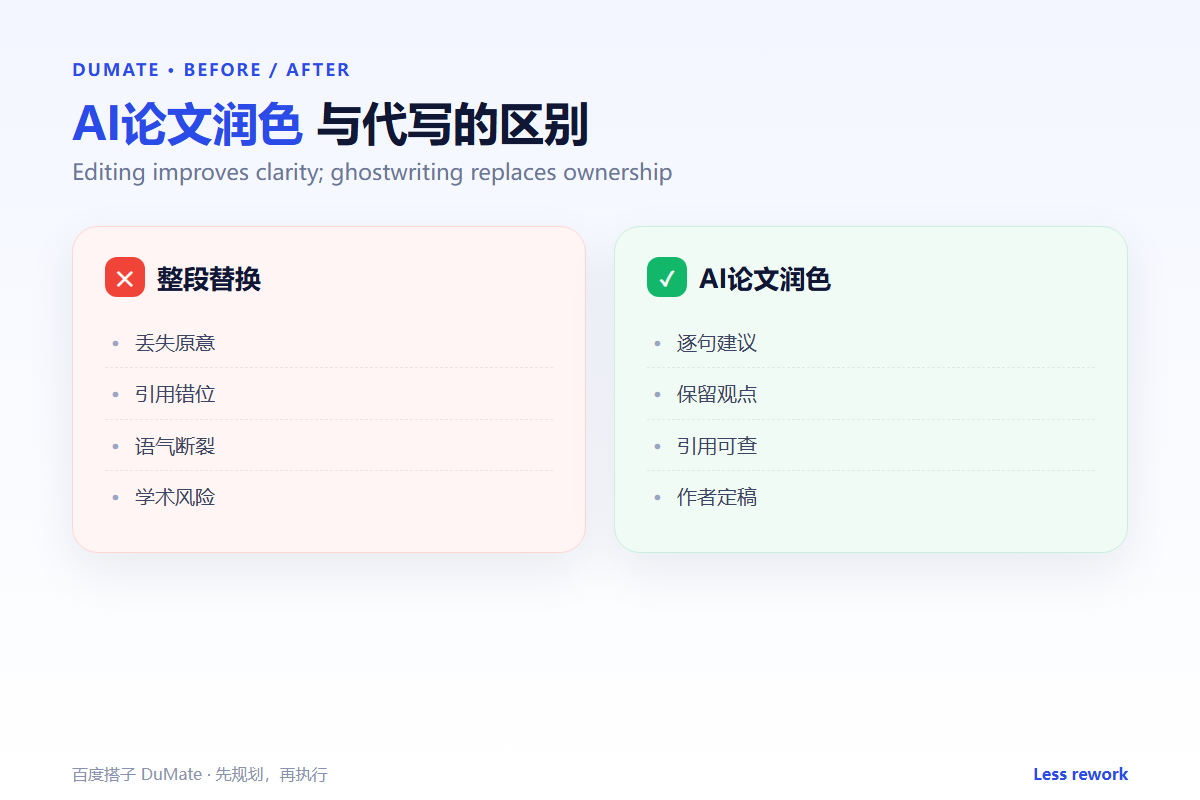
Is AI论文润色 the same as ghostwriting?
No. Polishing improves expression. Ghostwriting produces claims and structure. The author must remain the source of both.
Can it reduce the similarity score?
It may, but that should not be the goal. Rewriting to beat a checker can damage precision and is easy to detect.
What should I check before submission?
Claims, citations, numbers, and the author’s final approval. Read the paper once more without the tool open.
延伸阅读
For general drafting, see AI写作助手. Organize sources in an AI知识库. For literature synthesis, read AI文献综述. Citation formatting is easier with AI错别字检查 and AI PDF编辑. External references: NIST AI Risk Management Framework and ISO/IEC 42001.
评论
还没有评论,来说两句吧。以下为本文的引用通告: