
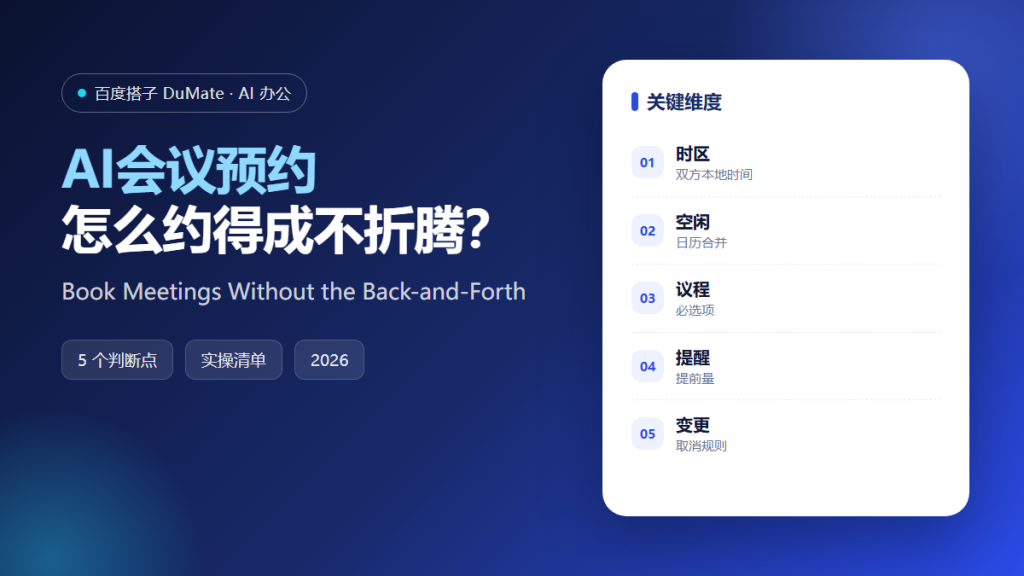
AI会议预约 is a small workflow with a large hidden cost. Every scheduling email is a context switch, and every ambiguous invite creates another round of messages. The goal is not to fill the calendar. The goal is to protect the time that matters and make the meeting easy to prepare for.
This guide covers the five-step method we use for internal and client meetings, the rules that prevent double booking, and the invite details that reduce no-shows.
Key Takeaways
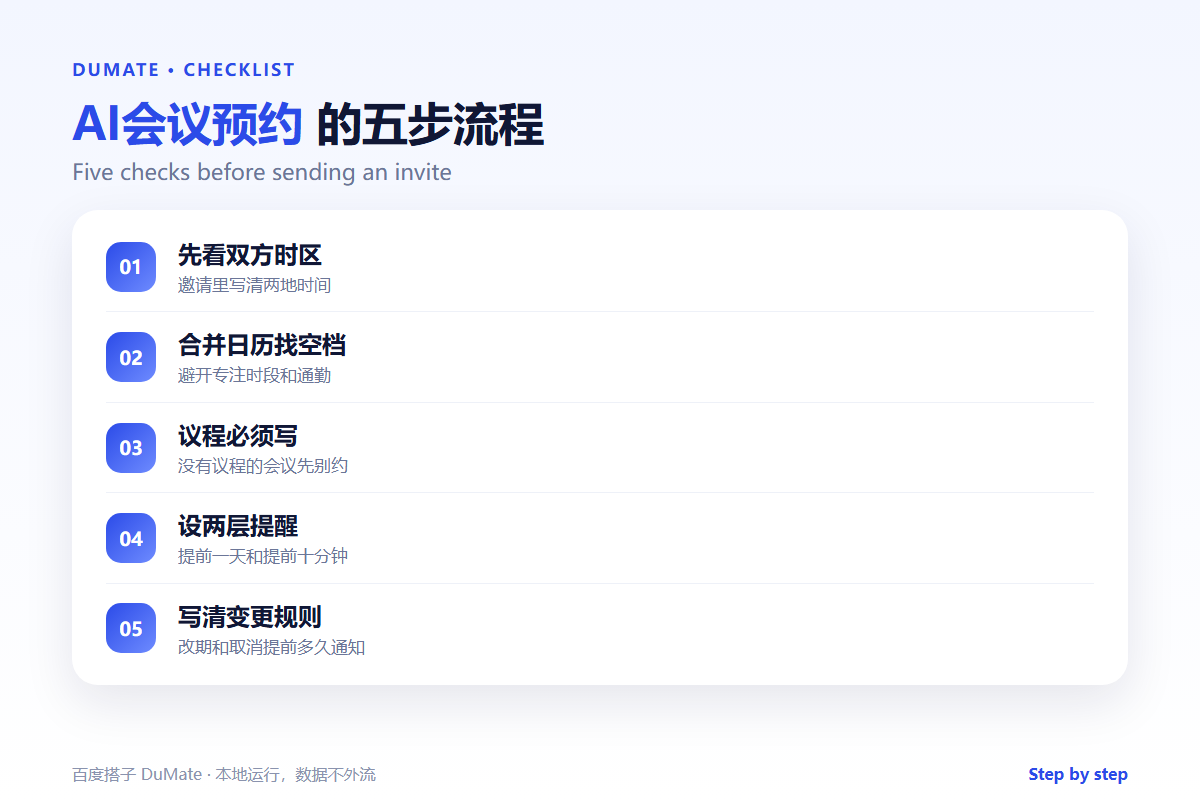
- Check both time zones before proposing a slot.
- Merge calendars instead of guessing availability.
- Require an agenda and a desired outcome.
- Set two reminders, not five.
- Write the change and cancellation rules.
Why AI会议预约 Should Protect Focus Time
A calendar with no gaps looks productive and feels chaotic. Back-to-back calls remove the time needed to write notes, follow up, and think. AI会议预约 can fill every empty slot, which is exactly why the process needs rules about what not to book.
The second issue is time zones. A slot that looks convenient in one city can be late at night in another. AI会议预约 can convert times automatically, but the invite should still show both local times so nobody has to calculate.
The third issue is preparation. A meeting without an agenda tends to become a status update that could have been a message. Requiring an agenda at booking time improves the quality of the meeting before it starts.
How AI会议预约 Works in Five Steps
Step 1: Define the purpose and the outcome
Write one sentence: we need to decide X, or we need to review Y. If the purpose is unclear, send a message instead. AI会议预约 should not be used to schedule uncertainty.
Step 2: Check time zones and working hours
Show the proposed time in both locations. Avoid slots outside normal working hours unless everyone agrees in advance. A short note about the constraint prevents silent resentment.
Step 3: Merge calendars and find a slot
Use free/busy data rather than memory. Protect focus blocks and travel time. AI会议预约 works best when the calendar already reflects priorities, so block deep work before scheduling anything else.
Step 4: Send a complete invite
Include the agenda, the desired outcome, the location or link, and any preparation. Attach the document that will be discussed. A complete invite reduces the first five minutes of every call.
Step 5: Set reminders and change rules
Use one reminder a day before and one ten minutes before. State how to reschedule and how late is too late. Clear rules reduce no-shows more than extra reminders.
An Invite Checklist
- Purpose and desired outcome.
- Agenda with time boxes.
- Both time zones.
- Preparation materials attached.
- Change and cancellation rules.
Where AI会议预约 Fails
It fails when the calendar is inaccurate. If focus blocks and personal appointments are missing, the tool will propose times that do not work. It also fails when the attendee list is too large, because a meeting with twelve people needs a different format, not a better slot.
- Scheduling over focus time.
- Invites without an agenda.
- Time zones shown in one location only.
- Recurring meetings that nobody reviews.
Before and After
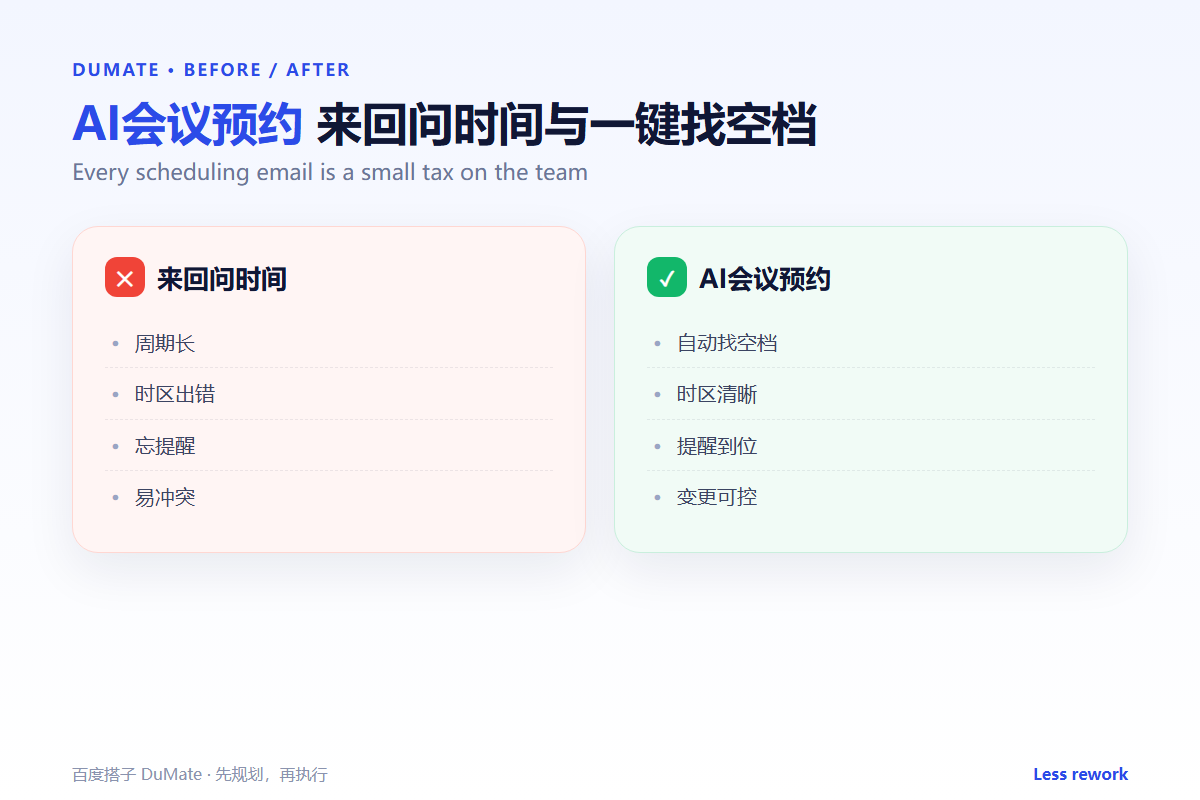
Before, a client meeting took six emails and two reschedules. After, AI会议预约 finds a slot from merged calendars, the invite includes an agenda and both time zones, and the meeting starts on time. The saved time is small per meeting and large across a month.
The bigger gain is attention. When meetings have a clear purpose, people arrive prepared, and the call ends with a decision instead of a follow-up.
Review recurring meetings every quarter. Ask whether each one still needs to exist, and whether it can be shorter or async. AI会议预约 makes it easy to keep a meeting alive; the review is what stops the calendar from filling with habits.
Finally, keep a short record of decisions after each meeting. Scheduling is only the beginning, and a meeting that produces no record tends to be scheduled again.
Protect a short buffer after every external call. Ten minutes is enough to write a note, send a follow-up, and reset before the next topic. Without that buffer, the meeting ends late and the notes never get written. A simple AI会议预约 rule can enforce the buffer automatically, and the calendar becomes calmer without reducing the number of meetings.
Review the invite template once a quarter. Remove fields nobody reads and add the one detail that keeps coming up, such as the dial-in number or the parking note. A template that reflects real meetings makes AI会议预约 faster for everyone, and it reduces the small errors that cause late starts. If a team keeps missing a detail, the fix belongs in the AI会议预约 template, not in another reminder email. A clear template is a small courtesy that saves every attendee a few minutes.
FAQ
Should we schedule across time zones automatically?
Propose slots automatically, but confirm with the attendees. AI会议预约 should not decide whose evening is sacrificed.
How long should a default meeting be?
Twenty-five or fifty minutes, not thirty or sixty. The short buffer helps people arrive and leave on time.
What about recurring meetings?
Set an end date and review the series quarterly. A recurring meeting without a review becomes permanent by accident.
延伸阅读
For calendar hygiene, see AI日程管理. For follow-up messages, read AI邮件助手. Turn meeting output into tasks with AI待办事项. Capture notes with AI会议纪要. Cross-app workflows are covered in AI跨应用操作. External references: NIST AI Risk Management Framework and Microsoft 365 support.
评论
还没有评论,来说两句吧。以下为本文的引用通告: