
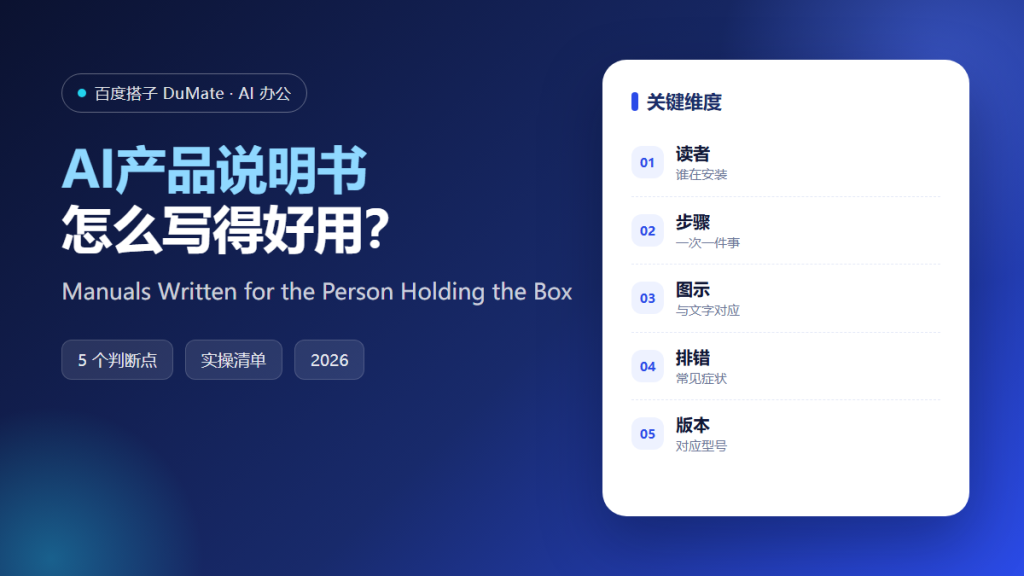
Product manuals are usually written by people who already know the product, for a reader who is holding a box, a cable, and a phone call from a client. The result lists features in the order the engineering team built them. AI产品说明书 fails in the same way when it is asked to polish that structure instead of replacing it.
This guide describes a five-step method for AI产品说明书 that begins with the first ten minutes of use, then tests whether a stranger can finish the setup without help.
Key Takeaways
- Write the first ten minutes before writing the feature list.
- AI产品说明书 should answer what the reader does next, not what the product contains.
- One step per action, with the expected result stated.
- Keep warnings where the risk occurs, not in a front section.
- Test with five people who have never seen the product.
Why AI产品说明书 Needs a Use Sequence
A manual is read in a state of mild panic. The reader has unpacked something, cannot find the power button, and does not want a taxonomy of accessories. A sequence that starts at unboxing and ends at a working device answers the only question in the room. AI产品说明书 that opens with specifications delays the answer by four pages and loses the reader at the second heading.
Sequence also exposes missing parts. When the steps are written in order, a gap becomes obvious: the reader is told to connect an app before being told to install it. Feature lists hide these gaps because each item is complete on its own. A draft that can be followed line by line is a test of the product as much as of the writing.
The third reason is support cost. Every unclear step becomes a call. A manual that states the expected result after each action lets the reader self-correct, and self-correction is cheaper than a queue. AI产品说明书 should be judged by the calls it prevents, not by the number of pages it fills.
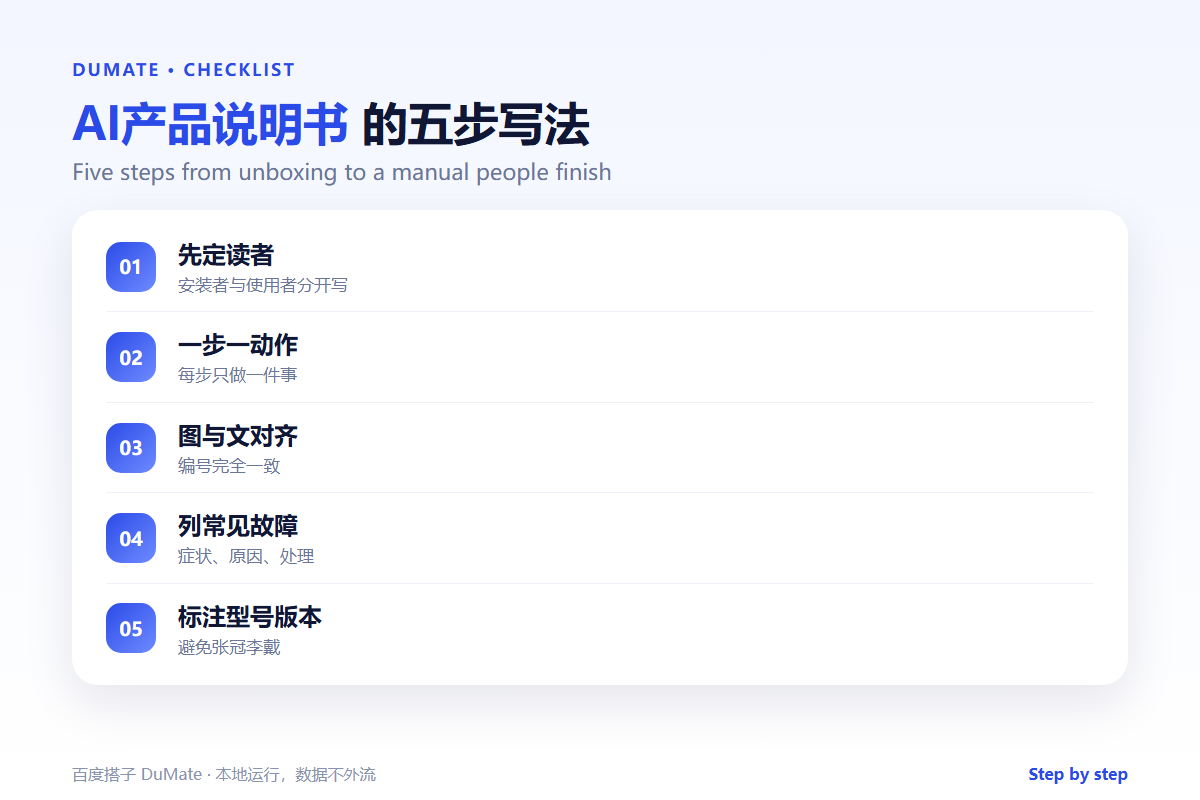
How AI产品说明书 Works in Five Steps
Step 1: Watch the first setup
Sit beside five new users and record where they hesitate. Note the moment they reach for the box again, and the sentence they say out loud. Those hesitations become the section order that AI产品说明书 follows. Do not ask what they think of the manual; watch what they do with the product.
Step 2: Write the critical path
Draft the shortest route from unopened box to first successful use. Number every action, and put the expected result on its own line. If a step needs a tool, a password, or a second person, say so before the step rather than inside it.
Step 3: Move risk to the point of risk
Warnings belong next to the action they protect, not in a safety chapter nobody reads. State the consequence in plain words, then the correct action. AI产品说明书 should use the same warning format every time, so a reader recognizes it without reading the heading.
Step 4: Cut the feature tour
Keep a short reference table for features and move everything else to a support page. The manual exists to make the product work, not to describe every menu. When a feature needs more than three lines, it needs its own document with its own title.
Step 5: Test with a stranger
Give the draft and an unopened box to someone who has never used the product. Ask them to set it up while you stay silent. Mark every pause longer than ten seconds. Revise the step where the pause happened, then test with two more people before printing.
A Usability Checklist for AI产品说明书
- The first page shows the finished setup, not the company history.
- Every step begins with a verb.
- Parts are named the same way on the diagram and in the text.
- Troubleshooting covers the five most common failures.
- AI产品说明书 is tested by someone outside the project team.
Where AI产品说明书 Fails
It fails when the manual is treated as a legal document, written to limit liability rather than to enable use. AI产品说明书 also fails when it is generated once and never updated, so the third hardware revision ships with instructions written for the first.
- Steps that skip the result the reader should see.
- Diagrams without labels, or labels in a different language.
- Warnings collected at the front where they are never read.
- Translations produced without checking the diagrams.
Before and After
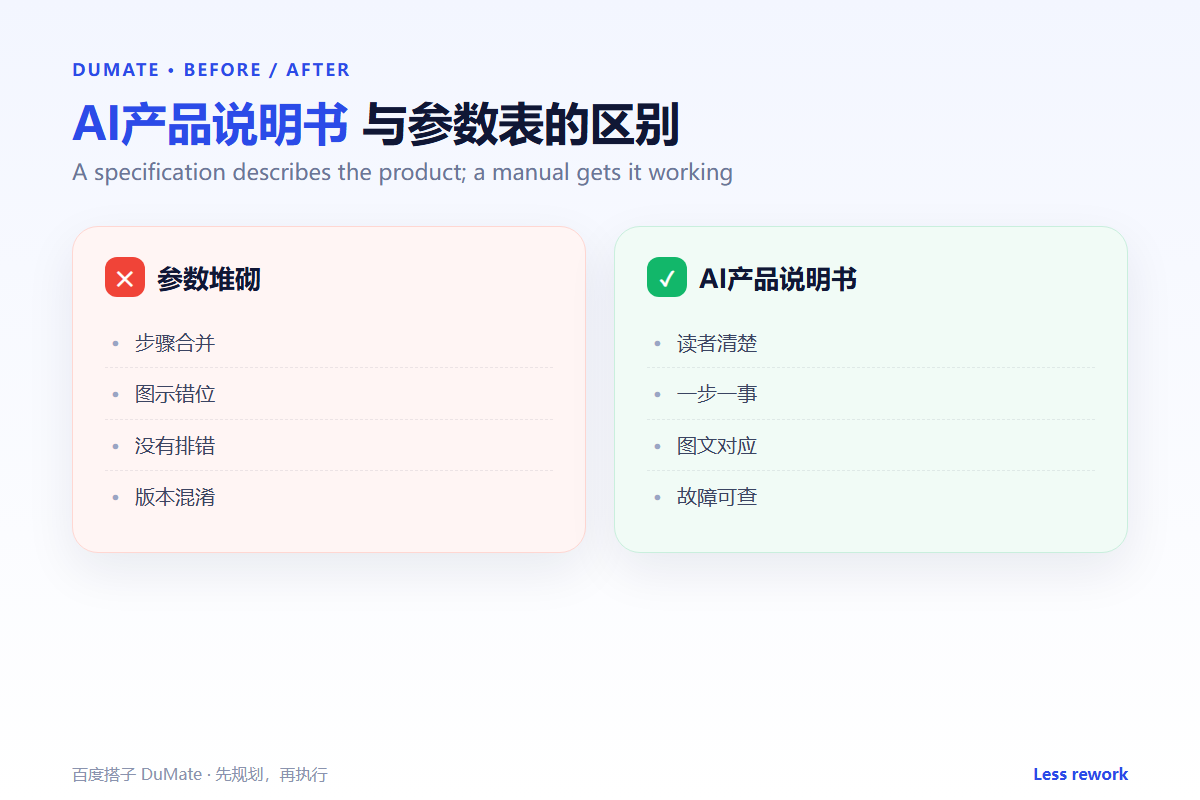
Before, a hardware team shipped a forty-page manual organized by component. Support received roughly nine hundred setup calls a month, and half of them concerned a cable that had been described only in a diagram footnote.
After, AI产品说明书 led with a six-step setup and a photograph of each result. The cable appeared in step two with its name printed on the connector. Setup calls fell by about a third in the first quarter, and the returns rate dropped with them.
FAQ
How long should a manual be?
As short as the setup allows. Twelve well-tested pages beat forty pages that describe every menu but skip the first connection.
Should AI产品说明书 be printed?
Print a short quick-start card and keep the full reference online, where it can be corrected. Most readers use a phone, so make the first page work on a small screen.
Can we translate with the same tool?
Only with a shared glossary and a review of every diagram. Translations that rename a part create a new support problem in the second language.
延伸阅读
Strong manuals borrow from product copy for the opening promise and from product prototype in five steps for early testing. Use training material design when the product needs a course, typo check before printing, and packaging design so the box and the manual agree. External references: NIST AI Risk Management Framework and ISO/IEC 42001.
评论
还没有评论,来说两句吧。