
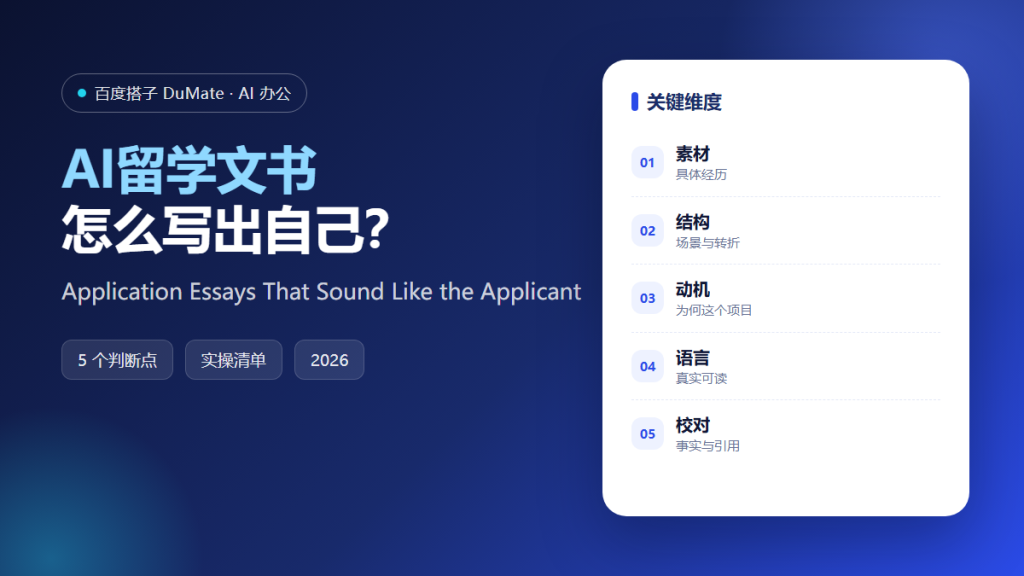
Admissions readers can tell within a paragraph whether an essay was written to sound impressive or to explain a decision. Long words and grand statements about passion do not survive a second read. AI留学文书 is useful for structure and honesty checks, not for producing a thesaurus version of a student’s life.
The five steps below cover the evidence inventory, the story choice, the draft in the student’s own voice, the program fit, and the final verification against the prompt.
Key Takeaways
- Start from specific events, not from adjectives.
- AI留学文书 should ask for evidence after every claim.
- One incident explained well beats five mentioned briefly.
- Program fit must name a course, a lab, or a professor.
- The final draft is read aloud and checked against the limit.
Why AI留学文书 Needs Evidence of Judgment
A statement that says the applicant is passionate about biology is a claim. A paragraph that describes a failed experiment, the decision to repeat it with a smaller sample, and what the result changed is evidence. AI留学文书 should push every sentence toward the second form, because readers are selecting for judgment under uncertainty.
Voice matters because the essay is also a writing sample. A draft that sounds like a corporate brochure raises a question about who wrote it. AI留学文书 can suggest structure and catch repetition, but the sentences must remain the student’s, including the imperfect ones that sound like a person rather than a product.
The third reason is fit. Many essays praise a university in terms that could apply to fifty others. Naming a specific course, a research group, or a teaching style shows that the student did the work. AI留学文书 should test each fit sentence by asking whether it would still be true at another school.
How AI留学文书 Works in Five Steps
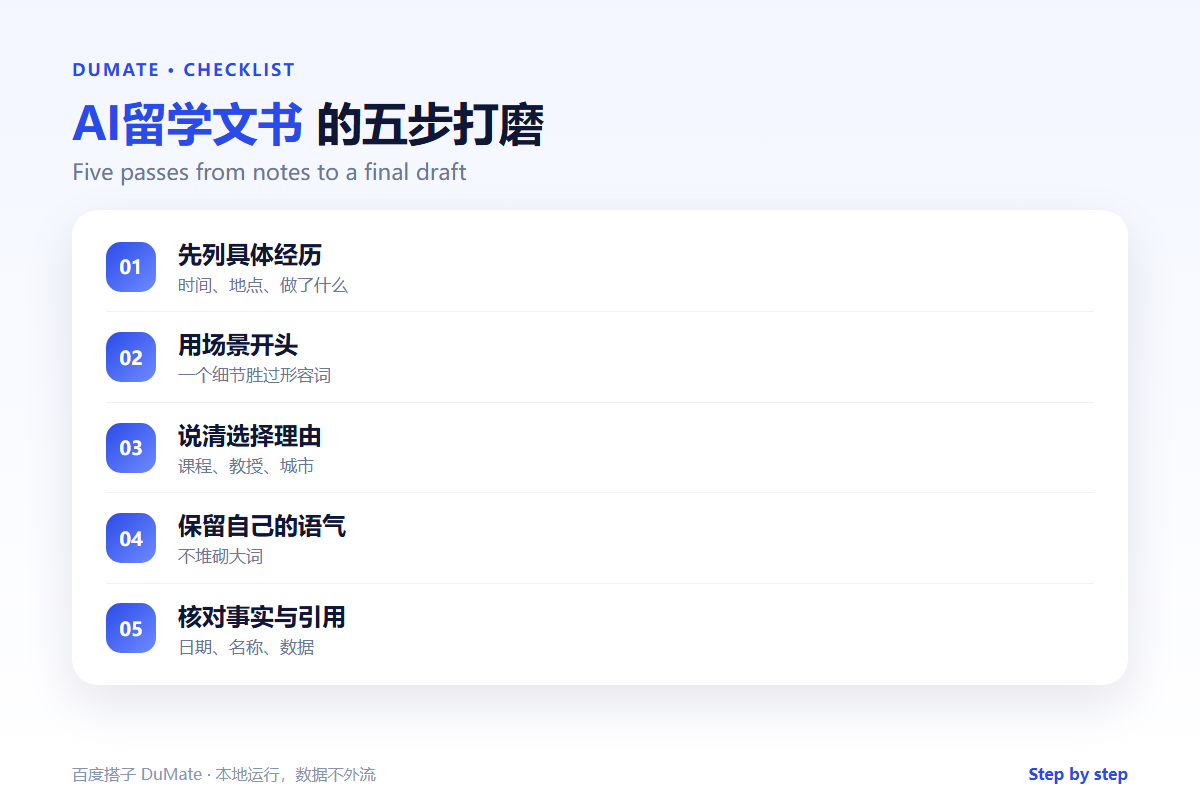
Step 1: Build an evidence inventory
List ten moments from the last three years: a problem solved, a disagreement, a failure, a project finished, a book that changed an opinion. For each, write what happened, what the student decided, and what changed. AI留学文书 works from this list, because a list of ten is easier to finish than a blank page.
Step 2: Choose one story
Pick the moment that reveals the most about how the student thinks, not the most impressive achievement. A quiet decision to help a classmate debug code can show more than a list of prizes. Cut the other nine from the essay and keep them for interviews, where a specific story is worth more than a summary. The inventory will still be useful next year.
Step 3: Draft in the student’s voice
Write the first draft by hand or in a plain editor, without asking a model for sentences. Then use AI留学文书 to identify vague claims, repeated words, and paragraphs that explain instead of show. Rewrite those passages in the student’s own words, including the shorter sentences that sound like speech. Keep a copy of the first draft so the change is visible.
Step 4: Connect to the program
Name two specific resources and one reason for each. Explain what the student wants to do with them. A sentence about a lab should mention the work, not just the reputation. This is where AI留学文书 can check facts, but the connection must be genuine enough to survive an interview question.
Step 5: Verify and read aloud
Check the word limit, the prompt, and every factual claim. Read the essay aloud; sentences that cannot be spoken are usually too long. Ask a teacher who knows the student whether the voice sounds right. AI留学文书 is finished when the student can defend every line.
An Application Checklist for AI留学文书
- Every claim has a specific event behind it.
- One story carries the essay.
- The voice matches the student’s speech.
- Program fit names real resources.
- The draft passes the read-aloud test.
Where AI留学文书 Fails
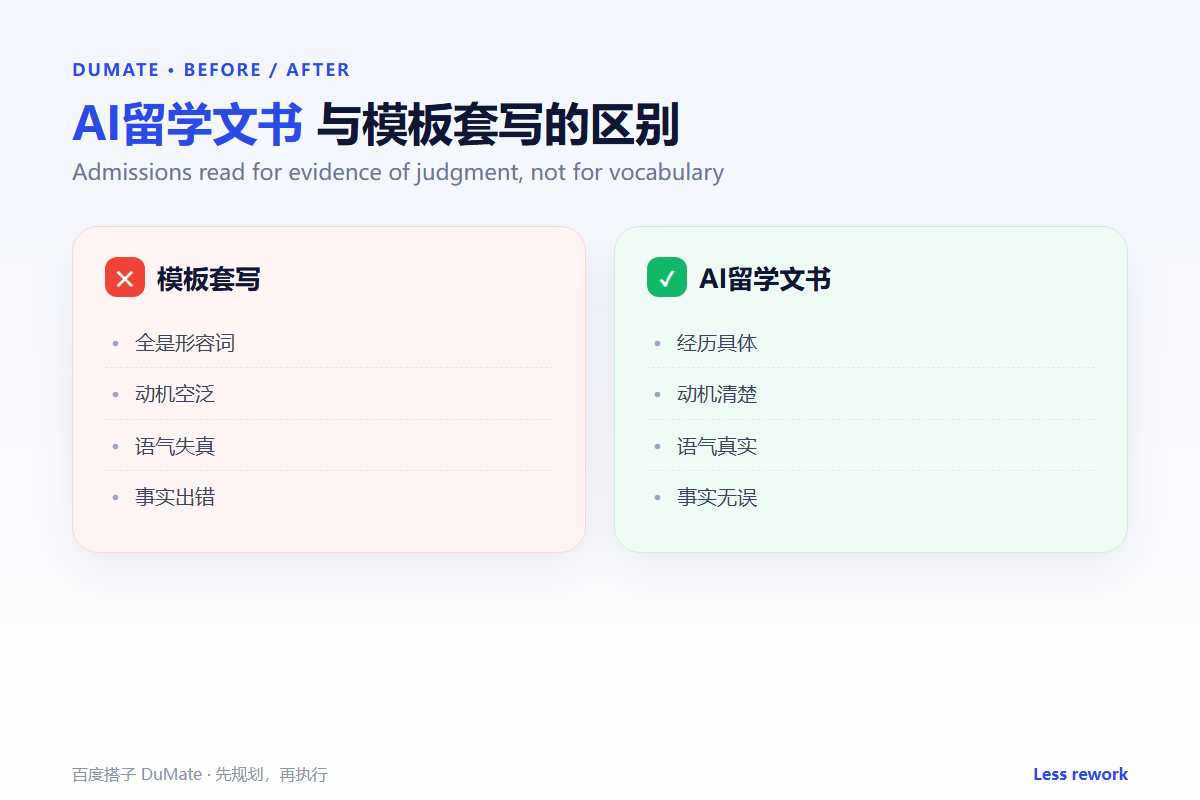
It fails when the essay sounds like every other essay, and it fails when a student cannot explain a sentence in an interview. AI留学文书 should make the thinking visible, not the vocabulary.
- Opening lines about childhood dreams.
- Achievements listed without a decision.
- Program fit copied from a brochure.
- Vocabulary no eighteen-year-old would use.
Before and After
Before, a student submitted an essay with 14 adjectives in the first paragraph and a list of five activities. It was rejected by three universities, and the interviewers asked about a project the essay described in one line.
After, AI留学文书 helped rebuild the essay around one failed robotics demo, the decision to simplify the design, and the result at the next competition. The draft lost 300 words of decoration, gained a specific program reference, and was accepted by two of the four schools. The student could explain every sentence, which mattered more than the wording.
FAQ
Is using AI留学文书 dishonest?
Not if it is used for structure, feedback, and fact checks. The risk is substituting its sentences for the student’s, which readers notice and interviews expose.
How personal should the essay be?
Personal enough to be yours, not so personal that it distracts from the argument. The test is whether the detail explains a decision. A detail that does not explain a decision is decoration.
Should I mention grades?
Only if they explain something the transcript cannot. The essay is a chance to show how you think, not to repeat the application form. AI留学文书 should keep the focus on the decision.
延伸阅读
Essay work improves with paper polish for sentence-level clarity and literature review for the reading behind the argument. Use essay grading to see how a reader scores evidence, career planning to connect the program to a later goal, and mock interview practice to rehearse the claims aloud. External references: NIST AI Risk Management Framework and ISO/IEC 42001.
评论
还没有评论,来说两句吧。