

The default edit removes every pause, every repeated word, and every interruption, then compresses the result until the episode fits a target length. It sounds professional and says less, because the pauses were where a guest thought and the tangent was where the useful example lived. AI播客剪辑 should decide what the episode is for before it removes anything.
The sequence below covers five steps for AI播客剪辑, from a single listening pass to a loudness check on a phone speaker, and the points where an editor should stop cutting.
Key Takeaways
- Listen once without editing and write the episode’s promise.
- AI播客剪辑 should remove whole segments, not individual syllables.
- Keep breaths at transitions and cut them inside long explanations.
- Target a consistent loudness rather than a louder file.
- Add chapters and timestamps so listeners can navigate.
Why AI播客剪辑 Needs a Listening Pass
An episode has one promise, and every segment either supports it or delays it. Editors who start cutting before naming that promise tend to preserve the parts they find interesting and remove the parts a listener needed. A single pass at normal speed, without a timeline or a marker, restores the listener’s perspective. AI播客剪辑 is faster after that pass, because the decisions are already made.
Removing silence changes meaning. A two-second pause before an answer signals difficulty, and deleting it makes a thoughtful reply sound glib. Filler words work the same way: some signal informality, others signal uncertainty, and a blanket rule removes both. The useful rule is to cut repetition and dead air at the wrong moment, then leave the rhythm of speech intact.
Navigation is the third reason. A ninety-minute conversation with no chapters asks a listener to gamble on where the good part is. Timestamps, a short description per chapter, and a transcript turn one long file into several entry points. AI播客剪辑 that produces those artifacts serves discovery as much as it serves audio quality.
How AI播客剪辑 Works in Five Steps
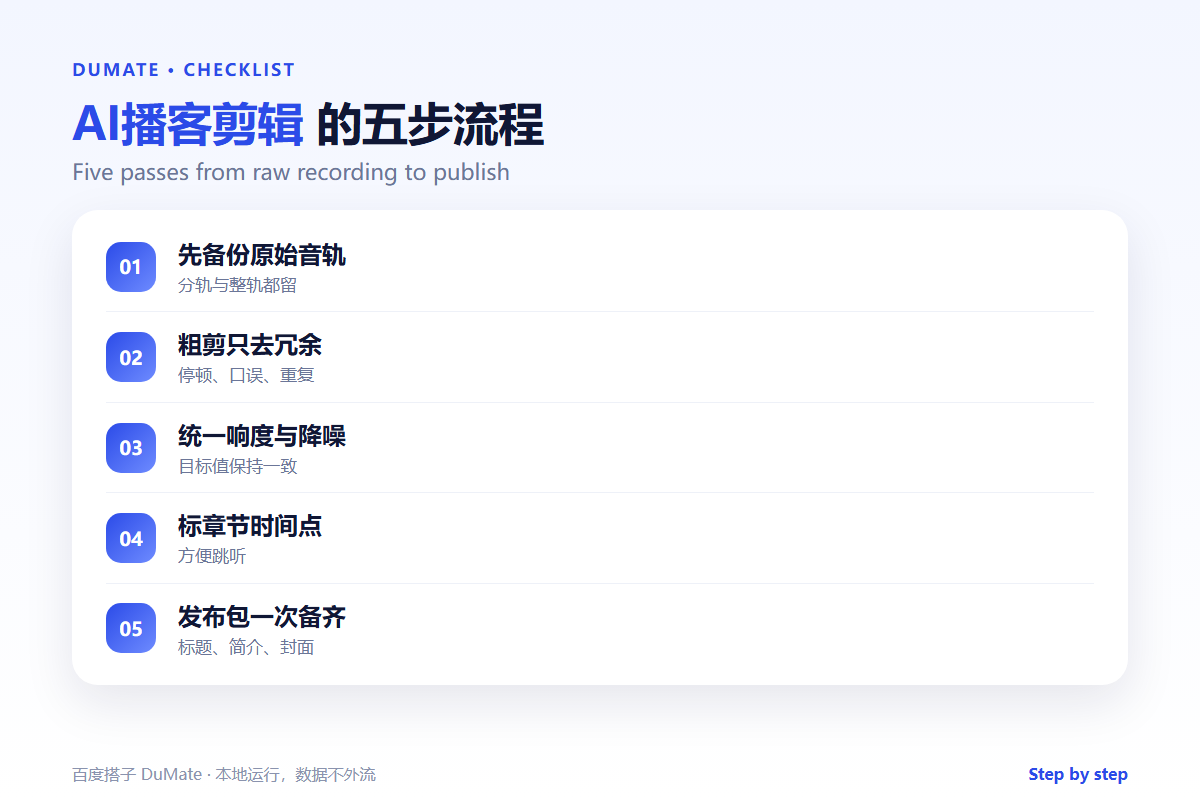
Step 1: Listen and name the promise
Play the raw file once at normal speed and write one sentence: what a listener will be able to say after hearing this. Note the three moments that support it, with rough timestamps. If a fourth moment feels essential, the promise is too broad, and the episode may need to become two.
Step 2: Mark the spine
Choose a cold open of twenty to forty seconds that poses the question, then three beats that answer it. Put the strongest beat first if the topic is unfamiliar. AI播客剪辑 should protect those beats before touching anything else, because they carry the reason someone stays.
Step 3: Cut segments, not syllables
Remove entire answers that repeat a point already made, and keep the example that illustrates it best. Cut false starts and long digressions, then listen again. Keep breaths at transitions and remove them only inside dense explanations, where they interrupt a chain of reasoning.
Step 4: Fix the sound in a fixed order
Reduce room noise, then handle plosives, then balance levels, then apply loudness. Aim for about minus sixteen LUFS integrated for stereo podcast audio, with a true peak no higher than minus one decibel. AI播客剪辑 should apply the same chain to every episode, so listeners never reach for the volume control.
Step 5: Add navigation and check the phone
Write chapter titles, timestamps, and a three-line summary. Publish the transcript with speaker labels. Then listen to the first two minutes on a phone speaker at low volume, because that is how most people will hear it, and any detail lost there should be fixed before release.
A Release Checklist for AI播客剪辑
- The first thirty seconds state the question.
- No segment repeats a point already made.
- Loudness and peak match the previous episode.
- Chapters have titles rather than numbers alone.
- AI播客剪辑 output is checked on a phone speaker.
Where AI播客剪辑 Fails
It fails when the edit is judged by how little silence remains. AI播客剪辑 also fails when a template is applied to every voice, so a slow, deliberate speaker ends up sounding rushed and a lively one sounds clipped. The audio is clean and the guest is gone.
- Every pause removed, leaving no room to think.
- Crossfades over natural turn-taking.
- Music beds louder than the conversation.
- Transcript published without names or spell checks.
Before and After
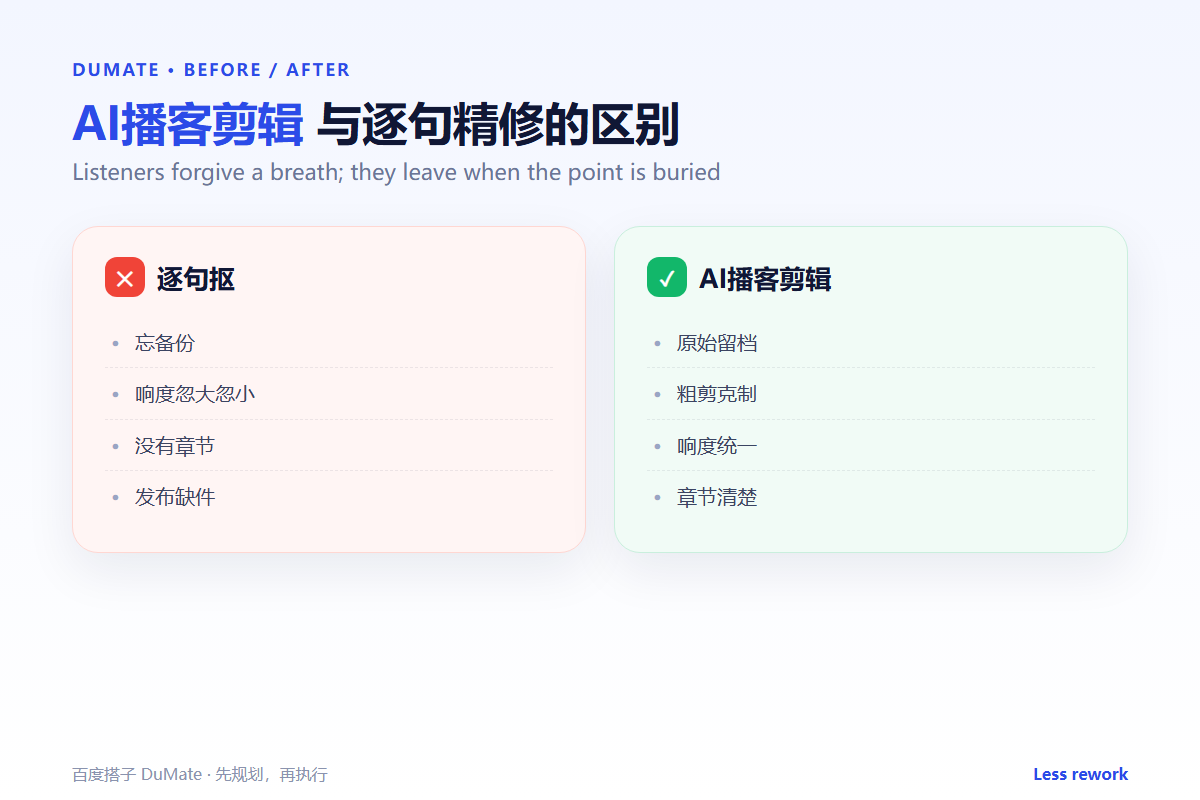
Before, a two-person show recorded eighty minutes, cut it to fifty-two by deleting pauses, and published without chapters. Average listening time was nineteen minutes, and the most-quoted segment was a tangent the editor had almost removed.
After, AI播客剪辑 kept the tangent, moved it to the first beat, and cut two repeated answers instead. The episode ran forty-six minutes with eight chapters. Average listening time rose to thirty-one minutes, and the transcript supplied the quotes used in the newsletter.
FAQ
How long should an episode be?
As long as the promise requires and no longer. A tight thirty minutes usually beats a loose hour, but a topic that needs ninety minutes should get them, with chapters to help a listener find the part they came for.
Should all filler words be removed?
No. Remove repeated words and false starts; keep the ones that carry hesitation or emphasis. AI播客剪辑 should preserve the speaker’s rhythm, not flatten it.
Which loudness target is right?
Minus sixteen LUFS integrated suits most stereo podcasts, with a true peak at minus one decibel. Consistency across episodes matters more than the exact figure.
延伸阅读
Pair the audio edit with video editing for the recorded version and video subtitle workflow for captions. Voice over helps when a segment needs a clean re-record, short video script turns one beat into a clip, and digital human presents the weekly summary. External references: NIST AI Risk Management Framework and ISO/IEC 42001.
评论
还没有评论,来说两句吧。