

Songs are usually drafted from a feeling, then filled with lines that describe the feeling. The result is sincere and forgettable, because a listener cannot repeat an emotion but can repeat a melody. AI歌曲创作 is most useful when it protects the one line a stranger could hum after a single hearing, and treats everything else as support.
What follows is a five-step approach to AI歌曲创作, from the hum test to a phone demo, with the checks that separate a draft with a future from a draft with good intentions.
Key Takeaways
- Write and sing the hook before any arrangement exists.
- AI歌曲创作 should keep one concrete image, not five abstractions.
- Match stressed syllables to strong beats.
- Make the chorus differ in range, rhythm, and density.
- Judge the demo on a phone speaker, not studio headphones.
Why AI歌曲创作 Needs a Hum Test
A melody that survives without instruments is doing the work that makes a song memorable. If the hook needs a production drop to feel strong, it is a production idea rather than a song. Humming the line alone, slightly too fast and slightly off key, exposes whether the contour is simple enough to repeat. AI歌曲创作 should run that test before it adds a single instrument.
Lyrics carry stress, and stress carries meaning. A line whose natural emphasis falls on weak beats sounds wrong even when every word is right. Singing the draft aloud reveals the collision between speech rhythm and bar structure, and the fix is usually to move one word rather than rewrite the line. This is craft, not decoration; it is the difference between a lyric that lands and one that mumbles.
The third test is contrast. A chorus earns its lift by differing from the verse, and difference is measurable: a higher range, a sparser rhythm, or a longer note. AI歌曲创作 that returns the same density in every section produces a song with no arrival point, and listeners describe it as flat without knowing why.
How AI歌曲创作 Works in Five Steps
Step 1: Write the hook line
Draft ten candidate lines and sing each one without accompaniment. Keep the two that feel natural to repeat. Then choose the one you can remember an hour later without looking. That line is the centre, and the rest of the song is written to reach it.
Step 2: Sing the stress pattern
Speak the lyric, mark the stressed syllables, then place them on strong beats. Adjust word order before adjusting the melody, because a small reordering often solves what sounds like a tune problem. AI歌曲创作 should reject any line that only works when the singer rushes a syllable.
Step 3: Build contrast, not volume
Give the chorus a higher starting note, a simpler rhythm, or a longer held vowel. Reduce the instrumentation in the verse so the chorus has somewhere to rise from. Two changes are usually enough; five make the section busy rather than bigger.
Step 4: Keep one concrete image
Choose a single object, place, or action and return to it in the final verse with new meaning. Replace abstract nouns with things a listener can see. AI歌曲创作 tends to produce generalities, so edit toward the specific detail that only this song could contain.
Step 5: Record and live with it
Record a one-take demo on a phone, then listen in a car, in a kitchen, and on laptop speakers. Note where attention drops, and mark the line you skipped. Revise only those places on the first pass, then leave the song alone for two days before deciding anything larger.
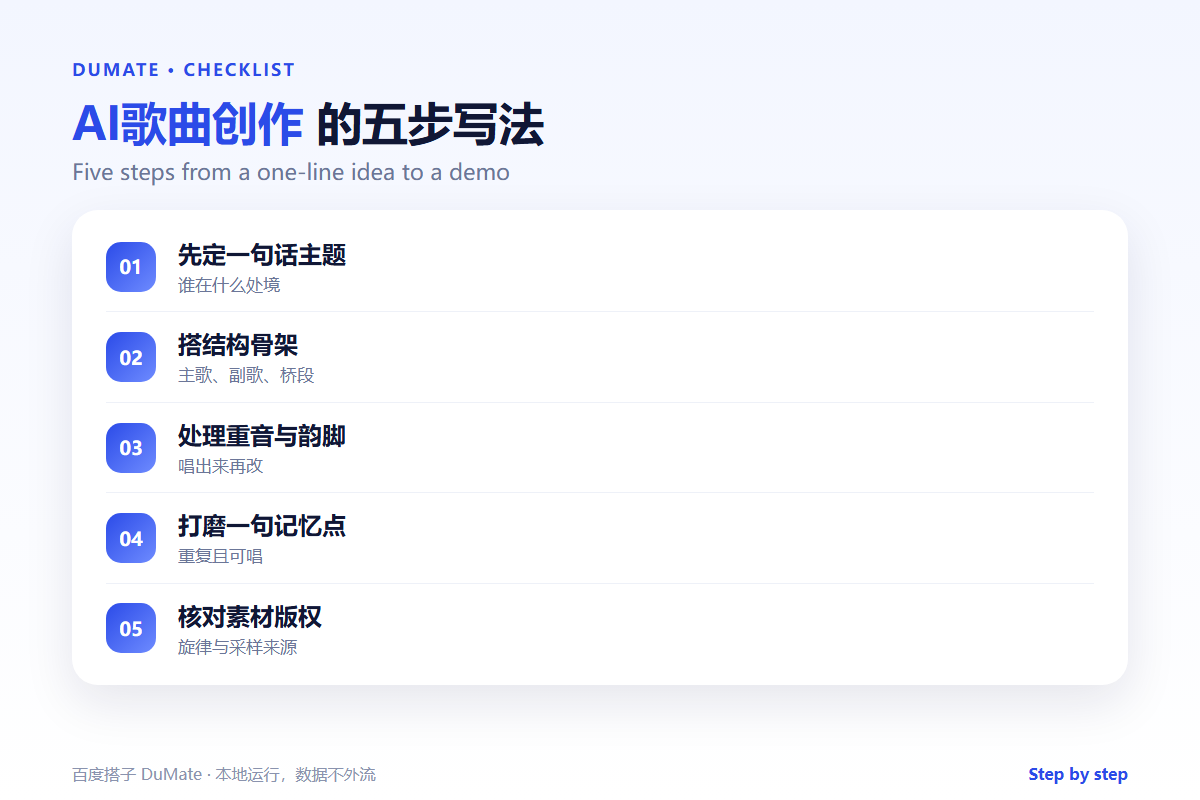
A Draft Checklist for AI歌曲创作
- The hook is memorable without harmony or effects.
- Every stressed syllable sits on a strong beat.
- The chorus differs in at least two measurable ways.
- One image returns with a changed meaning.
- AI歌曲创作 drafts are tested on ordinary speakers.
Where AI歌曲创作 Fails
It fails when the draft is polished before it is finished. AI歌曲创作 also fails when the lyric explains the feeling instead of showing the scene, which leaves a singer with nothing to perform and a listener with nothing to picture.
- Hooks that depend on a production effect.
- Verses that repeat the chorus at lower volume.
- Rhymes chosen for sound against sense.
- Five metaphors competing in one line.
Before and After
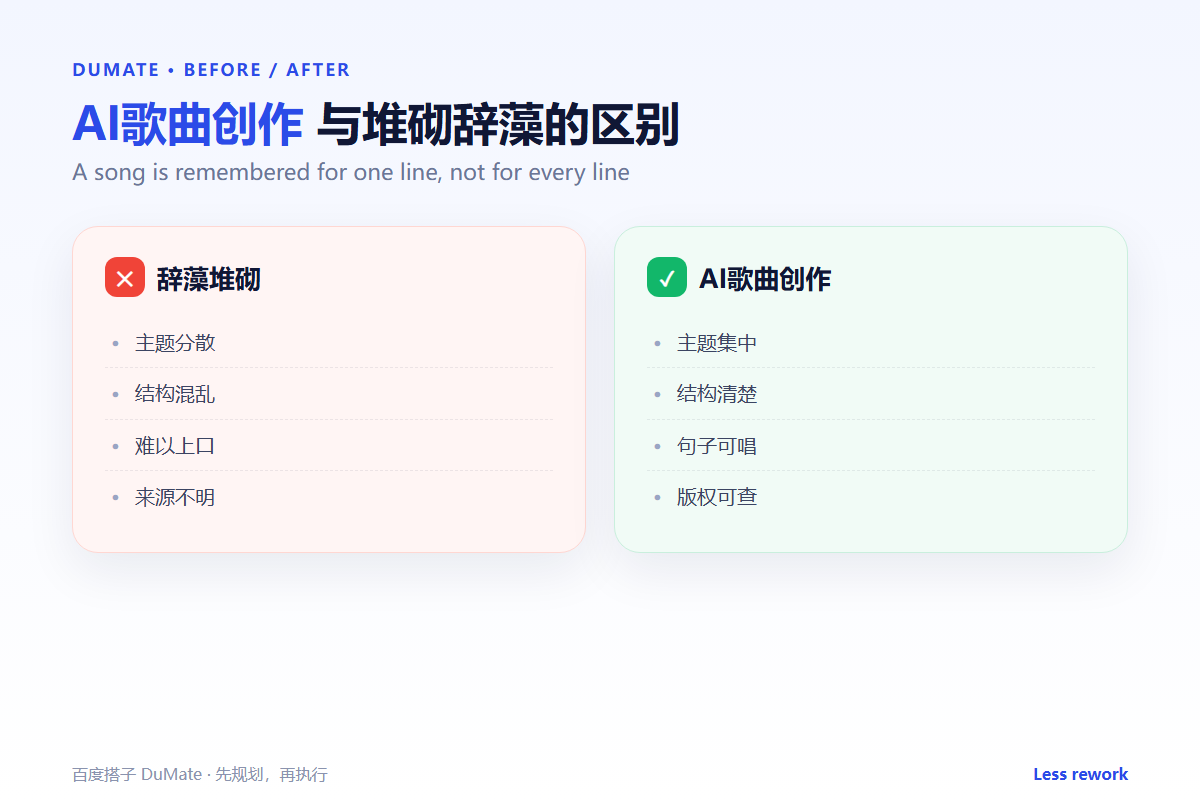
Before, a writer produced a demo with a six-line chorus and eleven abstractions. Listeners remembered the production but could not repeat a single phrase, and three cowriters suggested a different chorus, which made the song longer and less clear.
After, AI歌曲创作 reduced the chorus to one line and one image, a kitchen window at 6 a.m., and moved the highest note to the second syllable. The demo was recorded on a phone in one take. Two listeners hummed it back the next day, which had never happened with the earlier version.
FAQ
Should the melody or the lyric come first?
Either, as long as the hook is sung rather than typed. A lyric written in silence often has a rhythm that no melody can carry comfortably.
How many drafts does a song need?
Fewer than most writers produce, and more than most writers want. Two or three focused revisions after a two-day gap usually do more than ten immediate rewrites.
Can AI歌曲创作 write a chorus on its own?
It can generate options, but the hum test still belongs to a person. Choose the line you can repeat without the track, then build around it.
延伸阅读
Turn the demo into a release with short video script for the clip and digital human for a performance version. Voice over helps when the vocal needs a clean guide track, fiction drafting sharpens the storytelling instinct, and ad copy shows how one line can carry a whole campaign. External references: NIST AI Risk Management Framework and ISO/IEC 42001.
评论
还没有评论,来说两句吧。