
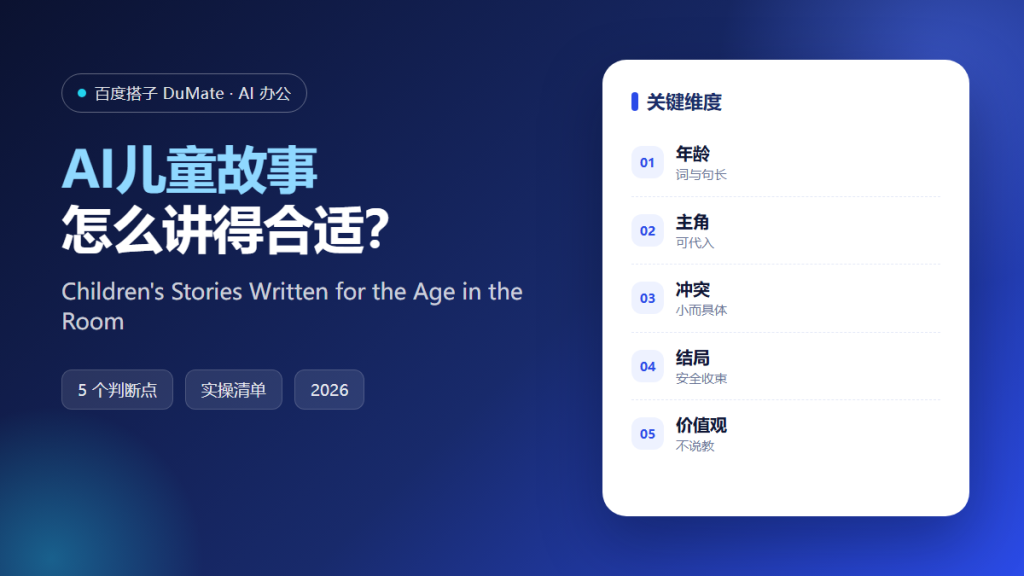
A children’s story is often written for an imagined child who is patient, quiet, and interested in the same things as the author. The real listener is four, tired, and holding a piece of toast. Sentences that look short on the page can still be too long to follow out loud. AI儿童故事 works when the age of that listener decides the vocabulary, the length, and the size of the problem.
The steps below show how AI儿童故事 can be shaped for a specific age band, then tested by reading to the children who will actually hear it.
Key Takeaways
- Name the listener’s age before writing the first sentence.
- AI儿童故事 should contain one problem a child can hold in mind.
- Keep sentences short enough to read in one breath.
- Repeat a phrase so the child can join in.
- Read the draft aloud to three children before publishing.
Why AI儿童故事 Needs an Age Band
A four-year-old and a seven-year-old need different stories, not different fonts. The younger child follows a single action per page and needs a physical detail to anchor it, while the older one can hold a plan and predict a consequence. Writing for both at once produces a story that is too slow for one and too simple for the other. AI儿童故事 should fix the band first and refuse to drift.
Fear is the second constraint. A threat that feels exciting at seven can be genuinely frightening at four, especially when the threat is a person or a loss of a parent. The safe pattern is a small danger, a capable child, and a return to comfort within the same scene. AI儿童故事 should resolve tension quickly and never leave a page ending on unresolved alarm.
Rhythm is the third. Children listen for beats, and a sentence that runs past one breath forces the reader to rush. Short clauses, repeated sounds, and a refrain every few pages give the child something to anticipate. That anticipation is the pleasure of the story, and it disappears when the prose is written for the eye instead of the ear.
How AI儿童故事 Works in Five Steps
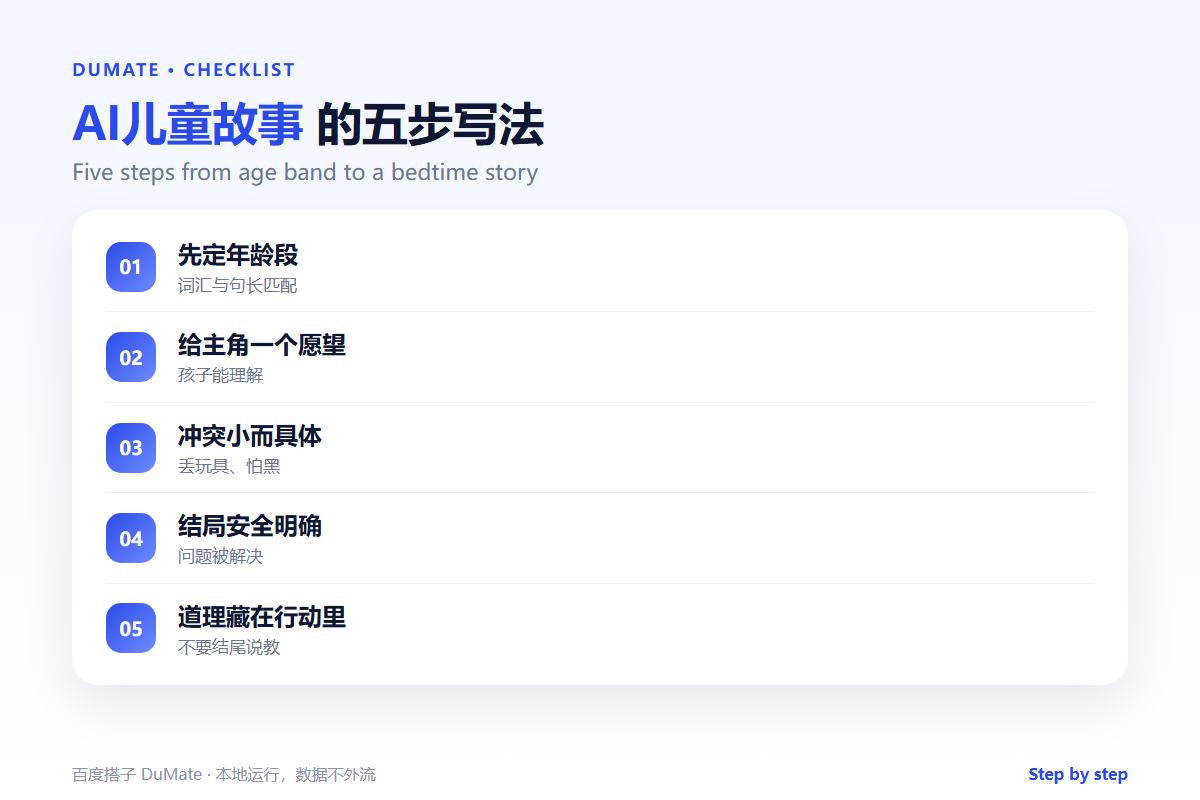
Step 1: Name the listener and the reader
Write two lines at the top of the draft: the child’s age and who will read aloud. A parent at bedtime, a teacher at circle time, and an audio narrator each need different sentence lengths. AI儿童故事 should keep those two lines visible, because they settle most arguments about wording later.
Step 2: Choose one problem
Pick a problem a child can describe in a sentence: a lost mitten, a friend who will not share, a dog that will not come inside. Keep it concrete and solvable within the story. A second problem can wait for a second book, and the child will remember the first one more clearly.
Step 3: Set the sentence budget
For ages three to five, aim for six to nine words per sentence and three hundred to six hundred words in total. For ages six to eight, twelve words and eight hundred to fifteen hundred words fit comfortably. Count one paragraph, not the whole book, then adjust the rest to match.
Step 4: Build the refrain and the pictures
Give the child a line to say, repeated at each turn of the story with one small change. Leave room in the text for the illustration rather than describing it twice. AI儿童故事 should write the words the picture cannot show, which is usually the feeling and the sound.
Step 5: Read it aloud
Read the draft to three children of the target age and watch their bodies rather than their faces. Note the page where someone shifts, asks a question, or leaves. Revise that page first, then read again to a different group before recording or printing.
A Read-Aloud Checklist for AI儿童故事
- Every sentence can be read in one breath.
- The problem appears within the first two pages.
- The refrain changes once, near the end.
- No page ends on unresolved fear.
- AI儿童故事 drafts are tested with real children.
Where AI儿童故事 Fails
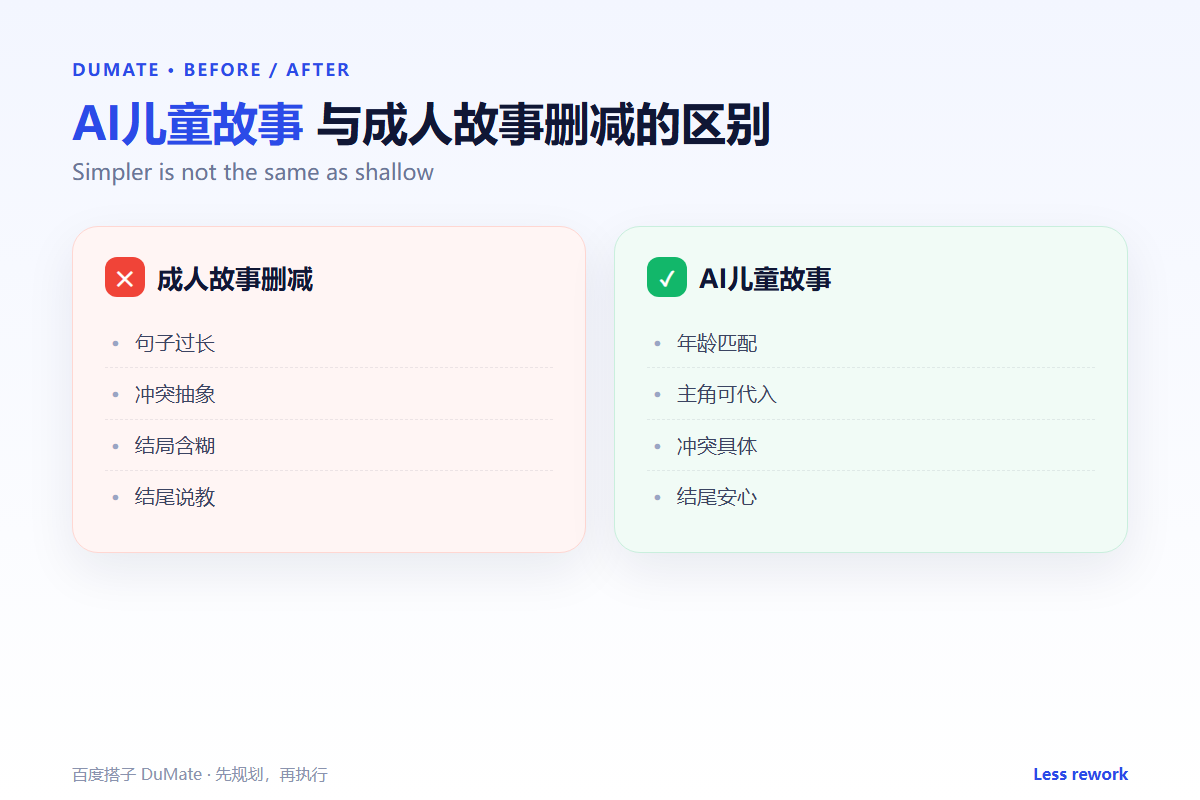
It fails when the story teaches a lesson before it earns attention. AI儿童故事 also fails when it borrows the tone of adult fiction, with irony or ambiguity that a young child cannot resolve, leaving the listener confused rather than curious.
- Sentences that stack three clauses before the verb.
- Villains described in adult terms, with motives.
- Illustrations that repeat the text word for word.
- Vocabulary chosen for the adult reading aloud.
Before and After
Before, a picture book draft ran to nine hundred words for a four-year-old, with an average sentence of sixteen words. In a classroom test, four children left the circle before page five, and the teacher stopped reading at page seven.
After, AI儿童故事 cut the text to four hundred and twenty words, split the long sentences, and added a repeated line on every third page. The same group stayed to the end, and six of nine children said the refrain along with the teacher. The second reading took six minutes instead of eleven.
FAQ
How long should a children’s story be?
Short enough for one sitting at the target age. Three to six hundred words suits ages three to five, and eight hundred to fifteen hundred works for early readers who follow a plot.
Should the story rhyme?
Only if the rhyme is accurate and the meaning survives. Forced rhyme teaches children to skip sense, and a rhythmic prose line often reads better aloud.
Can AI儿童故事 handle difficult subjects?
It can draft, but an adult must review the emotional arc. Grief, illness, and separation need a clear return to safety and a person who knows the child.
延伸阅读
Classroom use improves with lesson plan structure and speaking practice for the read-aloud. Fiction drafting sharpens scene and character, question bank supplies comprehension prompts, and courseware making turns the story into a shared reading activity. External references: NIST AI Risk Management Framework and ISO/IEC 42001.
评论
还没有评论,来说两句吧。