
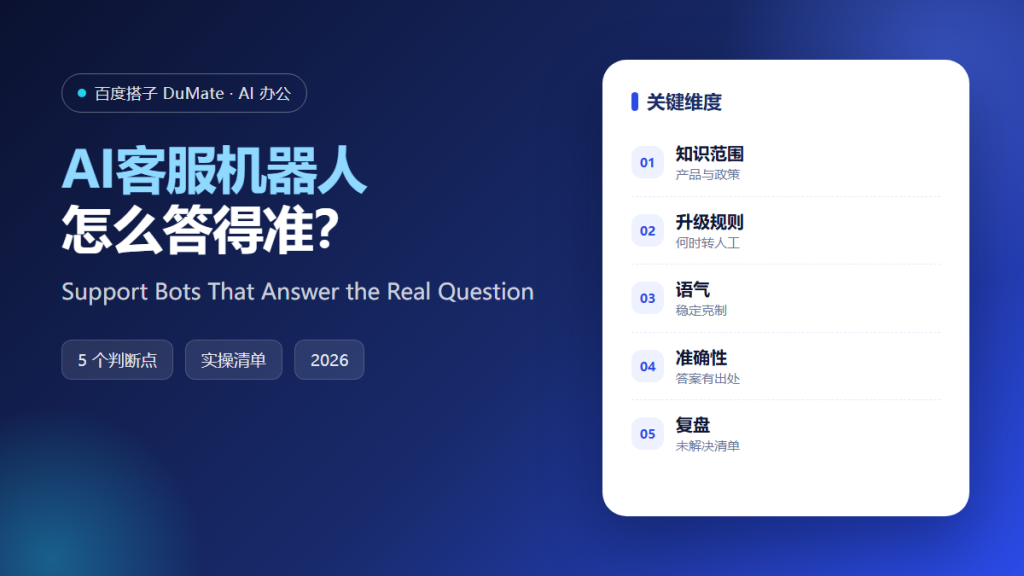
AI客服机器人 is often bought as a headcount fix and judged on one number: how many conversations it closes without a person. That number rewards the wrong behavior, because a bot can end a chat and lose a customer in the same minute. AI客服机器人 works when it answers a narrow set of questions accurately and hands everything else to a person with context attached.
This guide sets out a five-step method for launching AI客服机器人, the checks that keep answers honest, and the failures that turn a helpful assistant into a wall between a customer and the company.
Key Takeaways
- Define the intents the bot must handle before choosing a vendor.
- Route anything ambiguous to a person within one turn.
- Ground every reply in an approved article, not model memory.
- Measure repeat contact, not chat length or closure rate.
- AI客服机器人 transcripts deserve a weekly review, with fixes applied to the source.
Why AI客服机器人 Needs a Narrow Scope
Support work is wide. Order status, refund eligibility, password resets, invoice copies, and compatibility questions all arrive in the same inbox. A bot given all of it at once will answer confidently in the wrong place. AI客服机器人 performs best when the first release covers a short list of high-volume, low-risk intents and everything else is handed to a person.
Scope also decides the tone. A refund conversation needs precision and a record; a compatibility question needs patience and a link to a specification. With a narrow list, the writing team can test both, and AI客服机器人 stops improvising a voice it was never given. Tone is not decoration; it tells the customer whether the message was written for their situation.
The third reason is accountability. Every answer AI客服机器人 gives is a statement the company made in public. Narrow scope means the approved source exists, someone owns it, and a reviewer can trace a reply back to a policy rather than to a prompt written months ago.
How AI客服机器人 Works in Five Steps
Step 1: Map the top questions
Pull ninety days of transcripts and count the reasons people wrote in. Group them into ten to fifteen intents, note the volume of each, and mark the ones that involve money, legal risk, or account access. Keep the counts visible, because volume is the only honest argument for what to automate first, and that ranked list becomes the first release rather than the whole catalog.
Step 2: Write the approved answers
For each intent, write one canonical answer with the policy reference, the conditions, and the next action. Keep it readable on a phone. AI客服机器人 should quote this text instead of paraphrasing it, because paraphrase is where commitments appear by accident.
Step 3: Set the handover rule
Decide when the bot stops. Useful triggers are a second repeat of the same question, a request for a person, an angry message, or any intent outside the list. The handover should carry the transcript and a one-line summary so the customer does not start over.
Step 4: Replay real conversations
Test with two hundred historical threads and score each reply as correct, incomplete, or wrong. Score against the approved answer, not against what a fluent model would say. Wrong answers usually trace to a missing article or an ambiguous question, not to the model. Fix the source, then replay again before launch.
Step 5: Monitor and prune
After launch, sample AI客服机器人 transcripts every week. Track how often the bot answers, how often the customer returns within three days, and which articles get cited. Retire intents that generate complaints and add the ones that keep landing in handover.
‘ alt=’AI客服机器人 checklist: intent scope, approved answers and handover rules’ />
A Launch Checklist for AI客服机器人
- The intent list is short and ranked by volume.
- Each answer cites an approved policy or article.
- Handover triggers are written down and tested.
- The first message says clearly that AI客服机器人 is a bot.
- A named owner reviews transcripts every week.
Where AI客服机器人 Fails
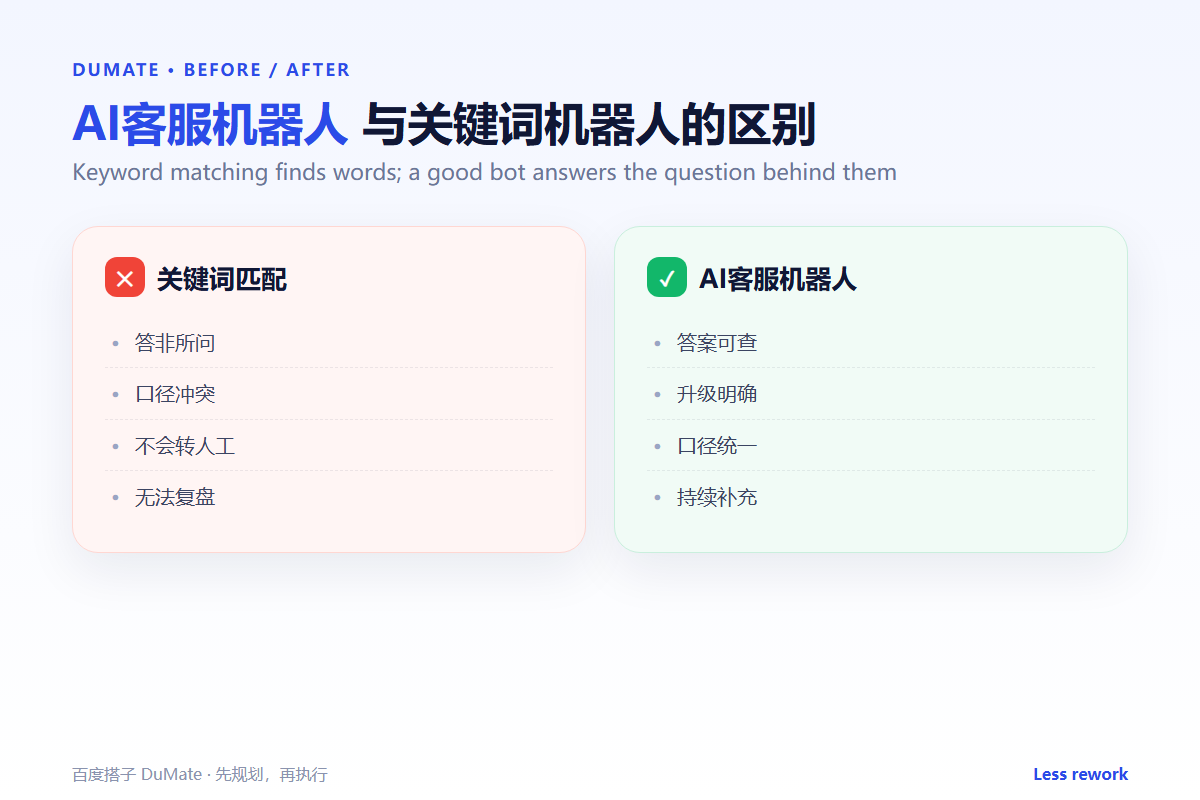
Most failures are organizational. The bot launches without an owner, the knowledge base is a folder of old PDFs, and nobody reads transcripts until complaints reach the support lead. AI客服机器人 then takes the blame for a process that was already broken.
- Answers invented when no article exists.
- Handover buried behind three menu levels.
- One knowledge base shared across regions with different policies.
- Success measured by chats closed rather than questions resolved.
Before and After
Before, a retail team pushed every message into one queue and answered the same delivery question four hundred times a week. Handling time looked acceptable because agents typed fast, while customers with refund problems waited behind them.
After, AI客服机器人 handled order status and return eligibility, quoted the policy, and passed anything unusual to a person with a summary attached. The queue shrank, but the real gain was that agents spent their hours on cases that needed judgment. They also stopped guessing which queue to check first, which removed a daily ritual that had never appeared in any report.
FAQ
Does AI客服机器人 reduce headcount?
Rarely at first. It absorbs repetitive volume, which gives the existing team room to handle difficult cases properly. It also changes the mix of work, which matters more than the total. Staffing follows the remaining workload, not the launch date.
How many intents should the first release cover?
Ten to fifteen is a practical start. Fewer leaves obvious volume untouched, and more makes testing and ownership difficult to sustain.
Which metric matters most?
Repeat contact within seventy-two hours tells you whether AI客服机器人 resolved the question, something closure rates tend to hide.
延伸阅读
Related workflows include sentiment monitoring for spotting frustration early, customer profile data for context on every handover, churn warning when repeat contacts persist, user segmentation for deciding which intents come first, and product copy for the wording customers actually read. External references: NIST AI Risk Management Framework and ISO/IEC 42001.
评论
还没有评论,来说两句吧。