
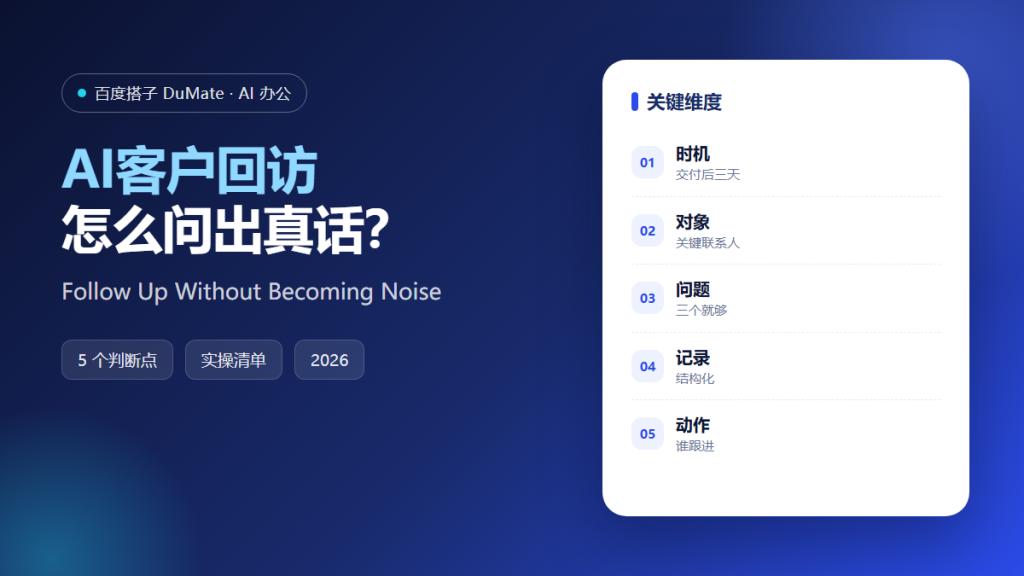
AI客户回访 has a bad reputation because most follow-up asks for a rating and offers nothing in return. Customers learn to ignore the message, and the team learns nothing from the silence. AI客户回访 becomes useful when it starts from a specific event and asks a question the company can act on.
This guide covers timing, channel choice, question design, and the stop rules that keep AI客户回访 from turning into a nuisance.
Key Takeaways
- Trigger follow-up from an event, not from a calendar.
- Ask one question that the team can act on.
- Use the channel the customer already chose.
- Report back what changed because of earlier answers.
- AI客户回访 should stop after two attempts or one request.
Why AI客户回访 Needs a Reason to Exist
Attention is the scarce resource. A message that arrives because a delivery was late or a repair was completed has an obvious reason, and the customer can connect it to something real. A message that arrives because ninety days have passed has no reason at all, and AI客户回访 sent on a schedule quickly becomes background noise that people filter without reading.
Cost matters too. Every follow-up competes with invoices, alerts, and family messages in the same inbox. Measuring send volume rewards the wrong behavior, because the cheapest message is the one that never needed to be sent. Reply rate and subsequent action are the numbers that show whether the program earns its place. A short message with one question costs less attention than a survey, and it is far more likely to be answered.
The third reason is learning. A structured question produces answers that can be counted, grouped, and routed to the team that owns the issue. A rating alone produces a number that nobody can fix, while AI客户回访 with one clear question produces a list of things to change.
How AI客户回访 Works in Five Steps
Step 1: Define the trigger
Choose events with a clear end: a first order delivered, a ticket resolved, a subscription renewed, or a repair signed off. Write down the delay between the event and the message. AI客户回访 works best when the trigger is recorded in the same system that knows the event happened, because manual lists age faster than anyone expects.
Step 2: Pick the moment and the channel
Send when the customer is likely to have an opinion and time to express it. Use the channel they used last: a reply in the same chat thread feels natural, while a new email about a chat feels like marketing. Respect quiet hours and local holidays.
Step 3: Ask one question
Prefer a question with a small number of meaningful answers, such as whether the issue was fully resolved. Add one open field, and keep it optional. AI客户回访 should not ask for a rating and a comment and a referral in the same message, because each additional request lowers the chance of any answer.
Step 4: Close the loop
Tell the customer what happened as a result. A short line saying that a confusing step was removed after similar feedback is more persuasive than any loyalty offer. Internally, assign each theme to an owner with a date, or the feedback becomes a report that nobody reads twice. Publish a monthly note listing what changed, even when the answer is that nothing did yet.
Step 5: Cap the frequency
Set a limit per customer per quarter and enforce it across teams. Stop immediately on request or on a negative reply, and suppress the address from future campaigns rather than only from that one. AI客户回访 that ignores a stop request loses the customer and the data.
‘ alt=’AI客户回访 checklist: event trigger, one question and frequency caps’ />
A Follow-Up Checklist for AI客户回访
- The trigger is a recorded event with a date.
- The message names the event in the first line.
- There is one main question and one optional field.
- An owner and a deadline exist for each theme.
- AI客户回访 follows frequency caps that apply across all teams.
Where AI客户回访 Fails
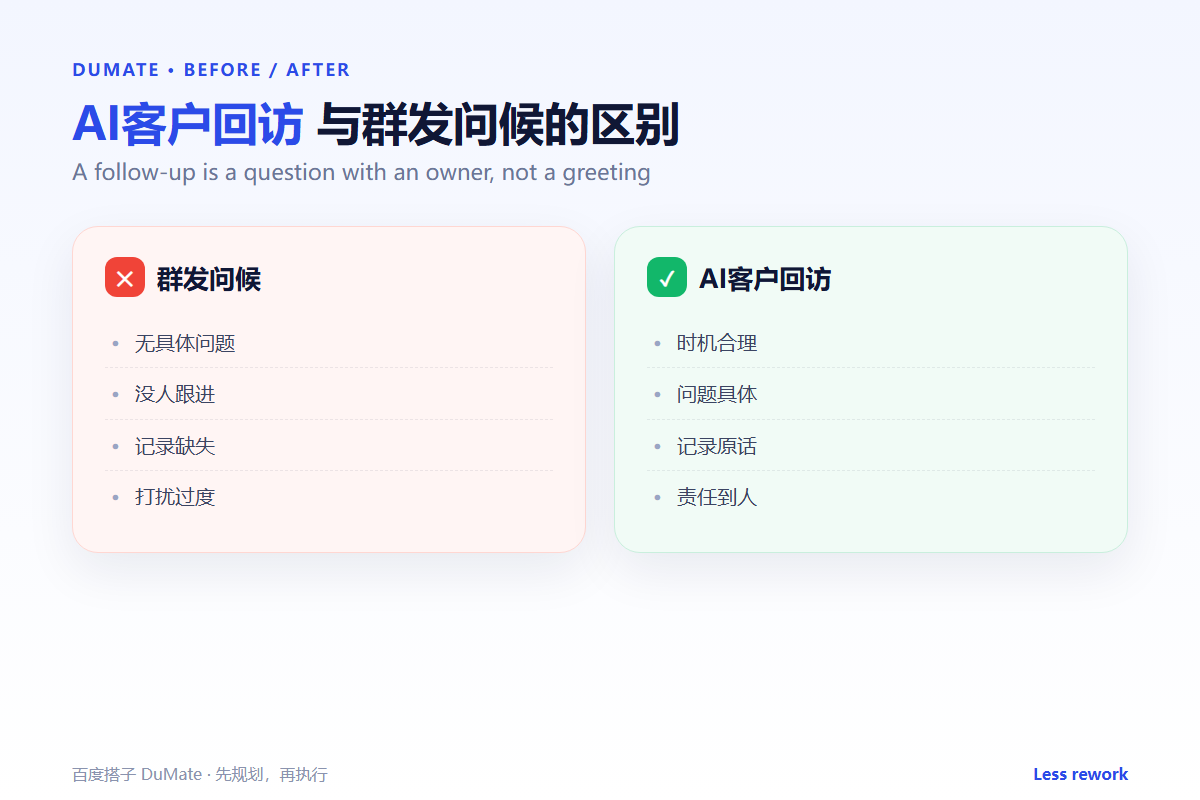
It fails when it is used as a survey with a friendly name, and it fails when the answers have nowhere to go. AI客户回访 also fails when the same message arrives after every interaction, because customers forgive a question but not a year of identical questions with no visible change.
- Identical messages sent after every interaction.
- Incentives that attract answers from people with no experience.
- Follow-up sent during a support dispute.
- No record of who was contacted and when.
Before and After
Before, an online store emailed every buyer thirty days after purchase and received a two percent response. The team read the comments for a week, found nothing actionable, and stopped reading.
After, AI客户回访 ran only after delivery problems and repairs, asked whether the issue was resolved, and routed themes to operations. Response rose above twenty percent, and a packaging change cut damage complaints within a month. The program also sent fewer messages, which customers noticed.
FAQ
How soon should a follow-up go out?
After the customer has had a chance to use the result, usually within a day or two. Too early captures relief, not experience. A weekend delay can also help, because the customer has usually tried the product by then.
Is a rating enough for AI客户回访?
Rarely. A score without a reason cannot be fixed. One short question about resolution is more useful than five stars.
Should we offer a discount for feedback?
Only with care. It attracts replies from people motivated by the incentive, which distorts the sample and makes the results harder to trust.
延伸阅读
Use customer profile and user segmentation to decide who hears from you, and watch churn warning when replies turn negative. Sentiment monitoring explains the tone of an answer, while data labeling turns open comments into themes the operations team can count. External references: NIST AI Risk Management Framework and ISO/IEC 42001.
评论
还没有评论,来说两句吧。