
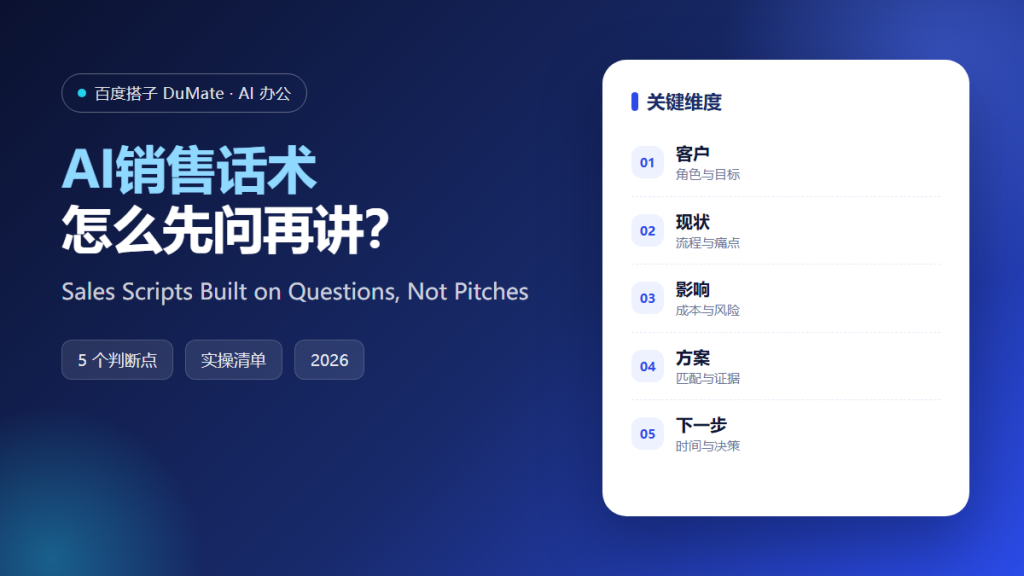
AI销售话术 is usually written as an answer, when the useful part is the question. A buyer who describes a current process, a delay, and a cost has given the seller everything needed for a relevant proposal. A pitch delivered before that sounds like every other pitch the buyer heard this month.
This guide covers a question-led structure for AI销售话术, the qualification points worth confirming, and the language that keeps a conversation honest when the answer is no.
Key Takeaways
- Open with a question about the current process.
- Quantify the problem before describing a solution.
- Confirm who decides and what happens next.
- Reuse the buyer’s own words in the summary.
- AI销售话术 should accept a clear no and record the reason.
Why AI销售话术 Needs Discovery Before Claims
Buyers can tell the difference between a script that listens and one that waits for a turn. Discovery questions change the shape of the conversation because the answer determines which part of the product matters. Without that, AI销售话术 produces polished claims that are true in general and irrelevant in particular.
Qualification is the second reason. Budget, authority, need, and timing are old categories, but they still decide whether a deal is real. Asking about them directly feels like an interrogation, so AI销售话术 works better when it asks about process and consequences and lets the answers reveal the constraints. A useful habit is to ask what happened the last time the buyer tried to solve the problem, because the story usually names the real obstacle.
The third reason is delivery risk. A seller who promises a feature to win a deal creates work for a delivery team that never agreed to it. AI销售话术 that stays close to documented capability protects the margin and the relationship, and it makes the handover to implementation far less dramatic.
How AI销售话术 Works in Five Steps
Step 1: Prepare a hypothesis
Before the call, write one sentence describing the problem you expect this buyer to have, based on their industry, size, and public signals. Treat it as a guess to test, not a fact to present. AI销售话术 improves when the opening question is designed to confirm or kill that guess quickly.
Step 2: Ask about the current process
Ask how the work happens today, who touches it, and where it slows down. Listen for the words the buyer uses, because those words belong in the follow-up summary. Resist the urge to describe your product in the first half of the call. Take notes in the buyer’s phrasing, not in your product’s vocabulary.
Step 3: Quantify the cost
Ask how often the problem occurs and what it costs in hours, rework, or lost revenue. A rough number supplied by the buyer is worth more than a precise number supplied by you. AI销售话术 becomes credible when the business case is built from the buyer’s own figures rather than from a benchmark slide.
Step 4: Test priority and authority
Ask what else is competing for attention this quarter and who else would need to agree. These two questions reveal timing and the real decision map without asking whether the buyer has budget, a question that rarely gets a useful answer. Timing questions also reveal whether the problem is urgent or merely interesting.
Step 5: Agree the next step or close
End with a specific next action, a date, and the people involved. If the answer is no, ask what would have to be true for a future conversation and record it. AI销售话术 that accepts a no cleanly leaves the door open; pressure closes it.
‘ alt=’AI销售话术 checklist: discovery questions, cost and next step’ />
A Discovery Checklist for AI销售话术
- The hypothesis is written before the call.
- The buyer speaks for most of the first half.
- The cost is expressed in the buyer’s numbers.
- The decision map includes names and dates.
- The next step is specific and accepted.
Where AI销售话术 Fails
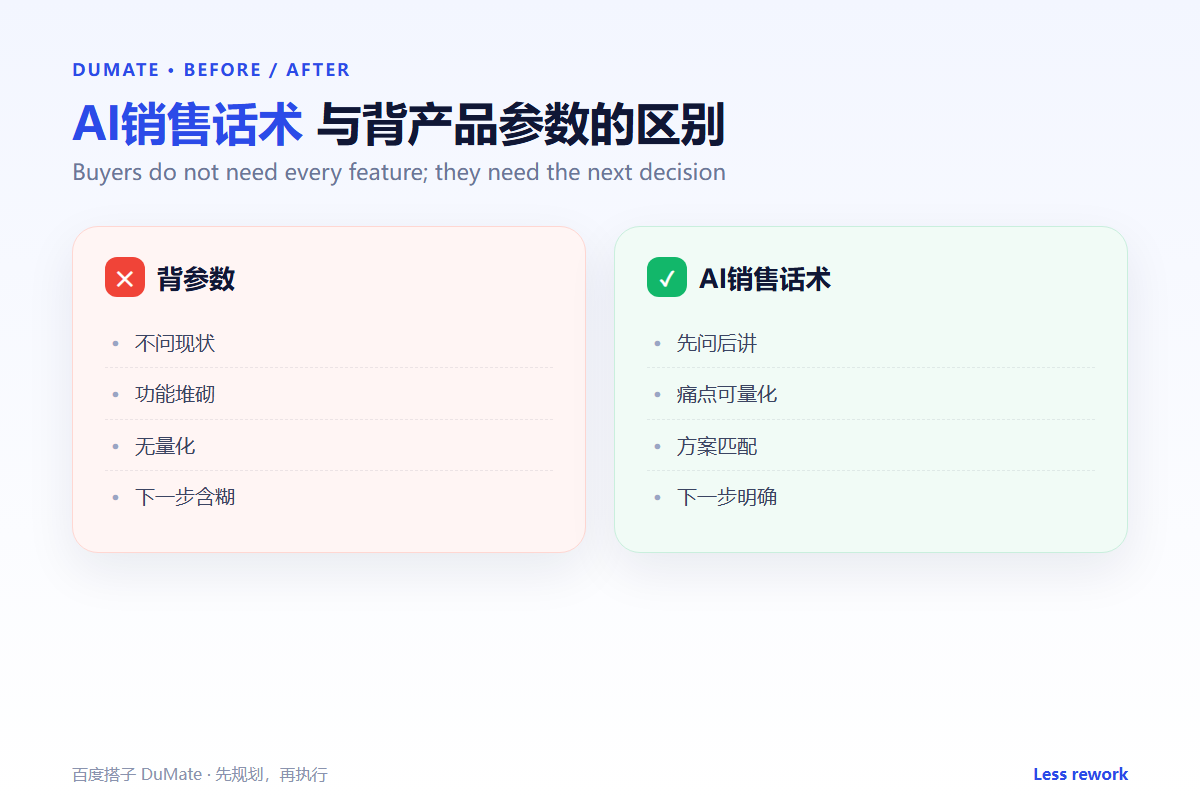
It fails when the script is optimized for talk time, and it fails when objection handling becomes a contest. AI销售话术 also fails when a concern is answered with a statistic instead of a question, because buyers notice the deflection and stop volunteering information.
- Feature lists delivered before any question.
- Discounts used to replace a missing business case.
- Objections answered with pressure rather than evidence.
- Notes that record the seller’s claims, not the buyer’s words.
Before and After
Before, a software team opened every call with a fifteen-minute demo. Prospects were polite, asked few questions, and disappeared after the second meeting. The pipeline looked healthy until the quarter ended.
After, AI销售话术 started with three process questions and a cost estimate. Calls became shorter and more specific, and several prospects disqualified themselves early, which saved weeks of work. The deals that remained closed faster because the proposal addressed a problem the buyer had described. The team also stopped building demos for deals that had no defined next step.
FAQ
How many discovery questions are enough?
Three or four good ones. A long list turns a conversation into a form, and the buyer stops answering honestly.
What if the buyer refuses to share numbers?
Offer a range and ask which end feels closer. A rough estimate still supports a decision, while a refusal to estimate is itself information about priority. That answer is more useful than a number that was invented to end the conversation.
Can AI销售话术 handle objections?
It can prepare evidence and questions. It cannot judge whether a concern is genuine, so a person should decide when to answer and when to ask more.
延伸阅读
Ground the conversation in customer profile research and feed outcomes into sales forecast. When the buyer is ready, support the claims with product copy and check competing offers through procurement comparison. For accounts that stall, see churn warning. External references: NIST AI Risk Management Framework and ISO/IEC 42001.
评论
还没有评论,来说两句吧。