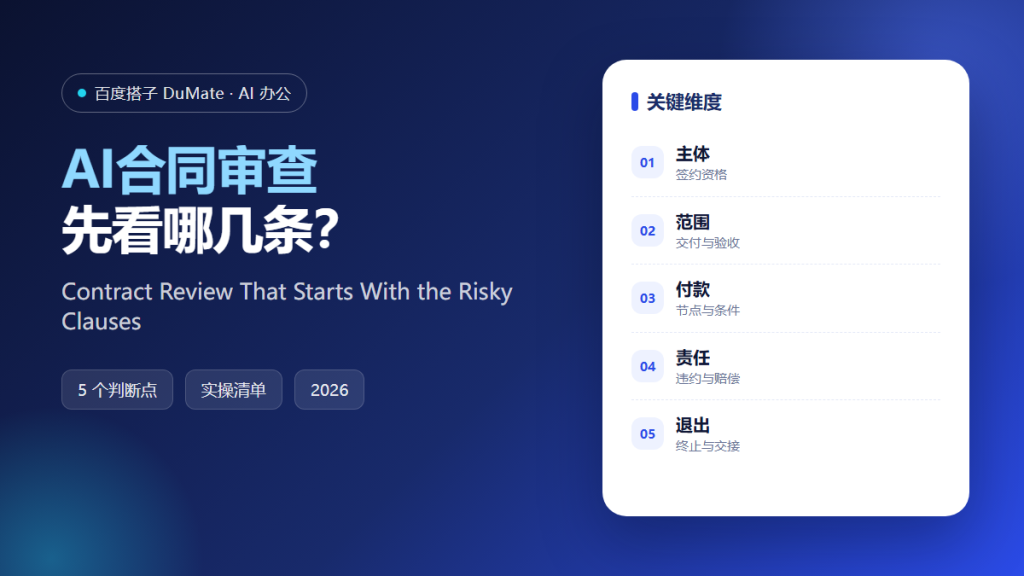
AI合同审查 is not a grammar exercise. Most contracts are readable; the danger sits in a few clauses that decide who pays when something goes wrong. AI合同审查 earns its place when it finds those clauses quickly and leaves a record of what was accepted.
This guide covers a risk-ordered review, the clauses that deserve the closest reading, and the notes that let a colleague understand a decision six months later.
Key Takeaways
- Confirm the parties and the documents in scope.
- Read money, liability, and termination first.
- Compare every deviation with the approved playbook.
- Write comments as questions, not as silent edits.
- AI合同审查 should record accepted risks with a name and a date.
Why AI合同审查 Needs a Risk Order
Attention is limited, and a hundred-page agreement will not receive equal reading. Ranking clauses by consequence puts the reviewer where the money is: payment terms, indemnities, caps, and exit rights. AI合同审查 that treats every paragraph as equally important produces a long comment list and misses the one sentence that shifts liability. A useful order is money, liability, termination, data, then everything else.
Consistency is the second reason. A company that accepts unlimited liability in one deal and a modest cap in another has no negotiating position left. AI合同审查 works best against a written playbook that states the preferred position, the acceptable range, and the point at which a clause must escalate. When the playbook is silent, the reviewer is negotiating from memory, and memory differs by person and by day.
The third reason is accountability. A model can flag a clause, but a person decides whether to accept it. Recording that decision, with a name and a date, turns a review into an audit trail. AI合同审查 that produces comments without an owner creates the illusion of control.
How AI合同审查 Works in Five Steps
Step 1: Confirm parties and documents
Check the legal names, registration numbers, and signatories against public records. List every annex and order form, because obligations often live outside the main body. AI合同审查 should be given the complete set, not one file with a note that the rest is standard.
Step 2: Map obligations and money
Build a short table of who owes what, when, and in which currency. Include penalties, indexation, and invoicing conditions. A payment clause that depends on acceptance needs a defined acceptance test, or the date will be argued later. Check whether invoices can be disputed and what happens to unpaid amounts during a dispute.
Step 3: Test liability and indemnity
Read the cap, the exclusions, and the indemnities together. Check whether the cap applies per claim or per year, and whether it covers the risks the business actually carries. AI合同审查 can compare the wording with the playbook, but the commercial judgment stays with the reviewer. Pay attention to indirect losses and to carve-outs that quietly remove the cap for the risks that matter most.
Step 4: Check term, termination, and exit
Confirm the initial term, the renewal mechanism, and the notice period. Look for exit costs, data return obligations, and transition assistance. AI合同审查 often finds a renewal clause that converts a one-year trial into a three-year commitment. Also check whether termination for convenience exists, and what notice it requires.
Step 5: Log deviations against the playbook
For each departure, note the clause, the risk, the decision, and the approver. Send questions to the counterparty in one batch, numbered to match the contract. AI合同审查 can assemble the list, but a lawyer should sign the final position. Keep the log next to the signed contract, so the next reviewer sees the trade-offs rather than only the final text.
‘ alt=’AI合同审查 checklist: parties, liability, termination and deviation log’ />
A Review Checklist for AI合同审查
- Parties and signatories are verified.
- The payment table has dates and triggers.
- Liability caps and exclusions are understood.
- Renewal and exit terms are acceptable.
- AI合同审查 notes identify an approver for each deviation.
Where AI合同审查 Fails
It fails when the model is asked whether a contract is fine, because the answer will be a summary rather than a judgment. AI合同审查 also fails when definitions are skipped, since a single defined term can reverse the meaning of three clauses.
- Annexes reviewed separately from the main agreement.
- Governing law and dispute forum ignored.
- Comments that rewrite clauses without explanation.
- Confidential text pasted into a tool without approval.
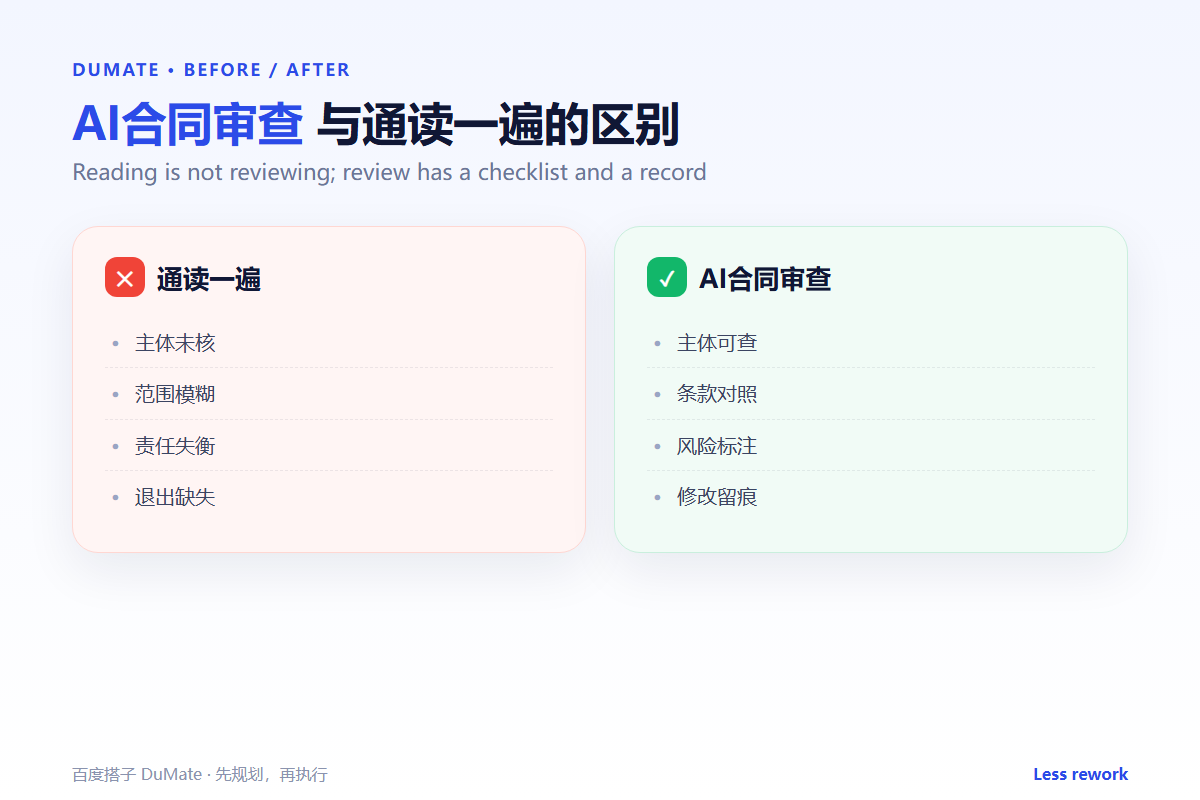
Before and After
Before, a sales team signed supplier agreements after a quick read, focusing on price. Two years later, a renewal notice period of ninety days locked the company into a service it had stopped using. The price had looked competitive, and the exit cost was never calculated.
After, AI合同审查 produced a one-page risk summary, flagged the renewal clause, and logged the accepted liability cap with a name. Reviews took slightly longer, and the surprises stopped. The team now keeps a one-page summary beside every signed agreement.
FAQ
Can AI合同审查 replace a lawyer?
No. It speeds up reading and comparison. Legal judgment, negotiation strategy, and sign-off remain with qualified people. It is also not a substitute for reading the clauses yourself.
Which clauses deserve the most attention?
Payment, liability, indemnity, termination, and data handling. AI合同审查 should rank them first, because they carry the largest financial consequences. Definitions deserve a place beside them, because they decide how those clauses are read.
How should comments be written?
As short questions with a clause reference and a suggested position. Silent edits create confusion about what was actually agreed. Number the comments so the counterparty can answer each one without guessing.
延伸阅读
Track revisions with document proofreading and route questions through legal consultation. Tender terms often need bid review, while recurring obligations belong in a policy briefing. Pricing assumptions should trace back to procurement comparison. External references: NIST AI Risk Management Framework and ISO/IEC 42001.
评论
还没有评论,来说两句吧。