

AI幻灯片生成 makes it easy to produce thirty slides in a minute, which is exactly the problem. A deck that exists to be read aloud needs fewer words than a document and more structure than a data dump. AI幻灯片生成 helps when the speaker has already decided the argument.
This guide describes a five-step routine for AI幻灯片生成, the rules that keep a deck readable from the back of a room, and the failure that turns a presentation into a document projected on a wall.
Key Takeaways
- Write the argument in sentences first.
- Put one idea on each slide.
- State the claim in the title.
- Use one visual per claim.
- Cut every slide you do not need.
Why AI幻灯片生成 Needs an Argument
A deck is a sequence, and a sequence needs a direction. Without a claim, slides become a tour of everything the team knows. AI幻灯片生成 will happily fill the tour, because it has no reason to stop and no way to know what matters.
The second reason is attention. An audience reads a dense slide instead of listening to the person in front of it. AI幻灯片生成 should keep text short enough that the speaker still has a job, which is the entire point of a presentation.
The third reason is reuse. A deck with a clear argument can be shortened for a meeting and expanded for a proposal. AI幻灯片生成 can produce both from the same outline, which keeps the message consistent across rooms and channels.
How AI幻灯片生成 Works in Five Steps
Step 1: Write the argument
Five sentences, each a claim, each supported by one fact. If a sentence cannot be supported, it is an opinion and belongs in an appendix rather than on a slide. Read the five aloud before opening any tool, because a claim that sounds weak in speech will not improve in a layout. A claim that needs two facts is two slides, not one crowded sentence. Give each claim a subject and a verb, and delete the qualifiers that make it unfalsifiable. Write for the ear, then edit for the eye.
Step 2: Split into one idea per slide
Each claim becomes one slide. AI幻灯片生成 should refuse to merge two claims onto one page, even when the page looks empty, because empty space is cheaper than a confused audience. If two slides feel thin, the argument is thin, not the deck. The title carries the claim, and the body carries the evidence. A slide that needs a second read is a slide that will be discussed instead of the decision.
Step 3: Fix the template
Two fonts, one accent colour, a grid. Constraint is what makes a generated deck look designed rather than assembled from a stock library. Lock the template before the first slide is drafted, and do not negotiate with it late at night. Decide the grid before the content, so the content cannot bend it. Use the same title position on every slide, so the audience learns where to look. A template is a contract with the audience.
Step 4: Build one visual per claim
A chart, a photo, or a single large number. If the visual needs a caption of three lines, it is a table pretending to be a picture. Choose the visual after the claim, so the claim decides what the audience looks at. Name the axis and the unit, even when the audience knows them. A photograph of the actual site beats a stock image of a similar one. One visual per claim also prevents the chart that answers three questions badly.
Step 5: Rehearse and cut
Present to a colleague and time it. Remove the slides you skipped. AI幻灯片生成 can rebuild the deck around the shorter outline in minutes, which is the one advantage worth paying for. A deck that survives a cut is usually the one that gets approved, so keep the cut version as the master. Cut the slide that repeats the previous one with a different chart. Time the silence as well as the words, because a pause is part of the delivery.
‘ alt=’AI幻灯片生成 checklist: argument, one idea per slide and rehearsal’ />
A Slide Checklist
- The argument fits in five sentences.
- Each title states a claim.
- No slide carries two ideas.
- Every visual supports one number or one contrast.
- The deck was timed aloud.
Where AI幻灯片生成 Fails
Generated decks fail when the outline is vague, because the tool fills space with plausible sentences that mean nothing. They also fail when the template changes halfway, which reads as carelessness even when the content is sound. AI幻灯片生成 cannot repair either problem after the fact.
- Paragraphs pasted into bullet points.
- Decorative charts with no labelled axis.
- Consistent-looking slides with no argument.
- No rehearsal, so the timing collapses.
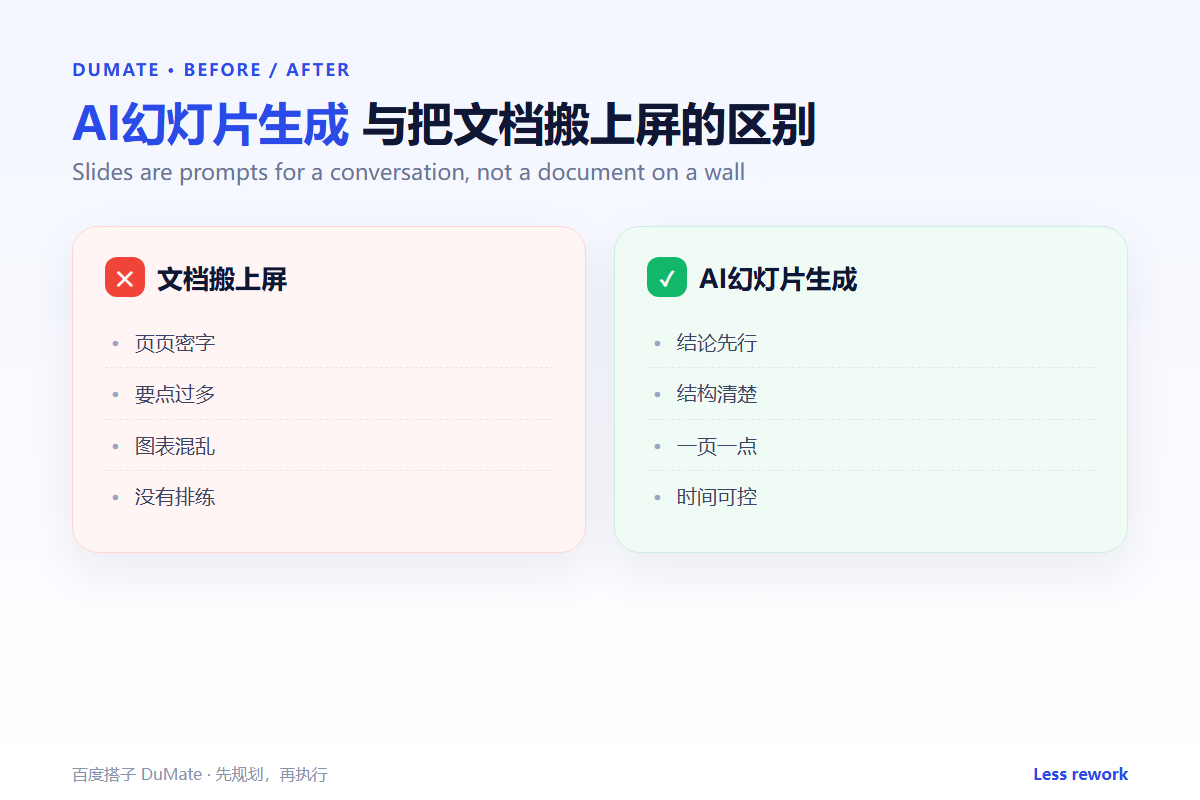
Before and After
Before, a product manager spent two days building a launch deck, and the review meeting spent twenty minutes asking what the recommendation was. The deck had forty slides and no answer.
After, AI幻灯片生成 built twelve slides from five claims, each with one number and one visual. The same deck was cut to six for the leadership review, and the recommendation appeared in the title of slide two.
FAQ
Should slides be readable without a speaker?
Only when they will be forwarded. A live deck can be sparse; a document that travels needs notes.
How many slides per minute?
Roughly one, including the title. Faster means the audience is reading instead of listening.
Can the deck match our brand?
Yes, if the template is locked first. AI幻灯片生成 follows fonts, spacing, and colour rules when they are defined before the first slide is drafted.
延伸阅读
For teaching decks, see courseware making, and for sequencing, lesson plan. Selling language is covered in product copy, visual layout in poster design, and formal wording in official writing. External references: NIST AI Risk Management Framework and ISO/IEC 42001.
评论
还没有评论,来说两句吧。